

biogas up to 40–50% has increased once food waste is
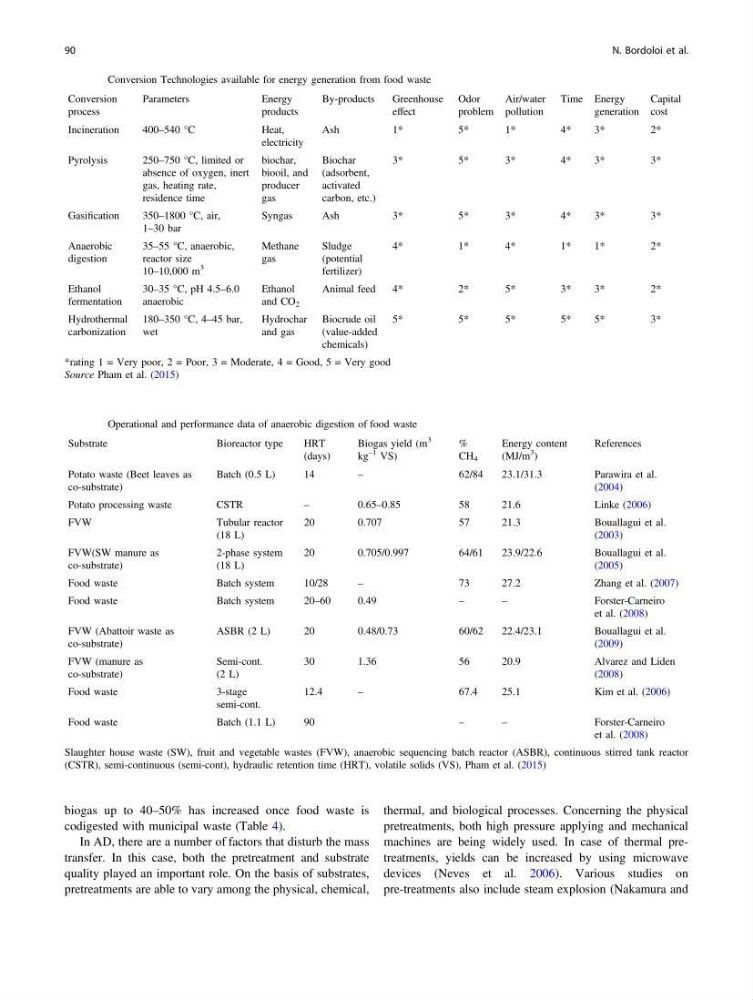
codigested with municipal waste (Table 4).
In AD, there are a number of factors that disturb the mass
transfer. In this case, both the pretreatment and substrate
quality played an important role. On the basis of substrates,
pretreatments are able to vary among the physical, chemical,
thermal, and biological processes. Concerning the physical
pretreatments, both high pressure applying and mechanical
machines are being widely used. In case of thermal pretreatments, yields can be increased by using microwave
devices (Neves et al. 2006). Various studies on
pre-treatments also include steam explosion (Nakamura and
Table 3 Conversion Technologies available for energy generation from food waste
Conversion
process
Parameters
Energy
products
By-products
Greenhouse
effect
Odor
problem
Air/water
pollution
Time Energy
generation
Capital
cost
Incineration
400–540 °C
Heat,
electricity
Ash
1*
5*
1*
4*
3*
2*
Pyrolysis
250–750 °C, limited or
absence of oxygen, inert
gas, heating rate,
residence time
biochar,
biooil, and
producer
gas
Biochar
(adsorbent,
activated
carbon, etc.)
3*
5*
3*
4*
3*
3*
Gasification
350–1800 °C, air,
1–30 bar
Syngas
Ash
3*
5*
3*
4*
3*
3*
Anaerobic
digestion
35–55 °C, anaerobic,
reactor size
10–10,000 m
3
Methane
gas
Sludge
(potential
fertilizer)
4*
1*
4*
1*
1*
2*
Ethanol
fermentation
30–35 °C, pH 4.5–6.0
anaerobic
Ethanol
and CO 2
Animal feed
4*
2*
5*
3*
3*
2*
Hydrothermal
carbonization
180–350 °C, 4–45 bar,
wet
Hydrochar
and gas
Biocrude oil
(value-added
chemicals)
5*
5*
5*
5*
5*
3*
*rating 1 = Very poor, 2 = Poor, 3 = Moderate, 4 = Good, 5 = Very good
Source Pham et al. (2015)
Table 4 Operational and performance data of anaerobic digestion of food waste
Substrate
Bioreactor type
HRT
(days)
Biogas yield (m
3
kg
–1 VS)
%
CH 4
Energy content
(MJ/m
3
)
References
Potato waste (Beet leaves as
co-substrate)
Batch (0.5 L)
14
–
62/84
23.1/31.3
Parawira et al.
(2004)
Potato processing waste
CSTR
–
0.65–0.85
58
21.6
Linke (2006)
FVW
Tubular reactor
(18 L)
20
0.707
57
21.3
Bouallagui et al.
(2003)
FVW(SW manure as
co-substrate)
2-phase system
(18 L)
20
0.705/0.997
64/61
23.9/22.6
Bouallagui et al.
(2005)
Food waste
Batch system
10/28
–
73
27.2
Zhang et al. (2007)
Food waste
Batch system
20–60
0.49
–
–
Forster-Carneiro
et al. (2008)
FVW (Abattoir waste as
co-substrate)
ASBR (2 L)
20
0.48/0.73
60/62
22.4/23.1
Bouallagui et al.
(2009)
FVW (manure as
co-substrate)
Semi-cont.
(2 L)
30
1.36
56
20.9
Alvarez and Liden
(2008)
Food waste
3-stage
semi-cont.
12.4
–
67.4
25.1
Kim et al. (2006)
Food waste
Batch (1.1 L)
90
–
–
Forster-Carneiro
et al. (2008)
Slaughter house waste (SW), fruit and vegetable wastes (FVW), anaerobic sequencing batch reactor (ASBR), continuous stirred tank reactor
(CSTR), semi-continuous (semi-cont), hydraulic retention time (HRT), volatile solids (VS), Pham et al. (2015)
90
N. Bordoloi et al.
codigested with municipal waste (Table 4).
In AD, there are a number of factors that disturb the mass
transfer. In this case, both the pretreatment and substrate
quality played an important role. On the basis of substrates,
pretreatments are able to vary among the physical, chemical,
thermal, and biological processes. Concerning the physical
pretreatments, both high pressure applying and mechanical
machines are being widely used. In case of thermal pretreatments, yields can be increased by using microwave
devices (Neves et al. 2006). Various studies on
pre-treatments also include steam explosion (Nakamura and
Table 3 Conversion Technologies available for energy generation from food waste
Conversion
process
Parameters
Energy
products
By-products
Greenhouse
effect
Odor
problem
Air/water
pollution
Time Energy
generation
Capital
cost
Incineration
400–540 °C
Heat,
electricity
Ash
1*
5*
1*
4*
3*
2*
Pyrolysis
250–750 °C, limited or
absence of oxygen, inert
gas, heating rate,
residence time
biochar,
biooil, and
producer
gas
Biochar
(adsorbent,
activated
carbon, etc.)
3*
5*
3*
4*
3*
3*
Gasification
350–1800 °C, air,
1–30 bar
Syngas
Ash
3*
5*
3*
4*
3*
3*
Anaerobic
digestion
35–55 °C, anaerobic,
reactor size
10–10,000 m
3
Methane
gas
Sludge
(potential
fertilizer)
4*
1*
4*
1*
1*
2*
Ethanol
fermentation
30–35 °C, pH 4.5–6.0
anaerobic
Ethanol
and CO 2
Animal feed
4*
2*
5*
3*
3*
2*
Hydrothermal
carbonization
180–350 °C, 4–45 bar,
wet
Hydrochar
and gas
Biocrude oil
(value-added
chemicals)
5*
5*
5*
5*
5*
3*
*rating 1 = Very poor, 2 = Poor, 3 = Moderate, 4 = Good, 5 = Very good
Source Pham et al. (2015)
Table 4 Operational and performance data of anaerobic digestion of food waste
Substrate
Bioreactor type
HRT
(days)
Biogas yield (m
3
kg
–1 VS)
%
CH 4
Energy content
(MJ/m
3
)
References
Potato waste (Beet leaves as
co-substrate)
Batch (0.5 L)
14
–
62/84
23.1/31.3
Parawira et al.
(2004)
Potato processing waste
CSTR
–
0.65–0.85
58
21.6
Linke (2006)
FVW
Tubular reactor
(18 L)
20
0.707
57
21.3
Bouallagui et al.
(2003)
FVW(SW manure as
co-substrate)
2-phase system
(18 L)
20
0.705/0.997
64/61
23.9/22.6
Bouallagui et al.
(2005)
Food waste
Batch system
10/28
–
73
27.2
Zhang et al. (2007)
Food waste
Batch system
20–60
0.49
–
–
Forster-Carneiro
et al. (2008)
FVW (Abattoir waste as
co-substrate)
ASBR (2 L)
20
0.48/0.73
60/62
22.4/23.1
Bouallagui et al.
(2009)
FVW (manure as
co-substrate)
Semi-cont.
(2 L)
30
1.36
56
20.9
Alvarez and Liden
(2008)
Food waste
3-stage
semi-cont.
12.4
–
67.4
25.1
Kim et al. (2006)
Food waste
Batch (1.1 L)
90
–
–
Forster-Carneiro
et al. (2008)
Slaughter house waste (SW), fruit and vegetable wastes (FVW), anaerobic sequencing batch reactor (ASBR), continuous stirred tank reactor
(CSTR), semi-continuous (semi-cont), hydraulic retention time (HRT), volatile solids (VS), Pham et al. (2015)
90
N. Bordoloi et al.