

(c) Xylanase
Xylanase is an enzyme that helps to degrade hemicellulase.
Rabinovich et al. (2002) and Shallom and Shoham (2003)
reported the structure, types, classification, function of
microbial hemicellulases. Hemicellulases used to hydrolyze
plant cell polysaccharides due to its multi-domain nature.
Xylan is one of the plentiful hemicellulose and xylanases are
important hemicellulases. Xylanases hydrolyses in xylan
backbone the b-1,4 bond that gives the short xylooligomers.
Further, xylooligomers are hydrolyzed by b-xylosidase into
single xylose units (Howard et al. 2003).
5 Technologies for Conversion of Food
Waste
A variety of technologies have been investigated for the
extraction of energy from food waste such as biological (e.g.
fermentation and anaerobic digestion) and thermochemical
(e.g. pyrolysis, gasification, incineration, and hydrothermal)
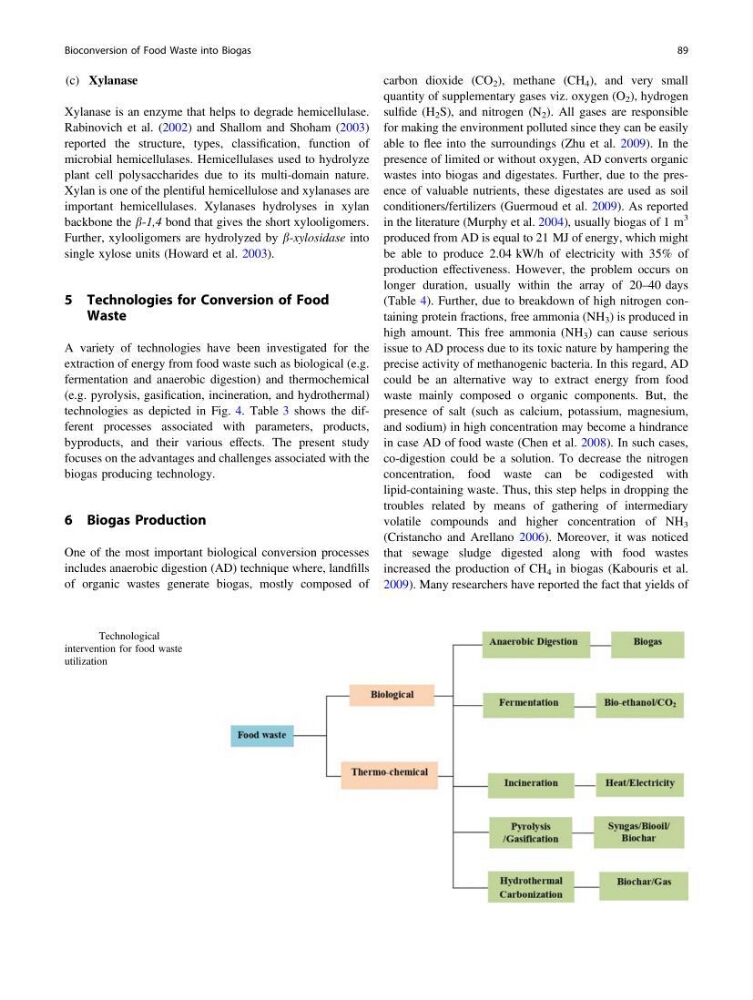
technologies as depicted in Fig. 4. Table 3 shows the different processes associated with parameters, products,
byproducts, and their various effects. The present study
focuses on the advantages and challenges associated with the
biogas producing technology.
6 Biogas Production
One of the most important biological conversion processes
includes anaerobic digestion (AD) technique where, landfills
of organic wastes generate biogas, mostly composed of
carbon dioxide (CO 2 ), methane (CH 4 ), and very small
quantity of supplementary gases viz. oxygen (O 2 ), hydrogen
sulfide (H 2 S), and nitrogen (N 2 ). All gases are responsible
for making the environment polluted since they can be easily
able to flee into the surroundings (Zhu et al. 2009). In the
presence of limited or without oxygen, AD converts organic
wastes into biogas and digestates. Further, due to the presence of valuable nutrients, these digestates are used as soil
conditioners/fertilizers (Guermoud et al. 2009). As reported
in the literature (Murphy et al. 2004), usually biogas of 1 m
3
produced from AD is equal to 21 MJ of energy, which might
be able to produce 2.04 kW/h of electricity with 35% of
production effectiveness. However, the problem occurs on
longer duration, usually within the array of 20–40 days
(Table 4). Further, due to breakdown of high nitrogen containing protein fractions, free ammonia (NH 3 ) is produced in
high amount. This free ammonia (NH 3 ) can cause serious
issue to AD process due to its toxic nature by hampering the
precise activity of methanogenic bacteria. In this regard, AD
could be an alternative way to extract energy from food
waste mainly composed o organic components. But, the
presence of salt (such as calcium, potassium, magnesium,
and sodium) in high concentration may become a hindrance
in case AD of food waste (Chen et al. 2008). In such cases,
co-digestion could be a solution. To decrease the nitrogen
concentration, food waste can be codigested with
lipid-containing waste. Thus, this step helps in dropping the
troubles related by means of gathering of intermediary
volatile compounds and higher concentration of NH 3
(Cristancho and Arellano 2006). Moreover, it was noticed
that sewage sludge digested along with food wastes
increased the production of CH 4 in biogas (Kabouris et al.
2009). Many researchers have reported the fact that yields of
Fig. 4 Technological
intervention for food waste
utilization
Bioconversion of Food Waste into Biogas
89
Xylanase is an enzyme that helps to degrade hemicellulase.
Rabinovich et al. (2002) and Shallom and Shoham (2003)
reported the structure, types, classification, function of
microbial hemicellulases. Hemicellulases used to hydrolyze
plant cell polysaccharides due to its multi-domain nature.
Xylan is one of the plentiful hemicellulose and xylanases are
important hemicellulases. Xylanases hydrolyses in xylan
backbone the b-1,4 bond that gives the short xylooligomers.
Further, xylooligomers are hydrolyzed by b-xylosidase into
single xylose units (Howard et al. 2003).
5 Technologies for Conversion of Food
Waste
A variety of technologies have been investigated for the
extraction of energy from food waste such as biological (e.g.
fermentation and anaerobic digestion) and thermochemical
(e.g. pyrolysis, gasification, incineration, and hydrothermal)
technologies as depicted in Fig. 4. Table 3 shows the different processes associated with parameters, products,
byproducts, and their various effects. The present study
focuses on the advantages and challenges associated with the
biogas producing technology.
6 Biogas Production
One of the most important biological conversion processes
includes anaerobic digestion (AD) technique where, landfills
of organic wastes generate biogas, mostly composed of
carbon dioxide (CO 2 ), methane (CH 4 ), and very small
quantity of supplementary gases viz. oxygen (O 2 ), hydrogen
sulfide (H 2 S), and nitrogen (N 2 ). All gases are responsible
for making the environment polluted since they can be easily
able to flee into the surroundings (Zhu et al. 2009). In the
presence of limited or without oxygen, AD converts organic
wastes into biogas and digestates. Further, due to the presence of valuable nutrients, these digestates are used as soil
conditioners/fertilizers (Guermoud et al. 2009). As reported
in the literature (Murphy et al. 2004), usually biogas of 1 m
3
produced from AD is equal to 21 MJ of energy, which might
be able to produce 2.04 kW/h of electricity with 35% of
production effectiveness. However, the problem occurs on
longer duration, usually within the array of 20–40 days
(Table 4). Further, due to breakdown of high nitrogen containing protein fractions, free ammonia (NH 3 ) is produced in
high amount. This free ammonia (NH 3 ) can cause serious
issue to AD process due to its toxic nature by hampering the
precise activity of methanogenic bacteria. In this regard, AD
could be an alternative way to extract energy from food
waste mainly composed o organic components. But, the
presence of salt (such as calcium, potassium, magnesium,
and sodium) in high concentration may become a hindrance
in case AD of food waste (Chen et al. 2008). In such cases,
co-digestion could be a solution. To decrease the nitrogen
concentration, food waste can be codigested with
lipid-containing waste. Thus, this step helps in dropping the
troubles related by means of gathering of intermediary
volatile compounds and higher concentration of NH 3
(Cristancho and Arellano 2006). Moreover, it was noticed
that sewage sludge digested along with food wastes
increased the production of CH 4 in biogas (Kabouris et al.
2009). Many researchers have reported the fact that yields of
Fig. 4 Technological
intervention for food waste
utilization
Bioconversion of Food Waste into Biogas
89