

even pesticides, and agro-chemicals to promote plant
growth. Depending on the objectives of the bioprocesses,
these feedstocks provide important organic and inorganic
compounds that can be into valuable products (Swain 2017).
Furthermore, the advantage is that the bio-refinery based on
waste conversion provides integrated management of wastes
(Biernat and Grzelak 2015). The agricultural activities
principally generate tons of waste, in the form of straw
wastes or agro-effluents. The straw crops are wheat, rice, oat,
barleys, rye, and grained crops, and the straw wastes include
the dry stalk of cereal plants that remain after the extraction
and removal of grains and chaffs, e.g., sawdust, sugarcane
bagasse, corn stoves, rice hulls, rice straws, and wheat straws
(Santulli 2017). The straw remains constitute almost half of
the total harvested yield, making them abundantly available
agricultural residues (Smil 1999). Besides, these straw
wastes have found applications as fuel, livestock duvet/
beddings and fodder, thatching roofs, and for making baskets. Straw biomass is considered as the major lignocellulosic material to be exploited for biofuels and bioproducts
(Santulli 2017; Ghaffar et al. 2015).
The straw biomass mainly comprises lignocellulosic
residues such as cellulose, hemicellulose, and lignin as core
constituents of plants cell wall, which are readily accessible
for biofuels and bioproducts generation (Kucharska and
Rybarczyk 2018; Putro et al. 2016). The average composition and amount of these constituents in the straw biomass
are summarized in Table 1. Cellulose is a polysaccharide of
linear chains of b associated D-glucose units, ranging from
several hundreds to many thousands. The simple structural
arrangement of cellulose makes it biodegradable (Lavanya
et al. 2011). Hemicellulose or polyose is a macromolecule
having molecular weight less than cellulose (Saha 2003).
The key difference is that cellulose is more crystalline in
nature, and highly resistant to hydrolysis, while hemicellulose has a more amorphous structure, having low stability
and easily hydrolysable. Hemicellulose in straw biomass
generally contains xylan, while the softwood hemicellulose
contains glucomannan (Pérez et al. 2002). Lignin is a
cross-linked phenolic polymer, having a rigid structure that
forms the main structural base in order to provide support to
tissues in some algae and vascular plants (Buranov and
Mazza 2008). Lignin is biodegradable and among the most
durable biopolymers available. Globally, around 73.9 Teragram (dry weight %) of the crop wastes/agriculture residues
could provide around 49.1 giga-liter (GL) of bioethanol per
year (Kim and Dale 2004). Hence, the bioconversion of
these lignocellulosic residues could lead to a more sustainable production of bioenergy and bioproducts, and could
address the problems caused by climate change.
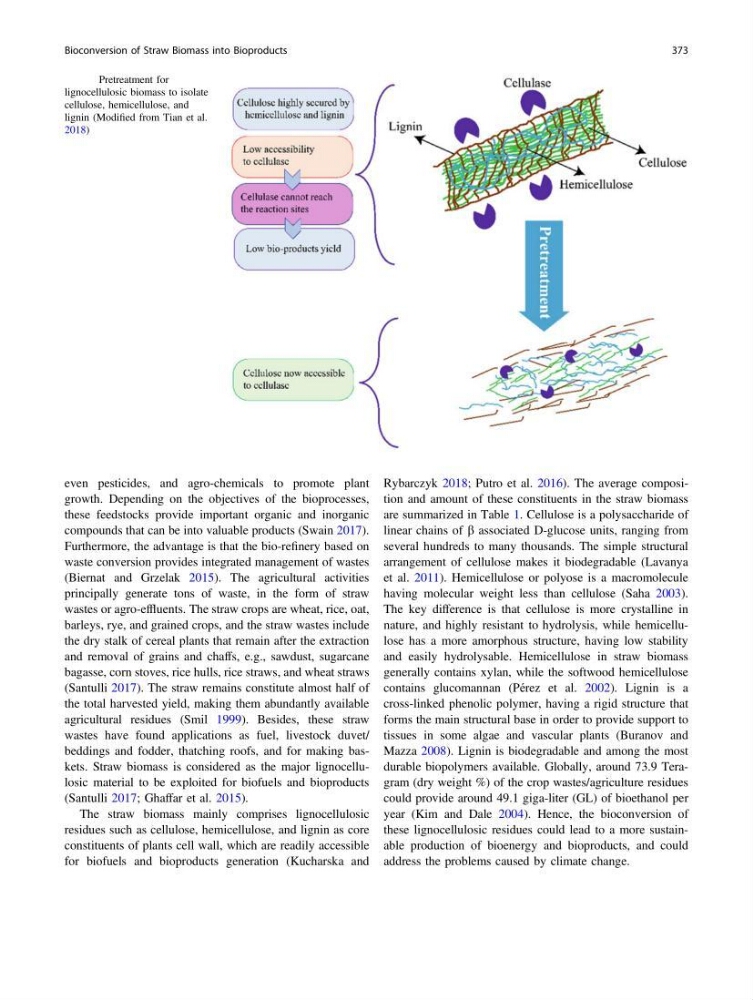
Fig. 5 Pretreatment for
lignocellulosic biomass to isolate
cellulose, hemicellulose, and
lignin (Modified from Tian et al.
2018)
Bioconversion of Straw Biomass into Bioproducts
373
growth. Depending on the objectives of the bioprocesses,
these feedstocks provide important organic and inorganic
compounds that can be into valuable products (Swain 2017).
Furthermore, the advantage is that the bio-refinery based on
waste conversion provides integrated management of wastes
(Biernat and Grzelak 2015). The agricultural activities
principally generate tons of waste, in the form of straw
wastes or agro-effluents. The straw crops are wheat, rice, oat,
barleys, rye, and grained crops, and the straw wastes include
the dry stalk of cereal plants that remain after the extraction
and removal of grains and chaffs, e.g., sawdust, sugarcane
bagasse, corn stoves, rice hulls, rice straws, and wheat straws
(Santulli 2017). The straw remains constitute almost half of
the total harvested yield, making them abundantly available
agricultural residues (Smil 1999). Besides, these straw
wastes have found applications as fuel, livestock duvet/
beddings and fodder, thatching roofs, and for making baskets. Straw biomass is considered as the major lignocellulosic material to be exploited for biofuels and bioproducts
(Santulli 2017; Ghaffar et al. 2015).
The straw biomass mainly comprises lignocellulosic
residues such as cellulose, hemicellulose, and lignin as core
constituents of plants cell wall, which are readily accessible
for biofuels and bioproducts generation (Kucharska and
Rybarczyk 2018; Putro et al. 2016). The average composition and amount of these constituents in the straw biomass
are summarized in Table 1. Cellulose is a polysaccharide of
linear chains of b associated D-glucose units, ranging from
several hundreds to many thousands. The simple structural
arrangement of cellulose makes it biodegradable (Lavanya
et al. 2011). Hemicellulose or polyose is a macromolecule
having molecular weight less than cellulose (Saha 2003).
The key difference is that cellulose is more crystalline in
nature, and highly resistant to hydrolysis, while hemicellulose has a more amorphous structure, having low stability
and easily hydrolysable. Hemicellulose in straw biomass
generally contains xylan, while the softwood hemicellulose
contains glucomannan (Pérez et al. 2002). Lignin is a
cross-linked phenolic polymer, having a rigid structure that
forms the main structural base in order to provide support to
tissues in some algae and vascular plants (Buranov and
Mazza 2008). Lignin is biodegradable and among the most
durable biopolymers available. Globally, around 73.9 Teragram (dry weight %) of the crop wastes/agriculture residues
could provide around 49.1 giga-liter (GL) of bioethanol per
year (Kim and Dale 2004). Hence, the bioconversion of
these lignocellulosic residues could lead to a more sustainable production of bioenergy and bioproducts, and could
address the problems caused by climate change.
Fig. 5 Pretreatment for
lignocellulosic biomass to isolate
cellulose, hemicellulose, and
lignin (Modified from Tian et al.
2018)
Bioconversion of Straw Biomass into Bioproducts
373