

compositions are very much dependent on the feedstocks
(Pino et al. 2018; Zhen et al. 2019; da Rosa et al. 2019). The
solid wastes from different sources such as the domestic
wastes; wastes from offices, schools, or municipalities; and
wastes from industrial sectors and factories, must, therefore,
be sorted out and screened (Lebersorger and Beigl 2011;
Millati and Cahyono 2019). The four major types are
domestic, agricultural, commercial, and industrial wastes
(Pancha et al. 2019; Millati and Cahyono 2019; Hargreaves
et al. 2008; Han et al. 2018). Among them, agricultural
wastes from the agriculture fields may include weed and
husk waste, cattle wastes (Millati and Cahyono 2019), or
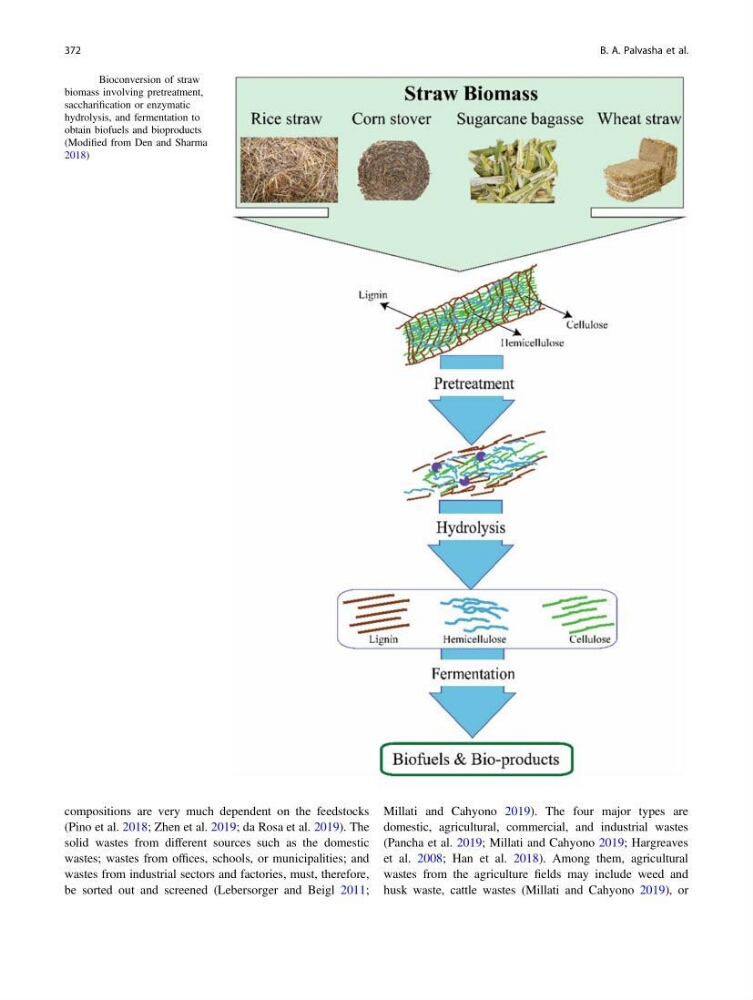
Fig. 4 Bioconversion of straw
biomass involving pretreatment,
saccharification or enzymatic
hydrolysis, and fermentation to
obtain biofuels and bioproducts
(Modified from Den and Sharma
2018)
372
B. A. Palvasha et al.
(Pino et al. 2018; Zhen et al. 2019; da Rosa et al. 2019). The
solid wastes from different sources such as the domestic
wastes; wastes from offices, schools, or municipalities; and
wastes from industrial sectors and factories, must, therefore,
be sorted out and screened (Lebersorger and Beigl 2011;
Millati and Cahyono 2019). The four major types are
domestic, agricultural, commercial, and industrial wastes
(Pancha et al. 2019; Millati and Cahyono 2019; Hargreaves
et al. 2008; Han et al. 2018). Among them, agricultural
wastes from the agriculture fields may include weed and
husk waste, cattle wastes (Millati and Cahyono 2019), or
Fig. 4 Bioconversion of straw
biomass involving pretreatment,
saccharification or enzymatic
hydrolysis, and fermentation to
obtain biofuels and bioproducts
(Modified from Den and Sharma
2018)
372
B. A. Palvasha et al.