

polymers/materials. When composite consists of at least one
material derived from a biological origin, it is termed as
bio-composite materials (Iqbal 2015). According to another
broader definition, bio-composites are substances that are
composed of bio-based or bio-derived polymers such as
polylactic acid PLAs or polyhydroxyalkanoate PHAs (Iqbal
2015).
Sustainable bioplastics and bio-composites made up of
biodegradable and bio-based materials are designated as
“green composites” and are major research areas among
environmental biotechnology (Saberi et al. 2017). Recently,
bio-composites have been developed for various functional
applications, e.g., biomedical, pharmaceutical, textile
industry, bio-based packaging, and others using agroindustrial waste/byproducts (Lancaster et al. 2013) to overcome the rising environmental pollution caused by the high
dependency on petroleum-based resources (Iqbal et al.
2013). Materials that are obtained from agro-industrial
wastes, having an acceptable level of biodegradability,
recyclability, environmental and commercial feasibility are
termed as sustainable bio-based materials.
Possible routes for the effective exploitation of
agro-industrial wastes and by-products into bio-composites
development have been represented in Fig. 5. The utilization
of agro-industrial wastes in bio-composites development
offers several advantages, i.e., a decrease in the relative
amount of non-renewable materials in bio-composites ultimately leading to the development of environmentally
friendly materials. Therefore, we can enhance the component of renewable biomass, which may also reduce the
overall bio-composite cost (Väisänen et al. 2016).
The environmental issues as a result of fossil-based
materials have increased the researcher’s concern in
bio-based and biodegradable materials development. About
90% of total thermoplastics is made up of six types of
polymers, e.g., polystyrene, polyethylene, polypropylene,
polyvinyl chloride, and polyethylene terephthalate (Lee et al.
2004). The exploitation of agro-industrial biomass for the
development of composites materials seems rather limited.
The desire for sustainable utilization of such wastes is an
emerging area due to an increase in agro-waste in developed
countries, possibly due to the availability of advanced
facilities than developing and under-developed countries,
which are rich in agro-industrial wastes. The present
scientific studies are focusing on scaling up rather than
optimization approaches. In conclusion, the development
of agro-waste plastic composites was lagging behind in
terms of commercial-scale development as compared with
fossil-based materials. Table 6 summarizes recent data
related to bio-composites development based on
agro-industrial biomass using a variety of different
techniques.
During the previous few years, the properties of composite materials have significantly been improved using
various synthetic, bio-based, or nano-scale reinforcements.
The market demand is increasing for natural fiber reinforced
polymer composites (Vaisanen et al. 2017) to reduce the
environmental damage caused by high usage of
non-biodegradable, petrochemical-based materials (Bilal
2020; Asgher et al. 2020). Proper utilization of
agro-industrial biomass requires a combination of global
policies, financial drivers, and environmental awareness that
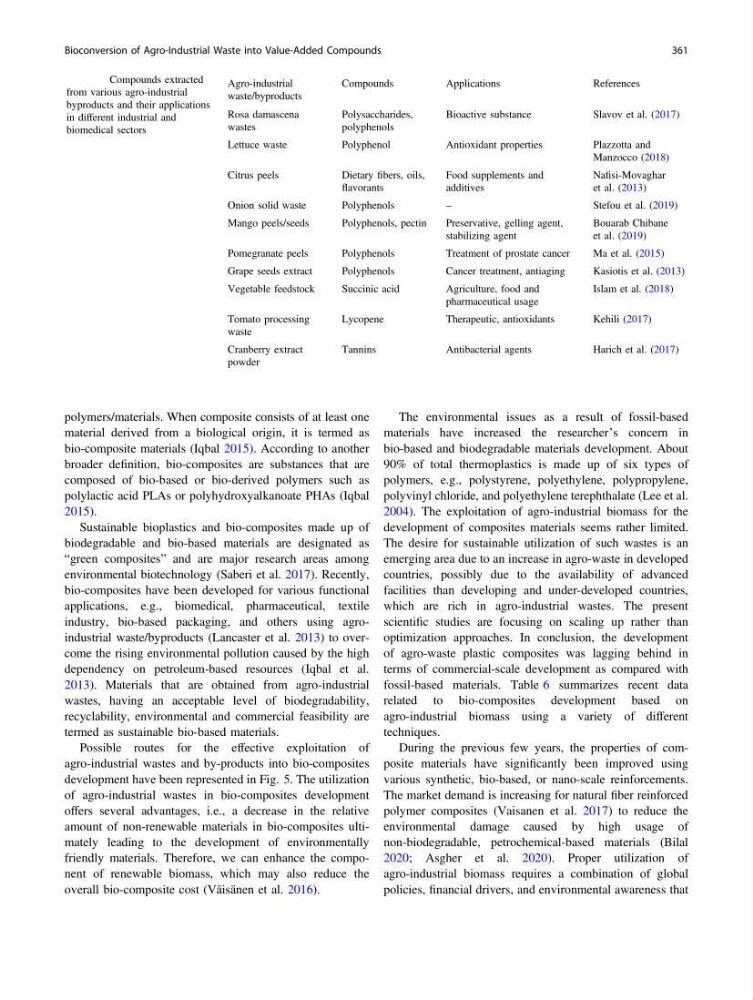
Table 5 Compounds extracted
from various agro-industrial
byproducts and their applications
in different industrial and
biomedical sectors
Agro-industrial
waste/byproducts
Compounds
Applications
References
Rosa damascena
wastes
Polysaccharides,
polyphenols
Bioactive substance
Slavov et al. (2017)
Lettuce waste
Polyphenol
Antioxidant properties
Plazzotta and
Manzocco (2018)
Citrus peels
Dietary fibers, oils,
flavorants
Food supplements and
additives
Nafisi-Movaghar
et al. (2013)
Onion solid waste
Polyphenols
–
Stefou et al. (2019)
Mango peels/seeds
Polyphenols, pectin
Preservative, gelling agent,
stabilizing agent
Bouarab Chibane
et al. (2019)
Pomegranate peels
Polyphenols
Treatment of prostate cancer
Ma et al. (2015)
Grape seeds extract
Polyphenols
Cancer treatment, antiaging
Kasiotis et al. (2013)
Vegetable feedstock
Succinic acid
Agriculture, food and
pharmaceutical usage
Islam et al. (2018)
Tomato processing
waste
Lycopene
Therapeutic, antioxidants
Kehili (2017)
Cranberry extract
powder
Tannins
Antibacterial agents
Harich et al. (2017)
Bioconversion of Agro-Industrial Waste into Value-Added Compounds
361
material derived from a biological origin, it is termed as
bio-composite materials (Iqbal 2015). According to another
broader definition, bio-composites are substances that are
composed of bio-based or bio-derived polymers such as
polylactic acid PLAs or polyhydroxyalkanoate PHAs (Iqbal
2015).
Sustainable bioplastics and bio-composites made up of
biodegradable and bio-based materials are designated as
“green composites” and are major research areas among
environmental biotechnology (Saberi et al. 2017). Recently,
bio-composites have been developed for various functional
applications, e.g., biomedical, pharmaceutical, textile
industry, bio-based packaging, and others using agroindustrial waste/byproducts (Lancaster et al. 2013) to overcome the rising environmental pollution caused by the high
dependency on petroleum-based resources (Iqbal et al.
2013). Materials that are obtained from agro-industrial
wastes, having an acceptable level of biodegradability,
recyclability, environmental and commercial feasibility are
termed as sustainable bio-based materials.
Possible routes for the effective exploitation of
agro-industrial wastes and by-products into bio-composites
development have been represented in Fig. 5. The utilization
of agro-industrial wastes in bio-composites development
offers several advantages, i.e., a decrease in the relative
amount of non-renewable materials in bio-composites ultimately leading to the development of environmentally
friendly materials. Therefore, we can enhance the component of renewable biomass, which may also reduce the
overall bio-composite cost (Väisänen et al. 2016).
The environmental issues as a result of fossil-based
materials have increased the researcher’s concern in
bio-based and biodegradable materials development. About
90% of total thermoplastics is made up of six types of
polymers, e.g., polystyrene, polyethylene, polypropylene,
polyvinyl chloride, and polyethylene terephthalate (Lee et al.
2004). The exploitation of agro-industrial biomass for the
development of composites materials seems rather limited.
The desire for sustainable utilization of such wastes is an
emerging area due to an increase in agro-waste in developed
countries, possibly due to the availability of advanced
facilities than developing and under-developed countries,
which are rich in agro-industrial wastes. The present
scientific studies are focusing on scaling up rather than
optimization approaches. In conclusion, the development
of agro-waste plastic composites was lagging behind in
terms of commercial-scale development as compared with
fossil-based materials. Table 6 summarizes recent data
related to bio-composites development based on
agro-industrial biomass using a variety of different
techniques.
During the previous few years, the properties of composite materials have significantly been improved using
various synthetic, bio-based, or nano-scale reinforcements.
The market demand is increasing for natural fiber reinforced
polymer composites (Vaisanen et al. 2017) to reduce the
environmental damage caused by high usage of
non-biodegradable, petrochemical-based materials (Bilal
2020; Asgher et al. 2020). Proper utilization of
agro-industrial biomass requires a combination of global
policies, financial drivers, and environmental awareness that
Table 5 Compounds extracted
from various agro-industrial
byproducts and their applications
in different industrial and
biomedical sectors
Agro-industrial
waste/byproducts
Compounds
Applications
References
Rosa damascena
wastes
Polysaccharides,
polyphenols
Bioactive substance
Slavov et al. (2017)
Lettuce waste
Polyphenol
Antioxidant properties
Plazzotta and
Manzocco (2018)
Citrus peels
Dietary fibers, oils,
flavorants
Food supplements and
additives
Nafisi-Movaghar
et al. (2013)
Onion solid waste
Polyphenols
–
Stefou et al. (2019)
Mango peels/seeds
Polyphenols, pectin
Preservative, gelling agent,
stabilizing agent
Bouarab Chibane
et al. (2019)
Pomegranate peels
Polyphenols
Treatment of prostate cancer
Ma et al. (2015)
Grape seeds extract
Polyphenols
Cancer treatment, antiaging
Kasiotis et al. (2013)
Vegetable feedstock
Succinic acid
Agriculture, food and
pharmaceutical usage
Islam et al. (2018)
Tomato processing
waste
Lycopene
Therapeutic, antioxidants
Kehili (2017)
Cranberry extract
powder
Tannins
Antibacterial agents
Harich et al. (2017)
Bioconversion of Agro-Industrial Waste into Value-Added Compounds
361