

provide incentives to extract organic waste components and
promote their secondary utilization in different industries.
The extraction and reuse of secondary and tertiary biomass
resources at industrial sectors will ensure that there is a good
supply of waste organic biomass and promote the development of bio-based chemicals and products.
3.6 Bio-pulping and Paper Industries
Pulping is the conversion of wood/lignocellulose to isolated
pulp fibers for papermaking. Paper and pulp can be produced
after lignocellulosic waste biomass, e.g., wood residues,
wastepaper, or agricultural biomass. This conversion process
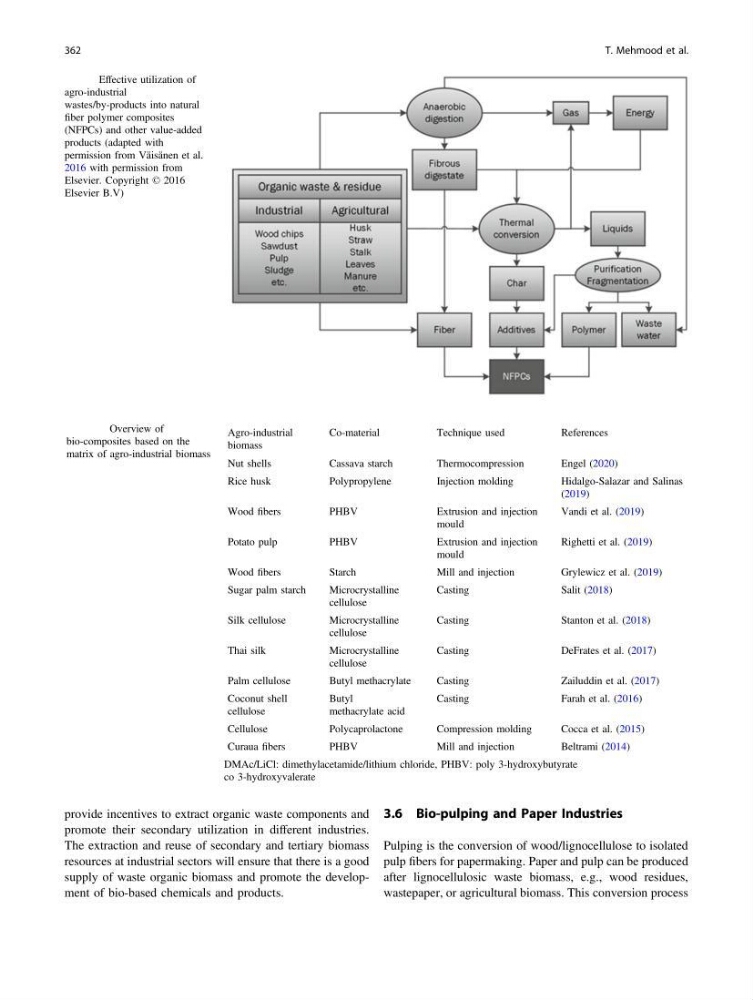
Fig. 5 Effective utilization of
agro-industrial
wastes/by-products into natural
fiber polymer composites
(NFPCs) and other value-added
products (adapted with
permission from Väisänen et al.
2016 with permission from
Elsevier. Copyright © 2016
Elsevier B.V)
Table 6 Overview of
bio-composites based on the
matrix of agro-industrial biomass
Agro-industrial
biomass
Co-material
Technique used
References
Nut shells
Cassava starch
Thermocompression
Engel (2020)
Rice husk
Polypropylene
Injection molding
Hidalgo-Salazar and Salinas
(2019)
Wood fibers
PHBV
Extrusion and injection
mould
Vandi et al. (2019)
Potato pulp
PHBV
Extrusion and injection
mould
Righetti et al. (2019)
Wood fibers
Starch
Mill and injection
Grylewicz et al. (2019)
Sugar palm starch
Microcrystalline
cellulose
Casting
Salit (2018)
Silk cellulose
Microcrystalline
cellulose
Casting
Stanton et al. (2018)
Thai silk
Microcrystalline
cellulose
Casting
DeFrates et al. (2017)
Palm cellulose
Butyl methacrylate
Casting
Zailuddin et al. (2017)
Coconut shell
cellulose
Butyl
methacrylate acid
Casting
Farah et al. (2016)
Cellulose
Polycaprolactone
Compression molding
Cocca et al. (2015)
Curaua fibers
PHBV
Mill and injection
Beltrami (2014)
DMAc/LiCl: dimethylacetamide/lithium chloride, PHBV: poly 3-hydroxybutyrate
co 3-hydroxyvalerate
362
T. Mehmood et al.
promote their secondary utilization in different industries.
The extraction and reuse of secondary and tertiary biomass
resources at industrial sectors will ensure that there is a good
supply of waste organic biomass and promote the development of bio-based chemicals and products.
3.6 Bio-pulping and Paper Industries
Pulping is the conversion of wood/lignocellulose to isolated
pulp fibers for papermaking. Paper and pulp can be produced
after lignocellulosic waste biomass, e.g., wood residues,
wastepaper, or agricultural biomass. This conversion process
Fig. 5 Effective utilization of
agro-industrial
wastes/by-products into natural
fiber polymer composites
(NFPCs) and other value-added
products (adapted with
permission from Väisänen et al.
2016 with permission from
Elsevier. Copyright © 2016
Elsevier B.V)
Table 6 Overview of
bio-composites based on the
matrix of agro-industrial biomass
Agro-industrial
biomass
Co-material
Technique used
References
Nut shells
Cassava starch
Thermocompression
Engel (2020)
Rice husk
Polypropylene
Injection molding
Hidalgo-Salazar and Salinas
(2019)
Wood fibers
PHBV
Extrusion and injection
mould
Vandi et al. (2019)
Potato pulp
PHBV
Extrusion and injection
mould
Righetti et al. (2019)
Wood fibers
Starch
Mill and injection
Grylewicz et al. (2019)
Sugar palm starch
Microcrystalline
cellulose
Casting
Salit (2018)
Silk cellulose
Microcrystalline
cellulose
Casting
Stanton et al. (2018)
Thai silk
Microcrystalline
cellulose
Casting
DeFrates et al. (2017)
Palm cellulose
Butyl methacrylate
Casting
Zailuddin et al. (2017)
Coconut shell
cellulose
Butyl
methacrylate acid
Casting
Farah et al. (2016)
Cellulose
Polycaprolactone
Compression molding
Cocca et al. (2015)
Curaua fibers
PHBV
Mill and injection
Beltrami (2014)
DMAc/LiCl: dimethylacetamide/lithium chloride, PHBV: poly 3-hydroxybutyrate
co 3-hydroxyvalerate
362
T. Mehmood et al.