

concentration of production stages. Though, the risks also
appear associated with instability problems of organic wastes,
supply, and logistics. In addition, the organic waste-derived
products show variable prices depending upon various factors
like supply–demand, purity, and product composition.
Therefore, it is difficult to determine the turnover rates and the
profitability of the products (Carlini et al. 2017). The conversion of agricultural industry waste into value-added fine
chemicals requires multi-step processing that comprises
(i) biological, chemical, or mechanical pre-treatment; (ii) enzymatic hydrolysis; and (iii) fermentation processes (Menon
and Rao 2012). The conversion of lignocellulosic biomass via
biochemical and thermo-mechanical pathways into different
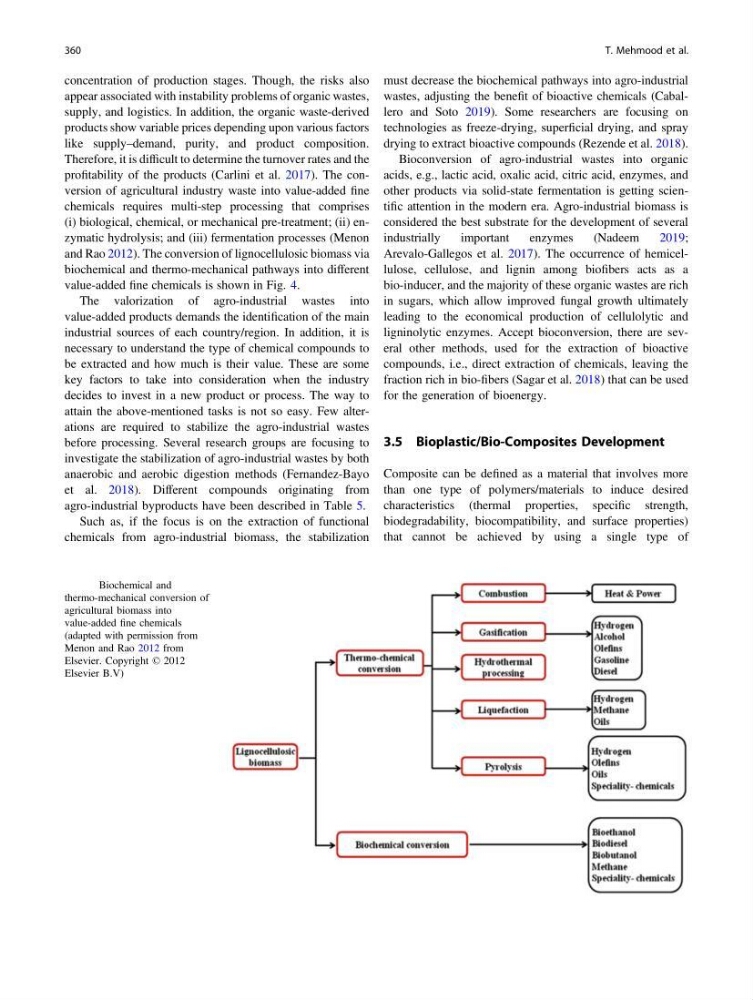
value-added fine chemicals is shown in Fig. 4.
The valorization of agro-industrial wastes into
value-added products demands the identification of the main
industrial sources of each country/region. In addition, it is
necessary to understand the type of chemical compounds to
be extracted and how much is their value. These are some
key factors to take into consideration when the industry
decides to invest in a new product or process. The way to
attain the above-mentioned tasks is not so easy. Few alterations are required to stabilize the agro-industrial wastes
before processing. Several research groups are focusing to
investigate the stabilization of agro-industrial wastes by both
anaerobic and aerobic digestion methods (Fernandez-Bayo
et al. 2018). Different compounds originating from
agro-industrial byproducts have been described in Table 5.
Such as, if the focus is on the extraction of functional
chemicals from agro-industrial biomass, the stabilization
must decrease the biochemical pathways into agro-industrial
wastes, adjusting the benefit of bioactive chemicals (Caballero and Soto 2019). Some researchers are focusing on
technologies as freeze-drying, superficial drying, and spray
drying to extract bioactive compounds (Rezende et al. 2018).
Bioconversion of agro-industrial wastes into organic
acids, e.g., lactic acid, oxalic acid, citric acid, enzymes, and
other products via solid-state fermentation is getting scientific attention in the modern era. Agro-industrial biomass is
considered the best substrate for the development of several
industrially
important
enzymes
(Nadeem
2019;
Arevalo-Gallegos et al. 2017). The occurrence of hemicellulose, cellulose, and lignin among biofibers acts as a
bio-inducer, and the majority of these organic wastes are rich
in sugars, which allow improved fungal growth ultimately
leading to the economical production of cellulolytic and
ligninolytic enzymes. Accept bioconversion, there are several other methods, used for the extraction of bioactive
compounds, i.e., direct extraction of chemicals, leaving the
fraction rich in bio-fibers (Sagar et al. 2018) that can be used
for the generation of bioenergy.
3.5 Bioplastic/Bio-Composites Development
Composite can be defined as a material that involves more
than one type of polymers/materials to induce desired
characteristics (thermal properties, specific strength,
biodegradability, biocompatibility, and surface properties)
that cannot be achieved by using a single type of
Fig. 4 Biochemical and
thermo-mechanical conversion of
agricultural biomass into
value-added fine chemicals
(adapted with permission from
Menon and Rao 2012 from
Elsevier. Copyright © 2012
Elsevier B.V)
360
T. Mehmood et al.
appear associated with instability problems of organic wastes,
supply, and logistics. In addition, the organic waste-derived
products show variable prices depending upon various factors
like supply–demand, purity, and product composition.
Therefore, it is difficult to determine the turnover rates and the
profitability of the products (Carlini et al. 2017). The conversion of agricultural industry waste into value-added fine
chemicals requires multi-step processing that comprises
(i) biological, chemical, or mechanical pre-treatment; (ii) enzymatic hydrolysis; and (iii) fermentation processes (Menon
and Rao 2012). The conversion of lignocellulosic biomass via
biochemical and thermo-mechanical pathways into different
value-added fine chemicals is shown in Fig. 4.
The valorization of agro-industrial wastes into
value-added products demands the identification of the main
industrial sources of each country/region. In addition, it is
necessary to understand the type of chemical compounds to
be extracted and how much is their value. These are some
key factors to take into consideration when the industry
decides to invest in a new product or process. The way to
attain the above-mentioned tasks is not so easy. Few alterations are required to stabilize the agro-industrial wastes
before processing. Several research groups are focusing to
investigate the stabilization of agro-industrial wastes by both
anaerobic and aerobic digestion methods (Fernandez-Bayo
et al. 2018). Different compounds originating from
agro-industrial byproducts have been described in Table 5.
Such as, if the focus is on the extraction of functional
chemicals from agro-industrial biomass, the stabilization
must decrease the biochemical pathways into agro-industrial
wastes, adjusting the benefit of bioactive chemicals (Caballero and Soto 2019). Some researchers are focusing on
technologies as freeze-drying, superficial drying, and spray
drying to extract bioactive compounds (Rezende et al. 2018).
Bioconversion of agro-industrial wastes into organic
acids, e.g., lactic acid, oxalic acid, citric acid, enzymes, and
other products via solid-state fermentation is getting scientific attention in the modern era. Agro-industrial biomass is
considered the best substrate for the development of several
industrially
important
enzymes
(Nadeem
2019;
Arevalo-Gallegos et al. 2017). The occurrence of hemicellulose, cellulose, and lignin among biofibers acts as a
bio-inducer, and the majority of these organic wastes are rich
in sugars, which allow improved fungal growth ultimately
leading to the economical production of cellulolytic and
ligninolytic enzymes. Accept bioconversion, there are several other methods, used for the extraction of bioactive
compounds, i.e., direct extraction of chemicals, leaving the
fraction rich in bio-fibers (Sagar et al. 2018) that can be used
for the generation of bioenergy.
3.5 Bioplastic/Bio-Composites Development
Composite can be defined as a material that involves more
than one type of polymers/materials to induce desired
characteristics (thermal properties, specific strength,
biodegradability, biocompatibility, and surface properties)
that cannot be achieved by using a single type of
Fig. 4 Biochemical and
thermo-mechanical conversion of
agricultural biomass into
value-added fine chemicals
(adapted with permission from
Menon and Rao 2012 from
Elsevier. Copyright © 2012
Elsevier B.V)
360
T. Mehmood et al.