

bio-surfactant at the industrial scale. The optimization of
metabolic pathways can be attained using statistical-based,
response surface methodology (RSM) approach, which can
help to study individual factors affecting the overall
bio-surfactant production.
3.4 Fine Chemicals
The agriculture processing industry generates a huge number
of organic wastes/byproducts in the form of kernels, pulp, and
peels. Their disposal in municipal bins or an open environment enhances ecological pollution (Anwar et al. 2014).
Therefore, the extraction of phytochemicals and/or other
bioactive compounds from organic wastes, which could be
used in cosmetics, pharmaceutics, and food processing
industries, could be the best option (Anwar et al. 2014). This
could, on one hand, provide a sustainable solution toward the
environmental pollution problem, while being economically
viable on the other hand. However, the utilization of
agro-industrial waste in bio-refineries lacks advanced
research explaining the economic feasibility of these biomaterials. Cristobal et al. (2018) concluded that not all organic
wastes possess similar potential as a raw substrate in
bio-refinery processes. The best economic replacements are
those letting the capitalization of economies of scale and the
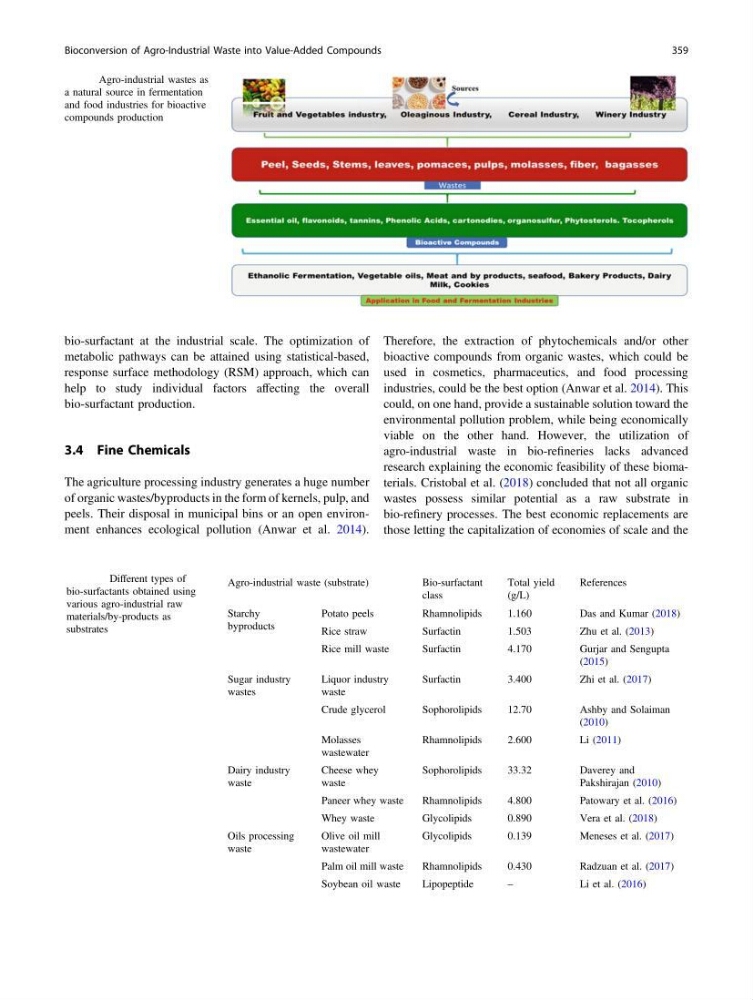
Fig. 3 Agro-industrial wastes as
a natural source in fermentation
and food industries for bioactive
compounds production
Table 4 Different types of
bio-surfactants obtained using
various agro-industrial raw
materials/by-products as
substrates
Agro-industrial waste (substrate)
Bio-surfactant
class
Total yield
(g/L)
References
Starchy
byproducts
Potato peels
Rhamnolipids
1.160
Das and Kumar (2018)
Rice straw
Surfactin
1.503
Zhu et al. (2013)
Rice mill waste
Surfactin
4.170
Gurjar and Sengupta
(2015)
Sugar industry
wastes
Liquor industry
waste
Surfactin
3.400
Zhi et al. (2017)
Crude glycerol
Sophorolipids
12.70
Ashby and Solaiman
(2010)
Molasses
wastewater
Rhamnolipids
2.600
Li (2011)
Dairy industry
waste
Cheese whey
waste
Sophorolipids
33.32
Daverey and
Pakshirajan (2010)
Paneer whey waste
Rhamnolipids
4.800
Patowary et al. (2016)
Whey waste
Glycolipids
0.890
Vera et al. (2018)
Oils processing
waste
Olive oil mill
wastewater
Glycolipids
0.139
Meneses et al. (2017)
Palm oil mill waste
Rhamnolipids
0.430
Radzuan et al. (2017)
Soybean oil waste
Lipopeptide
–
Li et al. (2016)
Bioconversion of Agro-Industrial Waste into Value-Added Compounds
359
metabolic pathways can be attained using statistical-based,
response surface methodology (RSM) approach, which can
help to study individual factors affecting the overall
bio-surfactant production.
3.4 Fine Chemicals
The agriculture processing industry generates a huge number
of organic wastes/byproducts in the form of kernels, pulp, and
peels. Their disposal in municipal bins or an open environment enhances ecological pollution (Anwar et al. 2014).
Therefore, the extraction of phytochemicals and/or other
bioactive compounds from organic wastes, which could be
used in cosmetics, pharmaceutics, and food processing
industries, could be the best option (Anwar et al. 2014). This
could, on one hand, provide a sustainable solution toward the
environmental pollution problem, while being economically
viable on the other hand. However, the utilization of
agro-industrial waste in bio-refineries lacks advanced
research explaining the economic feasibility of these biomaterials. Cristobal et al. (2018) concluded that not all organic
wastes possess similar potential as a raw substrate in
bio-refinery processes. The best economic replacements are
those letting the capitalization of economies of scale and the
Fig. 3 Agro-industrial wastes as
a natural source in fermentation
and food industries for bioactive
compounds production
Table 4 Different types of
bio-surfactants obtained using
various agro-industrial raw
materials/by-products as
substrates
Agro-industrial waste (substrate)
Bio-surfactant
class
Total yield
(g/L)
References
Starchy
byproducts
Potato peels
Rhamnolipids
1.160
Das and Kumar (2018)
Rice straw
Surfactin
1.503
Zhu et al. (2013)
Rice mill waste
Surfactin
4.170
Gurjar and Sengupta
(2015)
Sugar industry
wastes
Liquor industry
waste
Surfactin
3.400
Zhi et al. (2017)
Crude glycerol
Sophorolipids
12.70
Ashby and Solaiman
(2010)
Molasses
wastewater
Rhamnolipids
2.600
Li (2011)
Dairy industry
waste
Cheese whey
waste
Sophorolipids
33.32
Daverey and
Pakshirajan (2010)
Paneer whey waste
Rhamnolipids
4.800
Patowary et al. (2016)
Whey waste
Glycolipids
0.890
Vera et al. (2018)
Oils processing
waste
Olive oil mill
wastewater
Glycolipids
0.139
Meneses et al. (2017)
Palm oil mill waste
Rhamnolipids
0.430
Radzuan et al. (2017)
Soybean oil waste
Lipopeptide
–
Li et al. (2016)
Bioconversion of Agro-Industrial Waste into Value-Added Compounds
359