

3 HTL Reaction Networks and Product
Fractions
3.1 Biochemical Reaction Pathways
Synthesis of chemical compounds and bio-based materials
through the conversion of organic waste biomass is the key
challenge in chemistry, which requires the development of
green and sustainable technologies, abiding the principles of
green chemistry. Hydrothermal processes such as liquefaction, oxidation, carbonization, depolymerization and gasification have been discovered as green conversion
technologies for the processing of biomass feedstocks into
liquid, gaseous and solid chemical compounds (Maddi et al.
2016; Funke and Ziegler 2010; Hasegawa et al. 2011;
Onwudili et al. 2013). Moreover, thermochemical conversion processes can also control intermediate materials and
biomass feedstocks obtained from biological processes
(Öhrman et al. 2013). Conversion of non-renewable agricultural and forest residues containing sugar, cellulose,
hemicellulose, fibers, lignin, lignocellulose, proteins and
triacylglycerides to valuable chemicals can generate the wide
opportunities for the development of sustainable chemical
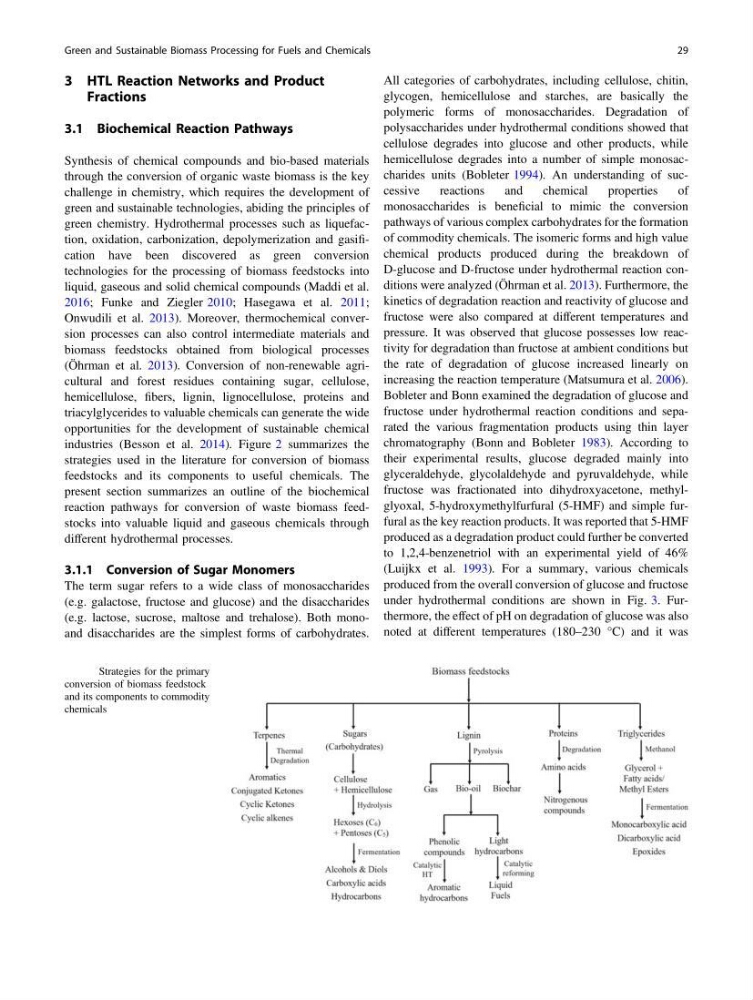
industries (Besson et al. 2014). Figure 2 summarizes the
strategies used in the literature for conversion of biomass
feedstocks and its components to useful chemicals. The
present section summarizes an outline of the biochemical
reaction pathways for conversion of waste biomass feedstocks into valuable liquid and gaseous chemicals through
different hydrothermal processes.
3.1.1 Conversion of Sugar Monomers
The term sugar refers to a wide class of monosaccharides
(e.g. galactose, fructose and glucose) and the disaccharides
(e.g. lactose, sucrose, maltose and trehalose). Both monoand disaccharides are the simplest forms of carbohydrates.
All categories of carbohydrates, including cellulose, chitin,
glycogen, hemicellulose and starches, are basically the
polymeric forms of monosaccharides. Degradation of
polysaccharides under hydrothermal conditions showed that
cellulose degrades into glucose and other products, while
hemicellulose degrades into a number of simple monosaccharides units (Bobleter 1994). An understanding of successive
reactions
and
chemical
properties
of
monosaccharides is beneficial to mimic the conversion
pathways of various complex carbohydrates for the formation
of commodity chemicals. The isomeric forms and high value
chemical products produced during the breakdown of
D-glucose and D-fructose under hydrothermal reaction conditions were analyzed (Öhrman et al. 2013). Furthermore, the
kinetics of degradation reaction and reactivity of glucose and
fructose were also compared at different temperatures and
pressure. It was observed that glucose possesses low reactivity for degradation than fructose at ambient conditions but
the rate of degradation of glucose increased linearly on
increasing the reaction temperature (Matsumura et al. 2006).
Bobleter and Bonn examined the degradation of glucose and
fructose under hydrothermal reaction conditions and separated the various fragmentation products using thin layer
chromatography (Bonn and Bobleter 1983). According to
their experimental results, glucose degraded mainly into
glyceraldehyde, glycolaldehyde and pyruvaldehyde, while
fructose was fractionated into dihydroxyacetone, methylglyoxal, 5-hydroxymethylfurfural (5-HMF) and simple furfural as the key reaction products. It was reported that 5-HMF
produced as a degradation product could further be converted
to 1,2,4-benzenetriol with an experimental yield of 46%
(Luijkx et al. 1993). For a summary, various chemicals
produced from the overall conversion of glucose and fructose
under hydrothermal conditions are shown in Fig. 3. Furthermore, the effect of pH on degradation of glucose was also
noted at different temperatures (180–230 °C) and it was
Fig. 2 Strategies for the primary
conversion of biomass feedstock
and its components to commodity
chemicals
Green and Sustainable Biomass Processing for Fuels and Chemicals
29
Fractions
3.1 Biochemical Reaction Pathways
Synthesis of chemical compounds and bio-based materials
through the conversion of organic waste biomass is the key
challenge in chemistry, which requires the development of
green and sustainable technologies, abiding the principles of
green chemistry. Hydrothermal processes such as liquefaction, oxidation, carbonization, depolymerization and gasification have been discovered as green conversion
technologies for the processing of biomass feedstocks into
liquid, gaseous and solid chemical compounds (Maddi et al.
2016; Funke and Ziegler 2010; Hasegawa et al. 2011;
Onwudili et al. 2013). Moreover, thermochemical conversion processes can also control intermediate materials and
biomass feedstocks obtained from biological processes
(Öhrman et al. 2013). Conversion of non-renewable agricultural and forest residues containing sugar, cellulose,
hemicellulose, fibers, lignin, lignocellulose, proteins and
triacylglycerides to valuable chemicals can generate the wide
opportunities for the development of sustainable chemical
industries (Besson et al. 2014). Figure 2 summarizes the
strategies used in the literature for conversion of biomass
feedstocks and its components to useful chemicals. The
present section summarizes an outline of the biochemical
reaction pathways for conversion of waste biomass feedstocks into valuable liquid and gaseous chemicals through
different hydrothermal processes.
3.1.1 Conversion of Sugar Monomers
The term sugar refers to a wide class of monosaccharides
(e.g. galactose, fructose and glucose) and the disaccharides
(e.g. lactose, sucrose, maltose and trehalose). Both monoand disaccharides are the simplest forms of carbohydrates.
All categories of carbohydrates, including cellulose, chitin,
glycogen, hemicellulose and starches, are basically the
polymeric forms of monosaccharides. Degradation of
polysaccharides under hydrothermal conditions showed that
cellulose degrades into glucose and other products, while
hemicellulose degrades into a number of simple monosaccharides units (Bobleter 1994). An understanding of successive
reactions
and
chemical
properties
of
monosaccharides is beneficial to mimic the conversion
pathways of various complex carbohydrates for the formation
of commodity chemicals. The isomeric forms and high value
chemical products produced during the breakdown of
D-glucose and D-fructose under hydrothermal reaction conditions were analyzed (Öhrman et al. 2013). Furthermore, the
kinetics of degradation reaction and reactivity of glucose and
fructose were also compared at different temperatures and
pressure. It was observed that glucose possesses low reactivity for degradation than fructose at ambient conditions but
the rate of degradation of glucose increased linearly on
increasing the reaction temperature (Matsumura et al. 2006).
Bobleter and Bonn examined the degradation of glucose and
fructose under hydrothermal reaction conditions and separated the various fragmentation products using thin layer
chromatography (Bonn and Bobleter 1983). According to
their experimental results, glucose degraded mainly into
glyceraldehyde, glycolaldehyde and pyruvaldehyde, while
fructose was fractionated into dihydroxyacetone, methylglyoxal, 5-hydroxymethylfurfural (5-HMF) and simple furfural as the key reaction products. It was reported that 5-HMF
produced as a degradation product could further be converted
to 1,2,4-benzenetriol with an experimental yield of 46%
(Luijkx et al. 1993). For a summary, various chemicals
produced from the overall conversion of glucose and fructose
under hydrothermal conditions are shown in Fig. 3. Furthermore, the effect of pH on degradation of glucose was also
noted at different temperatures (180–230 °C) and it was
Fig. 2 Strategies for the primary
conversion of biomass feedstock
and its components to commodity
chemicals
Green and Sustainable Biomass Processing for Fuels and Chemicals
29