

HTL via gasification at supercritical conditions (Cherad et al.
2016). It was reported that 30 mol H 2 /kg algae was produced
after the successful gasification of the 98% organics.
In supercritical water oxidation technology, the oxidative
conditions are used at high temperatures to generate thermal
energy and gas-phase containing a significant amount of
CO 2 . The principal objective of supercritical water oxidation
is the decomposition of industrial waste products including
toxic effluents and sludge, because of complete and rapid
oxidation reactions in supercritical environment. Therefore,
according to sustainable development, this process is termed
as green chemistry technology. Cocero et al. used supercritical water oxidation for waste streams under the temperature range of 575–825 °C, and noticed 99.95% removal
efficiency at 650 °C with residence time lower than the 50 s
and excess oxygen slightly higher than the stoichiometric
value (Cocero et al. 2002).
Since this chapter is more oriented in perspective of
bio-crude production through HTL, therefore the majority of
the HTL studies are based on sub-critical conditions (Biller
et al. 2016; Hietala et al. 2016; Xiu et al. 2010; Gai et al.
2015; Budrat and Shotipruk 2009; Grigoras et al. 2017;
Shakya et al. 2015). However, only limited references are
there to support the supercritical region for the bio-crude
production from different biomass, such as willow, barley
straw, co-liquefaction of glycerol and aspen wood, which are
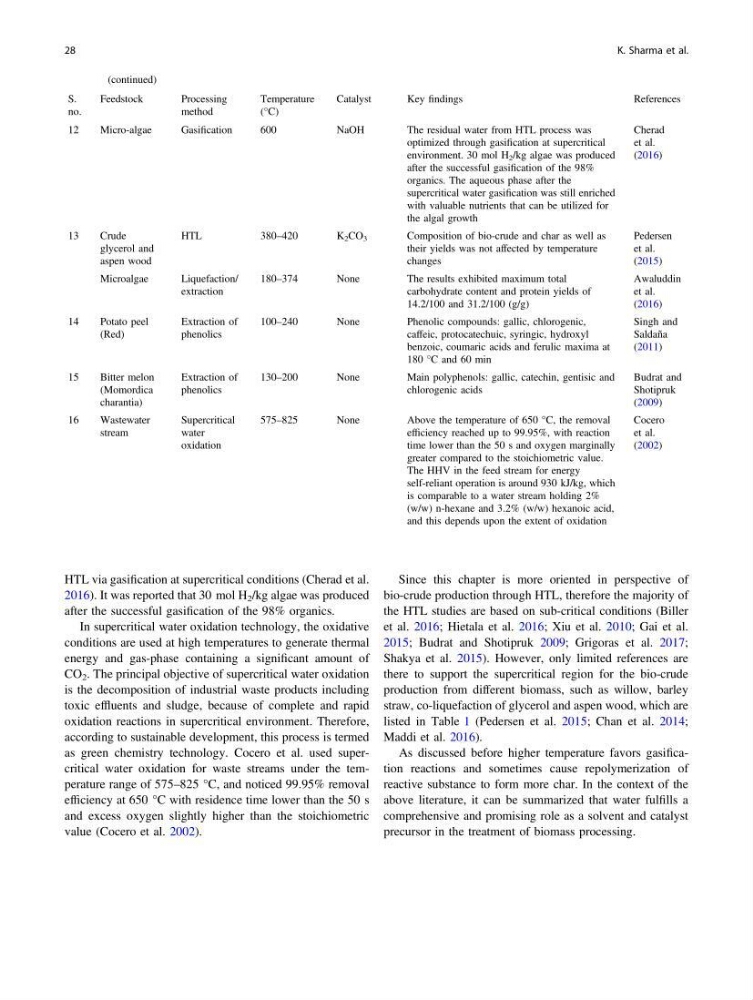
listed in Table 1 (Pedersen et al. 2015; Chan et al. 2014;
Maddi et al. 2016).
As discussed before higher temperature favors gasification reactions and sometimes cause repolymerization of
reactive substance to form more char. In the context of the
above literature, it can be summarized that water fulfills a
comprehensive and promising role as a solvent and catalyst
precursor in the treatment of biomass processing.
Table 1 (continued)
S.
no.
Feedstock
Processing
method
Temperature
(°C)
Catalyst
Key findings
References
12
Micro-algae
Gasification
600
NaOH
The residual water from HTL process was
optimized through gasification at supercritical
environment. 30 mol H 2 /kg algae was produced
after the successful gasification of the 98%
organics. The aqueous phase after the
supercritical water gasification was still enriched
with valuable nutrients that can be utilized for
the algal growth
Cherad
et al.
(2016)
13
Crude
glycerol and
aspen wood
HTL
380–420
K 2 CO 3
Composition of bio-crude and char as well as
their yields was not affected by temperature
changes
Pedersen
et al.
(2015)
Microalgae
Liquefaction/
extraction
180–374
None
The results exhibited maximum total
carbohydrate content and protein yields of
14.2/100 and 31.2/100 (g/g)
Awaluddin
et al.
(2016)
14
Potato peel
(Red)
Extraction of
phenolics
100–240
None
Phenolic compounds: gallic, chlorogenic,
caffeic, protocatechuic, syringic, hydroxyl
benzoic, coumaric acids and ferulic maxima at
180 °C and 60 min
Singh and
Saldaña
(2011)
15
Bitter melon
(Momordica
charantia)
Extraction of
phenolics
130–200
None
Main polyphenols: gallic, catechin, gentisic and
chlorogenic acids
Budrat and
Shotipruk
(2009)
16
Wastewater
stream
Supercritical
water
oxidation
575–825
None
Above the temperature of 650 °C, the removal
efficiency reached up to 99.95%, with reaction
time lower than the 50 s and oxygen marginally
greater compared to the stoichiometric value.
The HHV in the feed stream for energy
self-reliant operation is around 930 kJ/kg, which
is comparable to a water stream holding 2%
(w/w) n-hexane and 3.2% (w/w) hexanoic acid,
and this depends upon the extent of oxidation
Cocero
et al.
(2002)
28
K. Sharma et al.
2016). It was reported that 30 mol H 2 /kg algae was produced
after the successful gasification of the 98% organics.
In supercritical water oxidation technology, the oxidative
conditions are used at high temperatures to generate thermal
energy and gas-phase containing a significant amount of
CO 2 . The principal objective of supercritical water oxidation
is the decomposition of industrial waste products including
toxic effluents and sludge, because of complete and rapid
oxidation reactions in supercritical environment. Therefore,
according to sustainable development, this process is termed
as green chemistry technology. Cocero et al. used supercritical water oxidation for waste streams under the temperature range of 575–825 °C, and noticed 99.95% removal
efficiency at 650 °C with residence time lower than the 50 s
and excess oxygen slightly higher than the stoichiometric
value (Cocero et al. 2002).
Since this chapter is more oriented in perspective of
bio-crude production through HTL, therefore the majority of
the HTL studies are based on sub-critical conditions (Biller
et al. 2016; Hietala et al. 2016; Xiu et al. 2010; Gai et al.
2015; Budrat and Shotipruk 2009; Grigoras et al. 2017;
Shakya et al. 2015). However, only limited references are
there to support the supercritical region for the bio-crude
production from different biomass, such as willow, barley
straw, co-liquefaction of glycerol and aspen wood, which are
listed in Table 1 (Pedersen et al. 2015; Chan et al. 2014;
Maddi et al. 2016).
As discussed before higher temperature favors gasification reactions and sometimes cause repolymerization of
reactive substance to form more char. In the context of the
above literature, it can be summarized that water fulfills a
comprehensive and promising role as a solvent and catalyst
precursor in the treatment of biomass processing.
Table 1 (continued)
S.
no.
Feedstock
Processing
method
Temperature
(°C)
Catalyst
Key findings
References
12
Micro-algae
Gasification
600
NaOH
The residual water from HTL process was
optimized through gasification at supercritical
environment. 30 mol H 2 /kg algae was produced
after the successful gasification of the 98%
organics. The aqueous phase after the
supercritical water gasification was still enriched
with valuable nutrients that can be utilized for
the algal growth
Cherad
et al.
(2016)
13
Crude
glycerol and
aspen wood
HTL
380–420
K 2 CO 3
Composition of bio-crude and char as well as
their yields was not affected by temperature
changes
Pedersen
et al.
(2015)
Microalgae
Liquefaction/
extraction
180–374
None
The results exhibited maximum total
carbohydrate content and protein yields of
14.2/100 and 31.2/100 (g/g)
Awaluddin
et al.
(2016)
14
Potato peel
(Red)
Extraction of
phenolics
100–240
None
Phenolic compounds: gallic, chlorogenic,
caffeic, protocatechuic, syringic, hydroxyl
benzoic, coumaric acids and ferulic maxima at
180 °C and 60 min
Singh and
Saldaña
(2011)
15
Bitter melon
(Momordica
charantia)
Extraction of
phenolics
130–200
None
Main polyphenols: gallic, catechin, gentisic and
chlorogenic acids
Budrat and
Shotipruk
(2009)
16
Wastewater
stream
Supercritical
water
oxidation
575–825
None
Above the temperature of 650 °C, the removal
efficiency reached up to 99.95%, with reaction
time lower than the 50 s and oxygen marginally
greater compared to the stoichiometric value.
The HHV in the feed stream for energy
self-reliant operation is around 930 kJ/kg, which
is comparable to a water stream holding 2%
(w/w) n-hexane and 3.2% (w/w) hexanoic acid,
and this depends upon the extent of oxidation
Cocero
et al.
(2002)
28
K. Sharma et al.