

found, at 200 °C temperature, that the degradation of glucose
increases with decreasing pH of the solution (Xiang et al.
2004). Addition of 2 mM sulfuric acid solution to the fructose significantly increased reaction yield of 5-HMF and
furfural as well as reduced yields of pyruvaldehyde and lactic
acid without affecting reverse isomerization of fructose to
glucose (Antal et al. 1990).
After glucose, galactose and mannose are the next
monosaccharides (hexoses) present in hemicellulose in high
yield. Both galactose and mannose are important precursors
for the production of 5-HMF and have been widely used for
large-scale production. Mannose showed high reactivity in
the presence of CrCl 2 in either DMA-LiBr and produced
5-HMF in 69% yield, while a low yield of around 40% of
5-HMF was obtained on reacting galactose under similar
conditions (Binder et al. 2010). Like fructose, xylose is a
pentose sugar and an important building block of hemicellulose, which is considered as a main source for the global
production of furfural. The pyranose cyclic structure of
xylose was found to produce furfural as a main product
while open-chain structure produced pyruvaldehyde, glyceraldehyde, glycolaldehyde, lactic acid, acetol and formic
acid as degradation by-products in high yield (Antal et al.
1990). The effect of pressure and temperature on the yield of
furfural was noticed and observed that supercritical reaction
conditions favor formation of by-products over the furfural
(Qi and Xiuyang 2007).
3.1.2 Conversion of Non-sugar Monomers
Lignin is a complex organic compound with
randomly-oriented phenyl derivatives and acts as a sustainable biomass for aromatic compounds. The most dominant
monomers in lignin unit are all hydroxyl phenyl-alkane
derivatives such as p-coumaryl alcohol, sinapyl alcohol and
coniferyl alcohol (Fig. 4) (Joffres et al. 2013). Lignin
derivatives can be easily converted into monomer units
under sub- and supercritical conditions at varying pressure
from 20 to 25 MPa, temperature from 280 to 400 °C and
water-to-lignin ratio (2:50).
It was observed that with increase in density of water in a
hydrothermal environment increases the degradation of lignin into lightweight chemicals (Saisu et al. 2003).
Hydrothermal processing of lignin at 350 and 400 °C and
25–40 MPa pressure was studied by employing batch reactors in the absence of catalysts (Wahyudiono and Goto
2008). Under sub- and supercritical conditions, lignin was
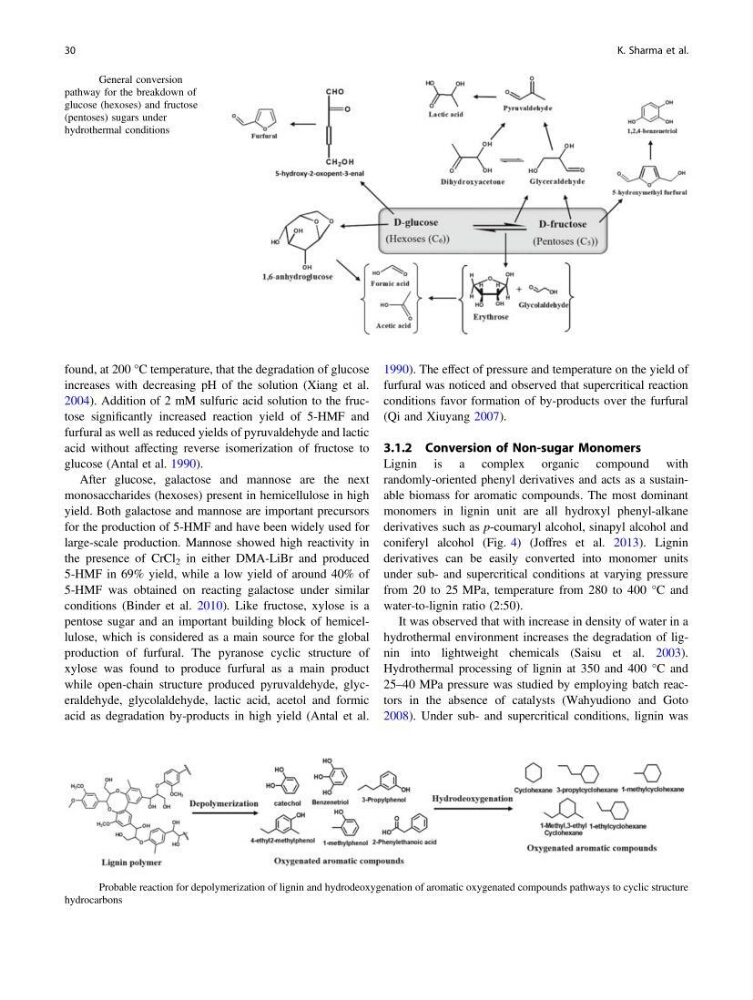
Fig. 3 General conversion
pathway for the breakdown of
glucose (hexoses) and fructose
(pentoses) sugars under
hydrothermal conditions
Fig. 4 Probable reaction for depolymerization of lignin and hydrodeoxygenation of aromatic oxygenated compounds pathways to cyclic structure
hydrocarbons
30
K. Sharma et al.
increases with decreasing pH of the solution (Xiang et al.
2004). Addition of 2 mM sulfuric acid solution to the fructose significantly increased reaction yield of 5-HMF and
furfural as well as reduced yields of pyruvaldehyde and lactic
acid without affecting reverse isomerization of fructose to
glucose (Antal et al. 1990).
After glucose, galactose and mannose are the next
monosaccharides (hexoses) present in hemicellulose in high
yield. Both galactose and mannose are important precursors
for the production of 5-HMF and have been widely used for
large-scale production. Mannose showed high reactivity in
the presence of CrCl 2 in either DMA-LiBr and produced
5-HMF in 69% yield, while a low yield of around 40% of
5-HMF was obtained on reacting galactose under similar
conditions (Binder et al. 2010). Like fructose, xylose is a
pentose sugar and an important building block of hemicellulose, which is considered as a main source for the global
production of furfural. The pyranose cyclic structure of
xylose was found to produce furfural as a main product
while open-chain structure produced pyruvaldehyde, glyceraldehyde, glycolaldehyde, lactic acid, acetol and formic
acid as degradation by-products in high yield (Antal et al.
1990). The effect of pressure and temperature on the yield of
furfural was noticed and observed that supercritical reaction
conditions favor formation of by-products over the furfural
(Qi and Xiuyang 2007).
3.1.2 Conversion of Non-sugar Monomers
Lignin is a complex organic compound with
randomly-oriented phenyl derivatives and acts as a sustainable biomass for aromatic compounds. The most dominant
monomers in lignin unit are all hydroxyl phenyl-alkane
derivatives such as p-coumaryl alcohol, sinapyl alcohol and
coniferyl alcohol (Fig. 4) (Joffres et al. 2013). Lignin
derivatives can be easily converted into monomer units
under sub- and supercritical conditions at varying pressure
from 20 to 25 MPa, temperature from 280 to 400 °C and
water-to-lignin ratio (2:50).
It was observed that with increase in density of water in a
hydrothermal environment increases the degradation of lignin into lightweight chemicals (Saisu et al. 2003).
Hydrothermal processing of lignin at 350 and 400 °C and
25–40 MPa pressure was studied by employing batch reactors in the absence of catalysts (Wahyudiono and Goto
2008). Under sub- and supercritical conditions, lignin was
Fig. 3 General conversion
pathway for the breakdown of
glucose (hexoses) and fructose
(pentoses) sugars under
hydrothermal conditions
Fig. 4 Probable reaction for depolymerization of lignin and hydrodeoxygenation of aromatic oxygenated compounds pathways to cyclic structure
hydrocarbons
30
K. Sharma et al.