

principles of green chemistry in that the use of auxiliary
substances during separation processes or any other intermediary process should eliminate unnecessary solvents use,
and if necessary, should be innocuous. ILs are used both as
solvents and catalysts and achieves this feat.
1.4 Unmatched Benefits of Ionic Liquids
ILs are revolutionary, in that they offer alternate usage to
conventional solvents in assorted chemical activities and
applications (Holbrey and Rogers 2002). These alternate
advantages are visible in areas of its thermodynamics and
kinetics. ILs have been (since its discovery) put to several
applications. ILs have no measurable vapor pressure, and
therefore cannot evolve Volatile Organic Compounds
(VOCs) (Nelson 2002). ILs exist as ions and as a result are
unlike other molecular liquids. Its intrinsic and extrinsic
properties: polarity, viscosity, conductivity, and thermal
stability can be adjusted by combining the exact pairs of
cation species with a co-anion species (Tan and Macfarlane
2009). An in-depth examination and study of ILs reveal a
wide range of applications for chemical processes. Some of
these processes include: Friedel Crafts reaction, Diels-Alder
reactions, RefÔrmatsky, Stille, Claisen rearrangement, and
Heck reaction. Other applications of ILs include nanoparticle
synthesis and catalytic oxidation. An increasing number of
researches are finding more relevance for the use of ILs
because they are practical and straightforward, compared
with similar reactions in traditional organic solvents such as
dipolar aprotic solvents. Conventional solvents are
eco-unfriendly, particularly chlorinated hydrocarbons.
Interestingly, ILs have been found to exhibit a property like
no other: tenability—the ability of the solvent to be designed
and redesigned to suit specific processes. Freemantle
described ILs as “designer solvents,” of which properties can
be customized for a particular process. This can be done by
(i) changing the structure of the cation, (ii) changing the
structure of the anion, or (iii) changing both the structure of
the anion and cation complementarily. This, in turn, changes
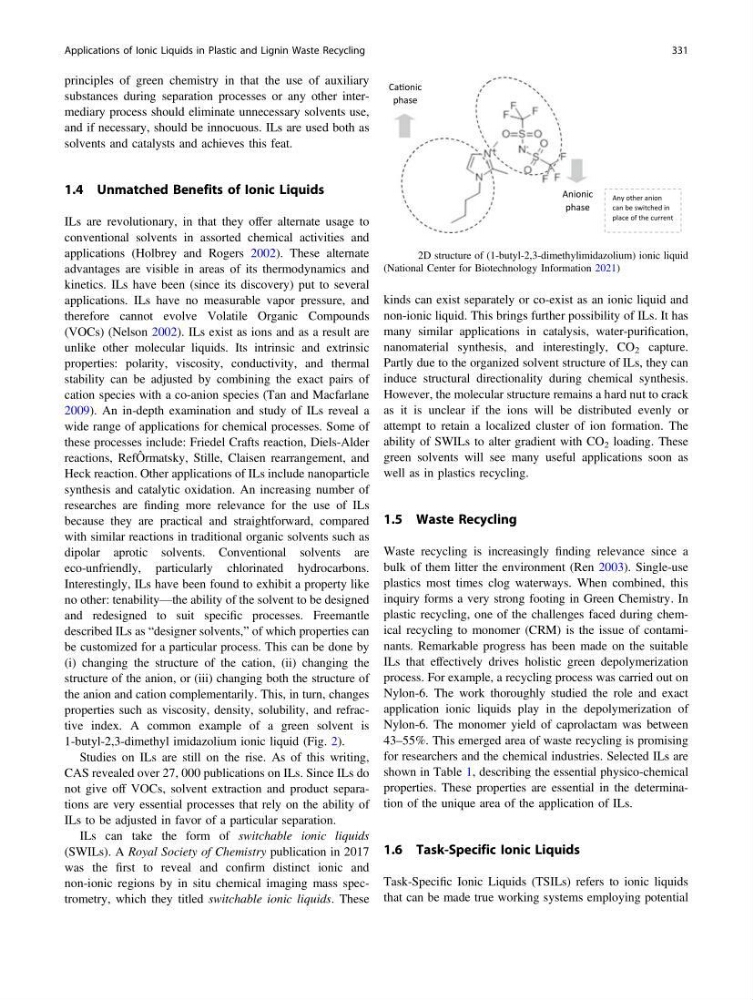
properties such as viscosity, density, solubility, and refractive index. A common example of a green solvent is
1-butyl-2,3-dimethyl imidazolium ionic liquid (Fig. 2).
Studies on ILs are still on the rise. As of this writing,
CAS revealed over 27, 000 publications on ILs. Since ILs do
not give off VOCs, solvent extraction and product separations are very essential processes that rely on the ability of
ILs to be adjusted in favor of a particular separation.
ILs can take the form of switchable ionic liquids
(SWILs). A Royal Society of Chemistry publication in 2017
was the first to reveal and confirm distinct ionic and
non-ionic regions by in situ chemical imaging mass spectrometry, which they titled switchable ionic liquids. These
kinds can exist separately or co-exist as an ionic liquid and
non-ionic liquid. This brings further possibility of ILs. It has
many similar applications in catalysis, water-purification,
nanomaterial synthesis, and interestingly, CO 2 capture.
Partly due to the organized solvent structure of ILs, they can
induce structural directionality during chemical synthesis.
However, the molecular structure remains a hard nut to crack
as it is unclear if the ions will be distributed evenly or
attempt to retain a localized cluster of ion formation. The
ability of SWILs to alter gradient with CO 2 loading. These
green solvents will see many useful applications soon as
well as in plastics recycling.
1.5 Waste Recycling
Waste recycling is increasingly finding relevance since a
bulk of them litter the environment (Ren 2003). Single-use
plastics most times clog waterways. When combined, this
inquiry forms a very strong footing in Green Chemistry. In
plastic recycling, one of the challenges faced during chemical recycling to monomer (CRM) is the issue of contaminants. Remarkable progress has been made on the suitable
ILs that effectively drives holistic green depolymerization
process. For example, a recycling process was carried out on
Nylon-6. The work thoroughly studied the role and exact
application ionic liquids play in the depolymerization of
Nylon-6. The monomer yield of caprolactam was between
43–55%. This emerged area of waste recycling is promising
for researchers and the chemical industries. Selected ILs are
shown in Table 1, describing the essential physico-chemical
properties. These properties are essential in the determination of the unique area of the application of ILs.
1.6 Task-Specific Ionic Liquids
Task-Specific Ionic Liquids (TSILs) refers to ionic liquids
that can be made true working systems employing potential
CaƟonic
phase
Anionic
phase
Any other anion
can be switched in
place of the current
Fig. 2 2D structure of (1-butyl-2,3-dimethylimidazolium) ionic liquid
(National Center for Biotechnology Information 2021)
Applications of Ionic Liquids in Plastic and Lignin Waste Recycling
331
substances during separation processes or any other intermediary process should eliminate unnecessary solvents use,
and if necessary, should be innocuous. ILs are used both as
solvents and catalysts and achieves this feat.
1.4 Unmatched Benefits of Ionic Liquids
ILs are revolutionary, in that they offer alternate usage to
conventional solvents in assorted chemical activities and
applications (Holbrey and Rogers 2002). These alternate
advantages are visible in areas of its thermodynamics and
kinetics. ILs have been (since its discovery) put to several
applications. ILs have no measurable vapor pressure, and
therefore cannot evolve Volatile Organic Compounds
(VOCs) (Nelson 2002). ILs exist as ions and as a result are
unlike other molecular liquids. Its intrinsic and extrinsic
properties: polarity, viscosity, conductivity, and thermal
stability can be adjusted by combining the exact pairs of
cation species with a co-anion species (Tan and Macfarlane
2009). An in-depth examination and study of ILs reveal a
wide range of applications for chemical processes. Some of
these processes include: Friedel Crafts reaction, Diels-Alder
reactions, RefÔrmatsky, Stille, Claisen rearrangement, and
Heck reaction. Other applications of ILs include nanoparticle
synthesis and catalytic oxidation. An increasing number of
researches are finding more relevance for the use of ILs
because they are practical and straightforward, compared
with similar reactions in traditional organic solvents such as
dipolar aprotic solvents. Conventional solvents are
eco-unfriendly, particularly chlorinated hydrocarbons.
Interestingly, ILs have been found to exhibit a property like
no other: tenability—the ability of the solvent to be designed
and redesigned to suit specific processes. Freemantle
described ILs as “designer solvents,” of which properties can
be customized for a particular process. This can be done by
(i) changing the structure of the cation, (ii) changing the
structure of the anion, or (iii) changing both the structure of
the anion and cation complementarily. This, in turn, changes
properties such as viscosity, density, solubility, and refractive index. A common example of a green solvent is
1-butyl-2,3-dimethyl imidazolium ionic liquid (Fig. 2).
Studies on ILs are still on the rise. As of this writing,
CAS revealed over 27, 000 publications on ILs. Since ILs do
not give off VOCs, solvent extraction and product separations are very essential processes that rely on the ability of
ILs to be adjusted in favor of a particular separation.
ILs can take the form of switchable ionic liquids
(SWILs). A Royal Society of Chemistry publication in 2017
was the first to reveal and confirm distinct ionic and
non-ionic regions by in situ chemical imaging mass spectrometry, which they titled switchable ionic liquids. These
kinds can exist separately or co-exist as an ionic liquid and
non-ionic liquid. This brings further possibility of ILs. It has
many similar applications in catalysis, water-purification,
nanomaterial synthesis, and interestingly, CO 2 capture.
Partly due to the organized solvent structure of ILs, they can
induce structural directionality during chemical synthesis.
However, the molecular structure remains a hard nut to crack
as it is unclear if the ions will be distributed evenly or
attempt to retain a localized cluster of ion formation. The
ability of SWILs to alter gradient with CO 2 loading. These
green solvents will see many useful applications soon as
well as in plastics recycling.
1.5 Waste Recycling
Waste recycling is increasingly finding relevance since a
bulk of them litter the environment (Ren 2003). Single-use
plastics most times clog waterways. When combined, this
inquiry forms a very strong footing in Green Chemistry. In
plastic recycling, one of the challenges faced during chemical recycling to monomer (CRM) is the issue of contaminants. Remarkable progress has been made on the suitable
ILs that effectively drives holistic green depolymerization
process. For example, a recycling process was carried out on
Nylon-6. The work thoroughly studied the role and exact
application ionic liquids play in the depolymerization of
Nylon-6. The monomer yield of caprolactam was between
43–55%. This emerged area of waste recycling is promising
for researchers and the chemical industries. Selected ILs are
shown in Table 1, describing the essential physico-chemical
properties. These properties are essential in the determination of the unique area of the application of ILs.
1.6 Task-Specific Ionic Liquids
Task-Specific Ionic Liquids (TSILs) refers to ionic liquids
that can be made true working systems employing potential
CaƟonic
phase
Anionic
phase
Any other anion
can be switched in
place of the current
Fig. 2 2D structure of (1-butyl-2,3-dimethylimidazolium) ionic liquid
(National Center for Biotechnology Information 2021)
Applications of Ionic Liquids in Plastic and Lignin Waste Recycling
331