

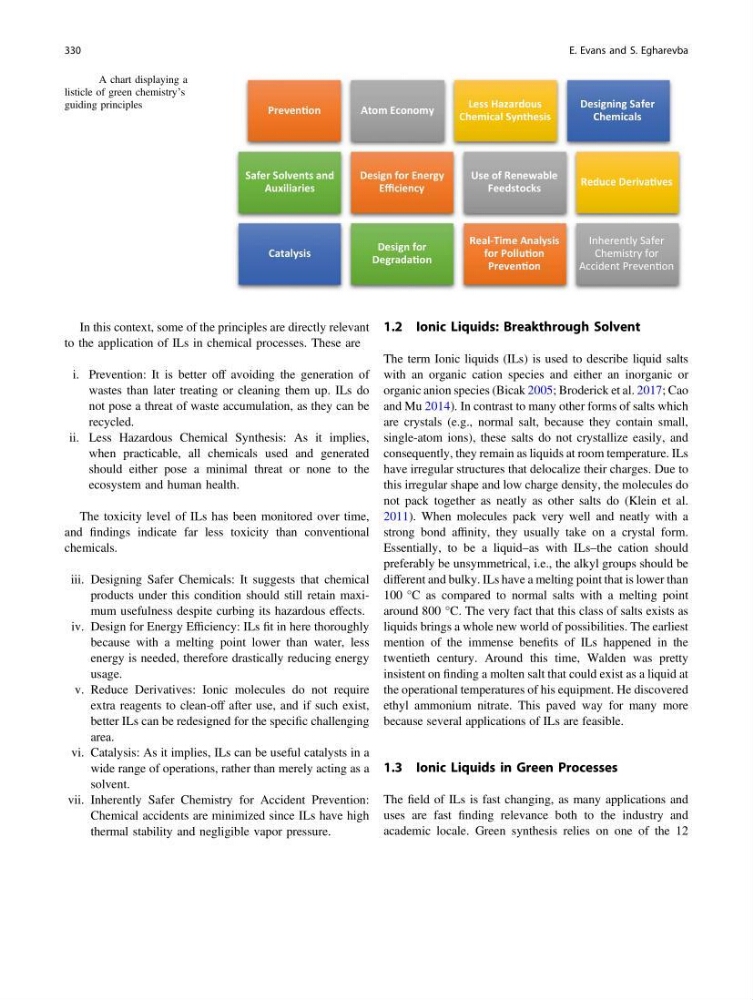
In this context, some of the principles are directly relevant
to the application of ILs in chemical processes. These are
i. Prevention: It is better off avoiding the generation of
wastes than later treating or cleaning them up. ILs do
not pose a threat of waste accumulation, as they can be
recycled.
ii. Less Hazardous Chemical Synthesis: As it implies,
when practicable, all chemicals used and generated
should either pose a minimal threat or none to the
ecosystem and human health.
The toxicity level of ILs has been monitored over time,
and findings indicate far less toxicity than conventional
chemicals.
iii. Designing Safer Chemicals: It suggests that chemical
products under this condition should still retain maximum usefulness despite curbing its hazardous effects.
iv. Design for Energy Efficiency: ILs fit in here thoroughly
because with a melting point lower than water, less
energy is needed, therefore drastically reducing energy
usage.
v. Reduce Derivatives: Ionic molecules do not require
extra reagents to clean-off after use, and if such exist,
better ILs can be redesigned for the specific challenging
area.
vi. Catalysis: As it implies, ILs can be useful catalysts in a
wide range of operations, rather than merely acting as a
solvent.
vii. Inherently Safer Chemistry for Accident Prevention:
Chemical accidents are minimized since ILs have high
thermal stability and negligible vapor pressure.
1.2 Ionic Liquids: Breakthrough Solvent
The term Ionic liquids (ILs) is used to describe liquid salts
with an organic cation species and either an inorganic or
organic anion species (Bicak 2005; Broderick et al. 2017; Cao
and Mu 2014). In contrast to many other forms of salts which
are crystals (e.g., normal salt, because they contain small,
single-atom ions), these salts do not crystallize easily, and
consequently, they remain as liquids at room temperature. ILs
have irregular structures that delocalize their charges. Due to
this irregular shape and low charge density, the molecules do
not pack together as neatly as other salts do (Klein et al.
2011). When molecules pack very well and neatly with a
strong bond affinity, they usually take on a crystal form.
Essentially, to be a liquid–as with ILs–the cation should
preferably be unsymmetrical, i.e., the alkyl groups should be
different and bulky. ILs have a melting point that is lower than
100 °C as compared to normal salts with a melting point
around 800 °C. The very fact that this class of salts exists as
liquids brings a whole new world of possibilities. The earliest
mention of the immense benefits of ILs happened in the
twentieth century. Around this time, Walden was pretty
insistent on finding a molten salt that could exist as a liquid at
the operational temperatures of his equipment. He discovered
ethyl ammonium nitrate. This paved way for many more
because several applications of ILs are feasible.
1.3 Ionic Liquids in Green Processes
The field of ILs is fast changing, as many applications and
uses are fast finding relevance both to the industry and
academic locale. Green synthesis relies on one of the 12
Prevenon
Atom Economy
Less Hazardous
Chemical Synthesis
Designing Safer
Chemicals
Safer Solvents and
Auxiliaries
Design for Energy
Efficiency
Use of Renewable
Feedstocks
Reduce Derivaves
Catalysis
Design for
Degradaon
Real-Time Analysis
for Polluon
Prevenon
Inherently Safer
Chemistry for
Accident PrevenƟon
Fig. 1 A chart displaying a
listicle of green chemistry’s
guiding principles
330
E. Evans and S. Egharevba
to the application of ILs in chemical processes. These are
i. Prevention: It is better off avoiding the generation of
wastes than later treating or cleaning them up. ILs do
not pose a threat of waste accumulation, as they can be
recycled.
ii. Less Hazardous Chemical Synthesis: As it implies,
when practicable, all chemicals used and generated
should either pose a minimal threat or none to the
ecosystem and human health.
The toxicity level of ILs has been monitored over time,
and findings indicate far less toxicity than conventional
chemicals.
iii. Designing Safer Chemicals: It suggests that chemical
products under this condition should still retain maximum usefulness despite curbing its hazardous effects.
iv. Design for Energy Efficiency: ILs fit in here thoroughly
because with a melting point lower than water, less
energy is needed, therefore drastically reducing energy
usage.
v. Reduce Derivatives: Ionic molecules do not require
extra reagents to clean-off after use, and if such exist,
better ILs can be redesigned for the specific challenging
area.
vi. Catalysis: As it implies, ILs can be useful catalysts in a
wide range of operations, rather than merely acting as a
solvent.
vii. Inherently Safer Chemistry for Accident Prevention:
Chemical accidents are minimized since ILs have high
thermal stability and negligible vapor pressure.
1.2 Ionic Liquids: Breakthrough Solvent
The term Ionic liquids (ILs) is used to describe liquid salts
with an organic cation species and either an inorganic or
organic anion species (Bicak 2005; Broderick et al. 2017; Cao
and Mu 2014). In contrast to many other forms of salts which
are crystals (e.g., normal salt, because they contain small,
single-atom ions), these salts do not crystallize easily, and
consequently, they remain as liquids at room temperature. ILs
have irregular structures that delocalize their charges. Due to
this irregular shape and low charge density, the molecules do
not pack together as neatly as other salts do (Klein et al.
2011). When molecules pack very well and neatly with a
strong bond affinity, they usually take on a crystal form.
Essentially, to be a liquid–as with ILs–the cation should
preferably be unsymmetrical, i.e., the alkyl groups should be
different and bulky. ILs have a melting point that is lower than
100 °C as compared to normal salts with a melting point
around 800 °C. The very fact that this class of salts exists as
liquids brings a whole new world of possibilities. The earliest
mention of the immense benefits of ILs happened in the
twentieth century. Around this time, Walden was pretty
insistent on finding a molten salt that could exist as a liquid at
the operational temperatures of his equipment. He discovered
ethyl ammonium nitrate. This paved way for many more
because several applications of ILs are feasible.
1.3 Ionic Liquids in Green Processes
The field of ILs is fast changing, as many applications and
uses are fast finding relevance both to the industry and
academic locale. Green synthesis relies on one of the 12
Prevenon
Atom Economy
Less Hazardous
Chemical Synthesis
Designing Safer
Chemicals
Safer Solvents and
Auxiliaries
Design for Energy
Efficiency
Use of Renewable
Feedstocks
Reduce Derivaves
Catalysis
Design for
Degradaon
Real-Time Analysis
for Polluon
Prevenon
Inherently Safer
Chemistry for
Accident PrevenƟon
Fig. 1 A chart displaying a
listicle of green chemistry’s
guiding principles
330
E. Evans and S. Egharevba