

separately. This will incur more cost for reactor design. The
fermentable sugars produced from the hydrolysis are not
usually utilized immediately, thereby leading to their accumulation resulting in end-product inhibition. Simultaneous
saccharification fermentation integrates the hydrolysis process with the fermentation process to produce hydrogen gas.
The fermentable sugars produced from the hydrolysis process are immediately utilized by the hydrogen-producing
bacteria. This process is carried out in the same reactor
hence; it requires simple reactor design with lesser cost when
compared to separate hydrolysis and fermentation process.
The complexity of hemicelluloses needs a combined
effort of endo-enzymes (which cleaves internally the major
chain), exo-enzymes (which releases monomeric sugars) and
supplementary enzymes (which cleaves the lateral chains of
the polymers or associated oligosaccharides), which results
in the release of various mono- and disaccharides depending
on hemicellulose type (Wagner 2013). Hemicellulase is the
general name for the group of enzymes that helps in conversion of hemicelluloses to its constituent sugars (such as
D-xylose, D-mannose, L-arabinose) by breaking the
polymeric chains within its structure. Examples of such
enzymes include endo-1, 4-xylanase, xylan 1,4-ß-xylosidase. Hydrolysis of lignocellulosic biomass generates products like hexoses (such as glucose) and pentose (such as
xylose) sugars. Xylose is the chief pentose sugar gotten from
hydrolysis of hemicellulose representing about 80% of total
sugar (Canilha et al. 2013); this sugar undergoes the fermentation process to produce hydrogen gas. Theoretically,
fermenting xylose sugar results in 3.33 mol of hydrogen per
mole of xylose if acetate is generated or it can yield 1.66 mol
of hydrogen gas per mole of xylose when butyrate is generated (Reginatto and Antônio 2015). Hydrogen can be
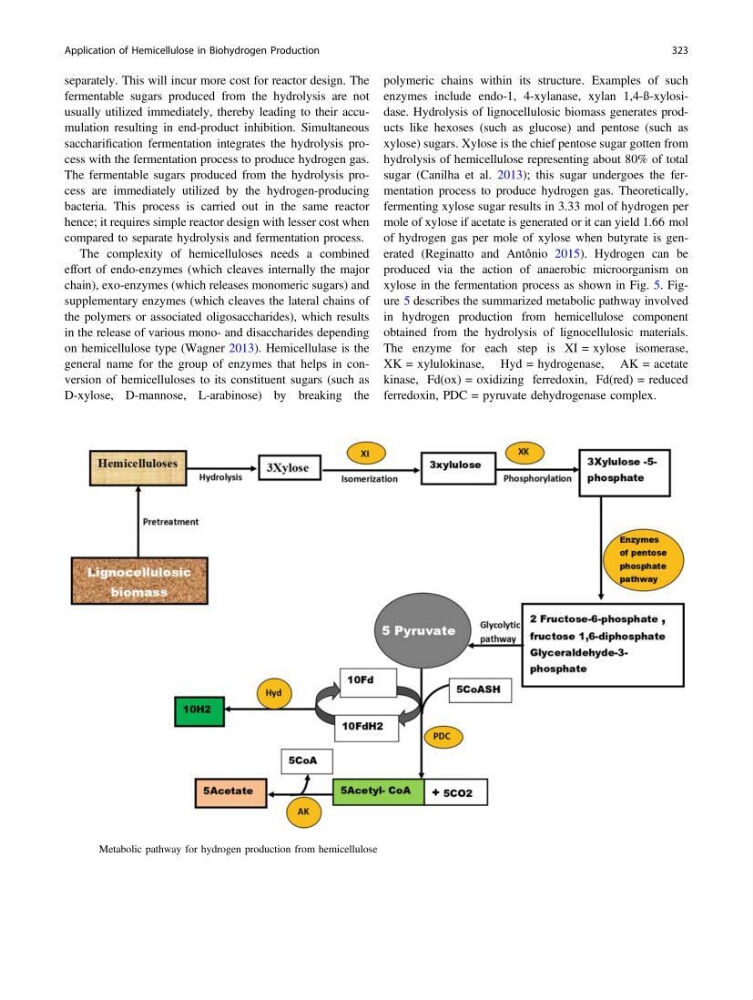
produced via the action of anaerobic microorganism on
xylose in the fermentation process as shown in Fig. 5. Figure 5 describes the summarized metabolic pathway involved
in hydrogen production from hemicellulose component
obtained from the hydrolysis of lignocellulosic materials.
The enzyme for each step is XI = xylose isomerase,
XK = xylulokinase, Hyd = hydrogenase, AK = acetate
kinase, Fd(ox) = oxidizing ferredoxin, Fd(red) = reduced
ferredoxin, PDC = pyruvate dehydrogenase complex.
Fig. 5 Metabolic pathway for hydrogen production from hemicellulose
Application of Hemicellulose in Biohydrogen Production
323
fermentable sugars produced from the hydrolysis are not
usually utilized immediately, thereby leading to their accumulation resulting in end-product inhibition. Simultaneous
saccharification fermentation integrates the hydrolysis process with the fermentation process to produce hydrogen gas.
The fermentable sugars produced from the hydrolysis process are immediately utilized by the hydrogen-producing
bacteria. This process is carried out in the same reactor
hence; it requires simple reactor design with lesser cost when
compared to separate hydrolysis and fermentation process.
The complexity of hemicelluloses needs a combined
effort of endo-enzymes (which cleaves internally the major
chain), exo-enzymes (which releases monomeric sugars) and
supplementary enzymes (which cleaves the lateral chains of
the polymers or associated oligosaccharides), which results
in the release of various mono- and disaccharides depending
on hemicellulose type (Wagner 2013). Hemicellulase is the
general name for the group of enzymes that helps in conversion of hemicelluloses to its constituent sugars (such as
D-xylose, D-mannose, L-arabinose) by breaking the
polymeric chains within its structure. Examples of such
enzymes include endo-1, 4-xylanase, xylan 1,4-ß-xylosidase. Hydrolysis of lignocellulosic biomass generates products like hexoses (such as glucose) and pentose (such as
xylose) sugars. Xylose is the chief pentose sugar gotten from
hydrolysis of hemicellulose representing about 80% of total
sugar (Canilha et al. 2013); this sugar undergoes the fermentation process to produce hydrogen gas. Theoretically,
fermenting xylose sugar results in 3.33 mol of hydrogen per
mole of xylose if acetate is generated or it can yield 1.66 mol
of hydrogen gas per mole of xylose when butyrate is generated (Reginatto and Antônio 2015). Hydrogen can be
produced via the action of anaerobic microorganism on
xylose in the fermentation process as shown in Fig. 5. Figure 5 describes the summarized metabolic pathway involved
in hydrogen production from hemicellulose component
obtained from the hydrolysis of lignocellulosic materials.
The enzyme for each step is XI = xylose isomerase,
XK = xylulokinase, Hyd = hydrogenase, AK = acetate
kinase, Fd(ox) = oxidizing ferredoxin, Fd(red) = reduced
ferredoxin, PDC = pyruvate dehydrogenase complex.
Fig. 5 Metabolic pathway for hydrogen production from hemicellulose
Application of Hemicellulose in Biohydrogen Production
323