

4.5 Gasification of Manures
Gasification is a process that uses heat for the conversion of
manure into a clean fuel gas. This is an endothermic procedure converting manure into a gas with low or medium
heat of combustion (Watson et al. 2018; Widjaya et al.
2018). It is achieved with various types of gasifiers such as
low-pressure gasifiers, fixed bed gasifiers and fluidized bed
gasifiers. There are numerous types of gasification processes
available; they depend on the type of biomass, manure or
any other matter (Watson et al. 2018; Widjaya et al. 2018).
The conversion of manure into a gas provides a remarkable
flexibility in the way that energy is being produced. The
gasification process can be completed in a fast way called
pyrolysis. This is a catalytic process in which volatile
components of the manure are vaporized during heating at a
temperature around 600 °C or more (Watson et al. 2018;
Widjaya et al. 2018). The char and ashes constitute the
non-vaporized by-products from pyrolysis. Char being the
fixed carbon fraction from pyrolysis can be gasified with
oxygen, steam and hydrogen after pyrolysis (Watson et al.
2018; Widjaya et al. 2018; Guo et al. 2020). A fraction of the
char which is not burned is finally burned to discharge the
heat needed for the endothermic reactions during gasification. Manure effluents present an opportunity to produce
clean and renewable fuels from the gasification process if the
relevant catalysts are used and the optimum operating conditions are established. Figure 10 summarizes the advantages and disadvantages of gasification of manure.
4.6 Methanol Production from Manure
Methanol is an alcohol made from natural gas, biomass or
organic matter. Biodegradable wastes including manure
constitute the raw material that can be converted to methanol. It is called biomethanol when made from these sources.
Methanol can be considered as a liquid fuel because it burns
much like gasoline. It is generally used as gasoline fuel
additives and in the manufacturing of many chemicals. It can
also be considered as a promising source of energy in the
transportation sector (fuel). Generally, methanol is produced from synthesis gas (syngas) which is a mixture of
CO, CO 2 and H 2 at 50–100 bar with temperature in the
range between 250 and 300 °C, using copper and zinc-based
catalysts or any other relevant catalysts. These catalysts are
already active at 200 °C and selective towards the formation
of H 2 and CO 2 . This is achieved through the anaerobic
digestion or gasification of the manure, biodegradable solid
wastes or any other feedstock (El-Mashad et al. 2011; Nanda
et al. 2016; Blug et al. 2014; Noor and Kamarudin 2014).
Briefly, the process is achieved in two stages: First, the
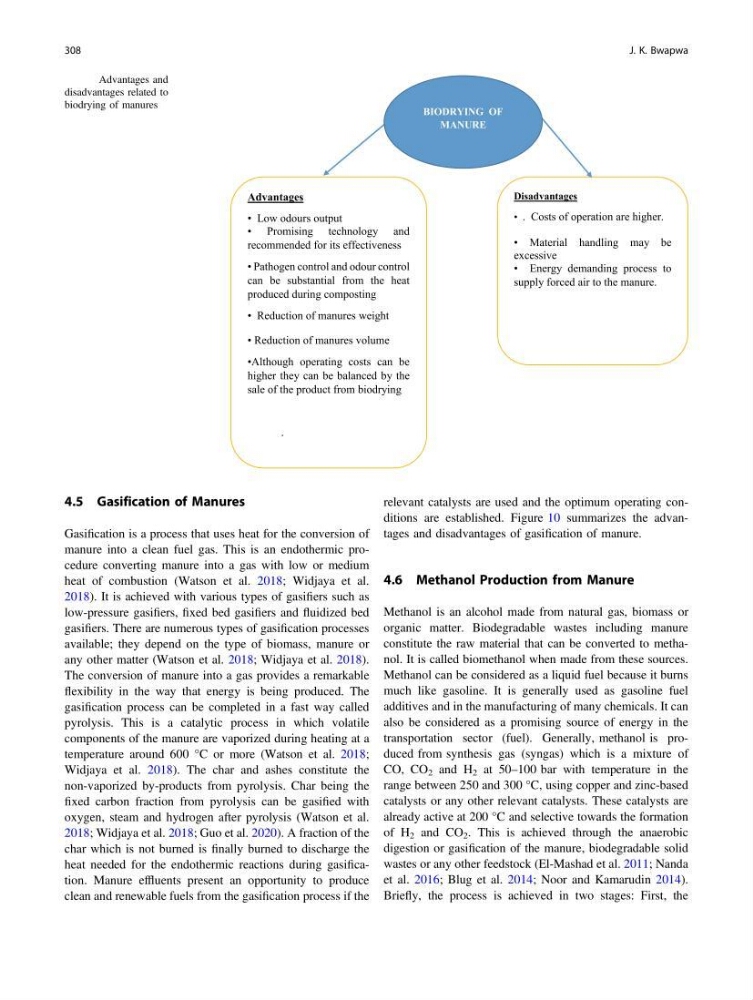
Fig. 9 Advantages and
disadvantages related to
biodrying of manures
308
J. K. Bwapwa
Gasification is a process that uses heat for the conversion of
manure into a clean fuel gas. This is an endothermic procedure converting manure into a gas with low or medium
heat of combustion (Watson et al. 2018; Widjaya et al.
2018). It is achieved with various types of gasifiers such as
low-pressure gasifiers, fixed bed gasifiers and fluidized bed
gasifiers. There are numerous types of gasification processes
available; they depend on the type of biomass, manure or
any other matter (Watson et al. 2018; Widjaya et al. 2018).
The conversion of manure into a gas provides a remarkable
flexibility in the way that energy is being produced. The
gasification process can be completed in a fast way called
pyrolysis. This is a catalytic process in which volatile
components of the manure are vaporized during heating at a
temperature around 600 °C or more (Watson et al. 2018;
Widjaya et al. 2018). The char and ashes constitute the
non-vaporized by-products from pyrolysis. Char being the
fixed carbon fraction from pyrolysis can be gasified with
oxygen, steam and hydrogen after pyrolysis (Watson et al.
2018; Widjaya et al. 2018; Guo et al. 2020). A fraction of the
char which is not burned is finally burned to discharge the
heat needed for the endothermic reactions during gasification. Manure effluents present an opportunity to produce
clean and renewable fuels from the gasification process if the
relevant catalysts are used and the optimum operating conditions are established. Figure 10 summarizes the advantages and disadvantages of gasification of manure.
4.6 Methanol Production from Manure
Methanol is an alcohol made from natural gas, biomass or
organic matter. Biodegradable wastes including manure
constitute the raw material that can be converted to methanol. It is called biomethanol when made from these sources.
Methanol can be considered as a liquid fuel because it burns
much like gasoline. It is generally used as gasoline fuel
additives and in the manufacturing of many chemicals. It can
also be considered as a promising source of energy in the
transportation sector (fuel). Generally, methanol is produced from synthesis gas (syngas) which is a mixture of
CO, CO 2 and H 2 at 50–100 bar with temperature in the
range between 250 and 300 °C, using copper and zinc-based
catalysts or any other relevant catalysts. These catalysts are
already active at 200 °C and selective towards the formation
of H 2 and CO 2 . This is achieved through the anaerobic
digestion or gasification of the manure, biodegradable solid
wastes or any other feedstock (El-Mashad et al. 2011; Nanda
et al. 2016; Blug et al. 2014; Noor and Kamarudin 2014).
Briefly, the process is achieved in two stages: First, the
Fig. 9 Advantages and
disadvantages related to
biodrying of manures
308
J. K. Bwapwa