

Extrusion process is completed after pasteurization in order
to convert new manure into a dry one without pathogens and
to handle it easily; this is a final product that may serve as a
fertilizer, amendment of soils, additive to animal feed or
energy applications (USPEA 1998). Finally, compaction of
manure under well-defined operating conditions at higher
pressure and temperature is undertaken; this is followed by a
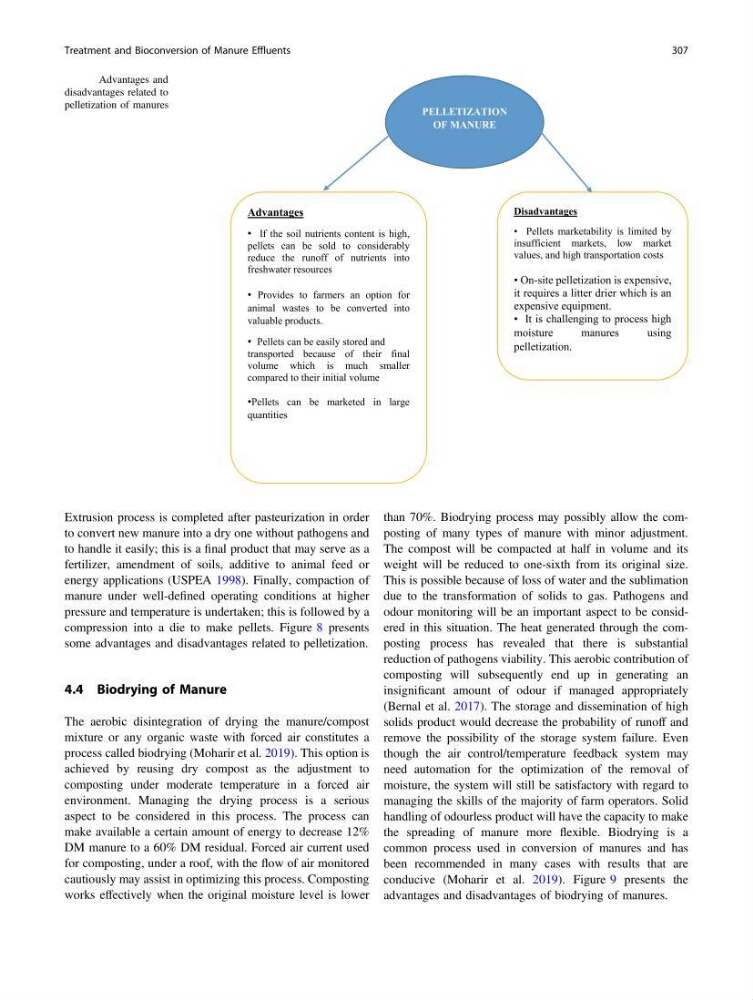
compression into a die to make pellets. Figure 8 presents
some advantages and disadvantages related to pelletization.
4.4 Biodrying of Manure
The aerobic disintegration of drying the manure/compost
mixture or any organic waste with forced air constitutes a
process called biodrying (Moharir et al. 2019). This option is
achieved by reusing dry compost as the adjustment to
composting under moderate temperature in a forced air
environment. Managing the drying process is a serious
aspect to be considered in this process. The process can
make available a certain amount of energy to decrease 12%
DM manure to a 60% DM residual. Forced air current used
for composting, under a roof, with the flow of air monitored
cautiously may assist in optimizing this process. Composting
works effectively when the original moisture level is lower
than 70%. Biodrying process may possibly allow the composting of many types of manure with minor adjustment.
The compost will be compacted at half in volume and its
weight will be reduced to one-sixth from its original size.
This is possible because of loss of water and the sublimation
due to the transformation of solids to gas. Pathogens and
odour monitoring will be an important aspect to be considered in this situation. The heat generated through the composting process has revealed that there is substantial
reduction of pathogens viability. This aerobic contribution of
composting will subsequently end up in generating an
insignificant amount of odour if managed appropriately
(Bernal et al. 2017). The storage and dissemination of high
solids product would decrease the probability of runoff and
remove the possibility of the storage system failure. Even
though the air control/temperature feedback system may
need automation for the optimization of the removal of
moisture, the system will still be satisfactory with regard to
managing the skills of the majority of farm operators. Solid
handling of odourless product will have the capacity to make
the spreading of manure more flexible. Biodrying is a
common process used in conversion of manures and has
been recommended in many cases with results that are
conducive (Moharir et al. 2019). Figure 9 presents the
advantages and disadvantages of biodrying of manures.
Fig. 8 Advantages and
disadvantages related to
pelletization of manures
Treatment and Bioconversion of Manure Effluents
307
to convert new manure into a dry one without pathogens and
to handle it easily; this is a final product that may serve as a
fertilizer, amendment of soils, additive to animal feed or
energy applications (USPEA 1998). Finally, compaction of
manure under well-defined operating conditions at higher
pressure and temperature is undertaken; this is followed by a
compression into a die to make pellets. Figure 8 presents
some advantages and disadvantages related to pelletization.
4.4 Biodrying of Manure
The aerobic disintegration of drying the manure/compost
mixture or any organic waste with forced air constitutes a
process called biodrying (Moharir et al. 2019). This option is
achieved by reusing dry compost as the adjustment to
composting under moderate temperature in a forced air
environment. Managing the drying process is a serious
aspect to be considered in this process. The process can
make available a certain amount of energy to decrease 12%
DM manure to a 60% DM residual. Forced air current used
for composting, under a roof, with the flow of air monitored
cautiously may assist in optimizing this process. Composting
works effectively when the original moisture level is lower
than 70%. Biodrying process may possibly allow the composting of many types of manure with minor adjustment.
The compost will be compacted at half in volume and its
weight will be reduced to one-sixth from its original size.
This is possible because of loss of water and the sublimation
due to the transformation of solids to gas. Pathogens and
odour monitoring will be an important aspect to be considered in this situation. The heat generated through the composting process has revealed that there is substantial
reduction of pathogens viability. This aerobic contribution of
composting will subsequently end up in generating an
insignificant amount of odour if managed appropriately
(Bernal et al. 2017). The storage and dissemination of high
solids product would decrease the probability of runoff and
remove the possibility of the storage system failure. Even
though the air control/temperature feedback system may
need automation for the optimization of the removal of
moisture, the system will still be satisfactory with regard to
managing the skills of the majority of farm operators. Solid
handling of odourless product will have the capacity to make
the spreading of manure more flexible. Biodrying is a
common process used in conversion of manures and has
been recommended in many cases with results that are
conducive (Moharir et al. 2019). Figure 9 presents the
advantages and disadvantages of biodrying of manures.
Fig. 8 Advantages and
disadvantages related to
pelletization of manures
Treatment and Bioconversion of Manure Effluents
307