

manures with high moisture content. This condition can be
removed with the use of solids separation technology. The
final product which is the compost is known to be odourless
with little moisture percentage, and a fine textured substance
may be used as a fertilizer or used in nurseries and gardens
(UNL 1998). It is also an important source of N 2 , organic
molecules and nutrients. Nitrogen (N 2 ) in compost is not
freely accessible as it is the case of N 2 in manure effluents.
Furthermore, the levels of K, P, and micronutrients in the
compost are equal to or greater than the one in manure
effluents. The most important factors influencing the composting rate and its effectiveness are described as follows:
carbon to nitrogen (C:N) ratio, water content, temperature,
aeration rate and the physical texture of organic matter
representing the particle size. The optimum temperature for
composting is around 56 °C. Despite the fact that the internal
part of the pile may normally reach this temperature, the
external part does not. Consequently, the pile must be mixed
as mentioned before to ensure the effectiveness of manure
composting (Purdue 1994). Moisture is a key factor requiring maintenance for optimal composting. At higher levels of
moisture, cavities are packed with liquids and subsequently
preventing aeration. Therefore, drying is from time to time
indispensable. This helps in getting an optimum moisture
percentage and eventually raising the effectiveness of composting (Purdue 1994). The addition of a bulking ingredient
may assist in reducing moisture (UNL 1998). At lower levels
of moisture, the microbial action is delayed or prevented.
The C:N ratio is fundamental in order to ensure that the
needed quantities of C and N 2 are accessible for microorganisms because they use carbon as a source of energy and
nitrogen as a nutrients source. In the event the ratio C:N is
smaller than 20:1, N 2 will outflow as NH 3 ; in case the
amount of carbon is higher, the biodegradation rate may
decline (Purdue 1994). The ideal ratio should be 30:1; the
optimum C:N ratio should be maintained to stop the loss of
N 2 and to make sure that composting process can be fast
(Purdue 1994). Aeration is an important process because it
helps maintain effective composting. The biodegradation
rate is higher with small particles due to the fact that they
have a large surface area providing living organisms with
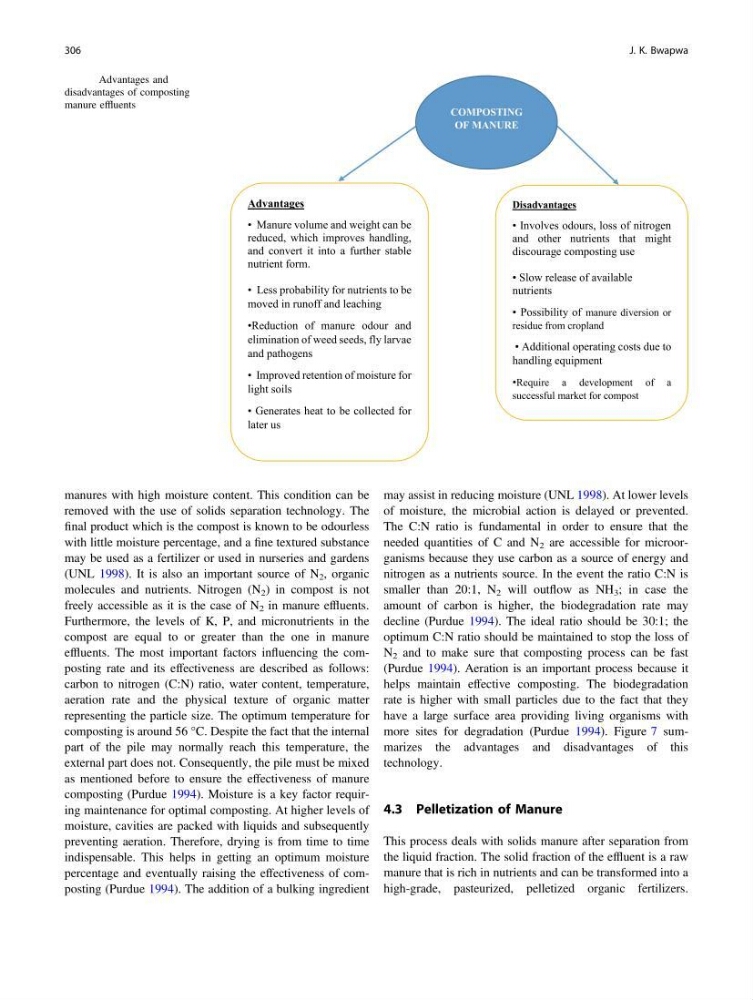
more sites for degradation (Purdue 1994). Figure 7 summarizes the advantages and disadvantages of this
technology.
4.3 Pelletization of Manure
This process deals with solids manure after separation from
the liquid fraction. The solid fraction of the effluent is a raw
manure that is rich in nutrients and can be transformed into a
high-grade, pasteurized, pelletized organic fertilizers.
Fig. 7 Advantages and
disadvantages of composting
manure effluents
306
J. K. Bwapwa
removed with the use of solids separation technology. The
final product which is the compost is known to be odourless
with little moisture percentage, and a fine textured substance
may be used as a fertilizer or used in nurseries and gardens
(UNL 1998). It is also an important source of N 2 , organic
molecules and nutrients. Nitrogen (N 2 ) in compost is not
freely accessible as it is the case of N 2 in manure effluents.
Furthermore, the levels of K, P, and micronutrients in the
compost are equal to or greater than the one in manure
effluents. The most important factors influencing the composting rate and its effectiveness are described as follows:
carbon to nitrogen (C:N) ratio, water content, temperature,
aeration rate and the physical texture of organic matter
representing the particle size. The optimum temperature for
composting is around 56 °C. Despite the fact that the internal
part of the pile may normally reach this temperature, the
external part does not. Consequently, the pile must be mixed
as mentioned before to ensure the effectiveness of manure
composting (Purdue 1994). Moisture is a key factor requiring maintenance for optimal composting. At higher levels of
moisture, cavities are packed with liquids and subsequently
preventing aeration. Therefore, drying is from time to time
indispensable. This helps in getting an optimum moisture
percentage and eventually raising the effectiveness of composting (Purdue 1994). The addition of a bulking ingredient
may assist in reducing moisture (UNL 1998). At lower levels
of moisture, the microbial action is delayed or prevented.
The C:N ratio is fundamental in order to ensure that the
needed quantities of C and N 2 are accessible for microorganisms because they use carbon as a source of energy and
nitrogen as a nutrients source. In the event the ratio C:N is
smaller than 20:1, N 2 will outflow as NH 3 ; in case the
amount of carbon is higher, the biodegradation rate may
decline (Purdue 1994). The ideal ratio should be 30:1; the
optimum C:N ratio should be maintained to stop the loss of
N 2 and to make sure that composting process can be fast
(Purdue 1994). Aeration is an important process because it
helps maintain effective composting. The biodegradation
rate is higher with small particles due to the fact that they
have a large surface area providing living organisms with
more sites for degradation (Purdue 1994). Figure 7 summarizes the advantages and disadvantages of this
technology.
4.3 Pelletization of Manure
This process deals with solids manure after separation from
the liquid fraction. The solid fraction of the effluent is a raw
manure that is rich in nutrients and can be transformed into a
high-grade, pasteurized, pelletized organic fertilizers.
Fig. 7 Advantages and
disadvantages of composting
manure effluents
306
J. K. Bwapwa