

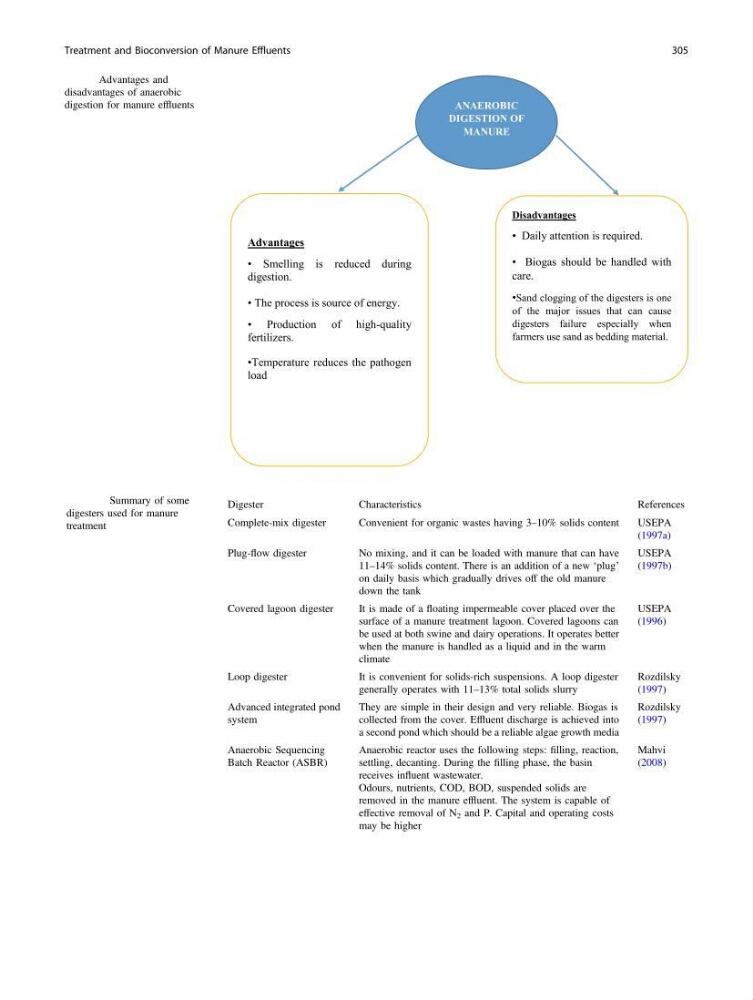
Fig. 6 Advantages and
disadvantages of anaerobic
digestion for manure effluents
Table 1 Summary of some
digesters used for manure
treatment
Digester
Characteristics
References
Complete-mix digester
Convenient for organic wastes having 3–10% solids content
USEPA
(1997a)
Plug-flow digester
No mixing, and it can be loaded with manure that can have
11–14% solids content. There is an addition of a new ‘plug’
on daily basis which gradually drives off the old manure
down the tank
USEPA
(1997b)
Covered lagoon digester
It is made of a floating impermeable cover placed over the
surface of a manure treatment lagoon. Covered lagoons can
be used at both swine and dairy operations. It operates better
when the manure is handled as a liquid and in the warm
climate
USEPA
(1996)
Loop digester
It is convenient for solids-rich suspensions. A loop digester
generally operates with 11–13% total solids slurry
Rozdilsky
(1997)
Advanced integrated pond
system
They are simple in their design and very reliable. Biogas is
collected from the cover. Effluent discharge is achieved into
a second pond which should be a reliable algae growth media
Rozdilsky
(1997)
Anaerobic Sequencing
Batch Reactor (ASBR)
Anaerobic reactor uses the following steps: filling, reaction,
settling, decanting. During the filling phase, the basin
receives influent wastewater.
Odours, nutrients, COD, BOD, suspended solids are
removed in the manure effluent. The system is capable of
effective removal of N 2 and P. Capital and operating costs
may be higher
Mahvi
(2008)
Treatment and Bioconversion of Manure Effluents
305
disadvantages of anaerobic
digestion for manure effluents
Table 1 Summary of some
digesters used for manure
treatment
Digester
Characteristics
References
Complete-mix digester
Convenient for organic wastes having 3–10% solids content
USEPA
(1997a)
Plug-flow digester
No mixing, and it can be loaded with manure that can have
11–14% solids content. There is an addition of a new ‘plug’
on daily basis which gradually drives off the old manure
down the tank
USEPA
(1997b)
Covered lagoon digester
It is made of a floating impermeable cover placed over the
surface of a manure treatment lagoon. Covered lagoons can
be used at both swine and dairy operations. It operates better
when the manure is handled as a liquid and in the warm
climate
USEPA
(1996)
Loop digester
It is convenient for solids-rich suspensions. A loop digester
generally operates with 11–13% total solids slurry
Rozdilsky
(1997)
Advanced integrated pond
system
They are simple in their design and very reliable. Biogas is
collected from the cover. Effluent discharge is achieved into
a second pond which should be a reliable algae growth media
Rozdilsky
(1997)
Anaerobic Sequencing
Batch Reactor (ASBR)
Anaerobic reactor uses the following steps: filling, reaction,
settling, decanting. During the filling phase, the basin
receives influent wastewater.
Odours, nutrients, COD, BOD, suspended solids are
removed in the manure effluent. The system is capable of
effective removal of N 2 and P. Capital and operating costs
may be higher
Mahvi
(2008)
Treatment and Bioconversion of Manure Effluents
305