

3 Property Characterizations of Bioplastics
Produced from Food Waste
Modern society has developed increasingly sustainable products, given the great concern for the waste disposal in the
environment (Freitas Netto et al. 2020). Bioplastics developed
from natural resources, e.g., cellulose, chitin, and starch, are
viable substitutes for nonrenewable polymers, with advantages, for example, biodegradability, biocompatibility, few
toxicity, and cost (Hossain et al. 2018). However, biopolymer
technology is not yet fully developed, and some parameters,
e.g., mechanical properties and adaptations to industrial processes must be improved (Santos and Tavares 2015).
Bioplastics are formed by changing biopolymers structures
(Chen and Patel 2012). Starches (polysaccharides) of tuberous
roots, such as cassava, carrots, and potatoes or cereals (corn,
soy, and rice) mixed with vegetable residues (coconut fiber,
wood sawdust, and cassava peel), and common thermoplastics
are based on many bioplastics (Rosa et al. 2001).
The complete characterization of bioplastics is critical as
these can potentially replace non-biodegradable materials for
packaging manufacturing. Essential parameters are described in biopackage studies.
3.1 General Characteristics of the Residues
Utilized
In this study, it is proposed using various residues (shrimp,
rice, and cassava husks, soybean residues, and natural fibers)
for the bioplastic production. Therefore, it is necessary to
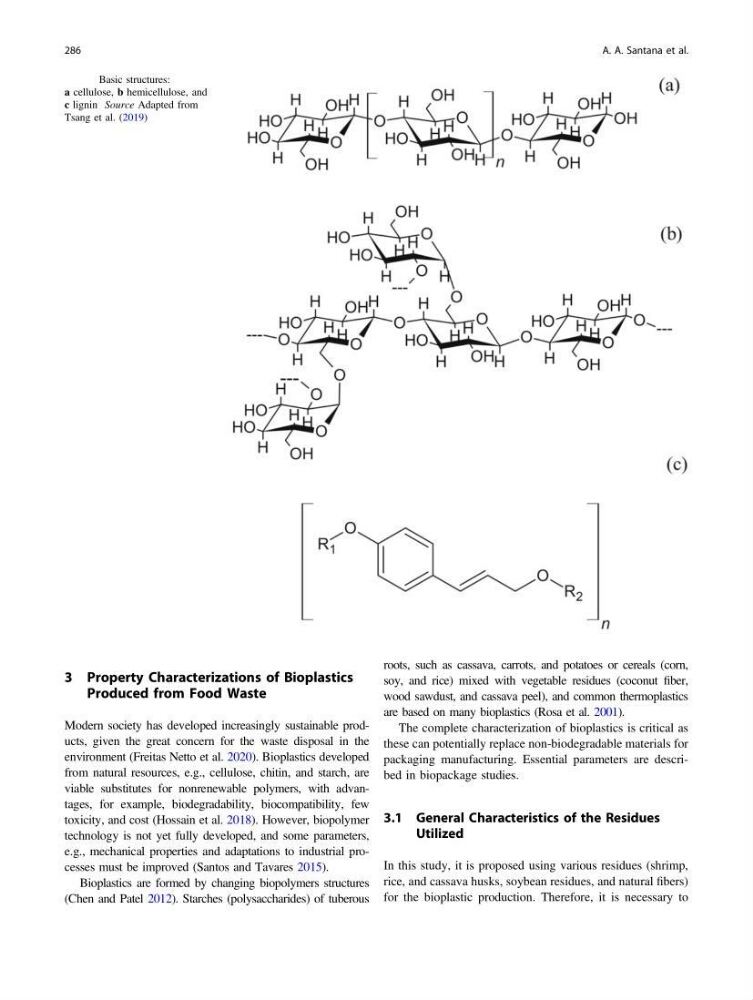
Fig. 4 Basic structures:
a cellulose, b hemicellulose, and
c lignin Source Adapted from
Tsang et al. (2019)
286
A. A. Santana et al.
Produced from Food Waste
Modern society has developed increasingly sustainable products, given the great concern for the waste disposal in the
environment (Freitas Netto et al. 2020). Bioplastics developed
from natural resources, e.g., cellulose, chitin, and starch, are
viable substitutes for nonrenewable polymers, with advantages, for example, biodegradability, biocompatibility, few
toxicity, and cost (Hossain et al. 2018). However, biopolymer
technology is not yet fully developed, and some parameters,
e.g., mechanical properties and adaptations to industrial processes must be improved (Santos and Tavares 2015).
Bioplastics are formed by changing biopolymers structures
(Chen and Patel 2012). Starches (polysaccharides) of tuberous
roots, such as cassava, carrots, and potatoes or cereals (corn,
soy, and rice) mixed with vegetable residues (coconut fiber,
wood sawdust, and cassava peel), and common thermoplastics
are based on many bioplastics (Rosa et al. 2001).
The complete characterization of bioplastics is critical as
these can potentially replace non-biodegradable materials for
packaging manufacturing. Essential parameters are described in biopackage studies.
3.1 General Characteristics of the Residues
Utilized
In this study, it is proposed using various residues (shrimp,
rice, and cassava husks, soybean residues, and natural fibers)
for the bioplastic production. Therefore, it is necessary to
Fig. 4 Basic structures:
a cellulose, b hemicellulose, and
c lignin Source Adapted from
Tsang et al. (2019)
286
A. A. Santana et al.