

understand the fundamental characteristics of these residues,
which are widely discussed in the literature.
3.1.1 Husks of Shrimp, Rice, Cassava, Soybean
Residues, and Natural Fibers
Bioplastics, which are derived from biomasses, have gained
attention for the development of food packaging materials
(Shah et al. 2019). Chitosan is currently the most favored
biopolymers that may be attributed to their biocompatibility,
biodegradability, non-toxicity, antioxidant, antimicrobial,
and anticancer features (Wahid et al. 2019). Additionally, it
is a low-cost matter achieved from aquatic resources, such as
sea fruits rinds (Vilela et al. 2017; Xie et al. 2017). Chitin is
an essential structural biopolymer, which consists of a large
fraction of insects and crustaceous exoscaffold (Miteluț et al.
2015; Darbasi et al. 2017).
Cellulose-based bioplastics created through physicochemical modification or chemically modified cellulose is
commonly employed (Bilo et al. 2018). The cellulose utilized includes that from peanut husks, citrus fruit shells, and
corn straw. Fresh cellulose does not present the same
physicochemical characteristics as those of thermoplastics
(Tsang et al. 2019). However, these plastic features may be
added to cellulose fibers through some mechanical pretreatments. In addition, the esterification of the hydroxyl
groups with acid in the cellulosic structure ascertains the
bioplastic features, such as fluidity, resistance, and durability
that can be equivalent to those of the common plastics (Hps
et al. 2016).
Numerous studies (Paixão et al. 2019; Costa et al. 2017;
Mali et al. 2010; Batista et al. 2005; Bastioli 2005) have
been conducted to characterize the functional properties of
starch biofilms. According to Mali et al. (2010), starch is an
abundant feedstock worldwide, with many possibilities for
chemical, physical modification, genetic, and origin-resistant
film, and coatings applications. In addition, starch biofilms
have potential applications for the food, agricultural, and
pharmaceutical sectors, and in various sectors where
biodegradability is required (Batista et al. 2005; Bastioli
2005).
3.2 Technological Characterizations
of the Bioplastics Produced by Food
Residues
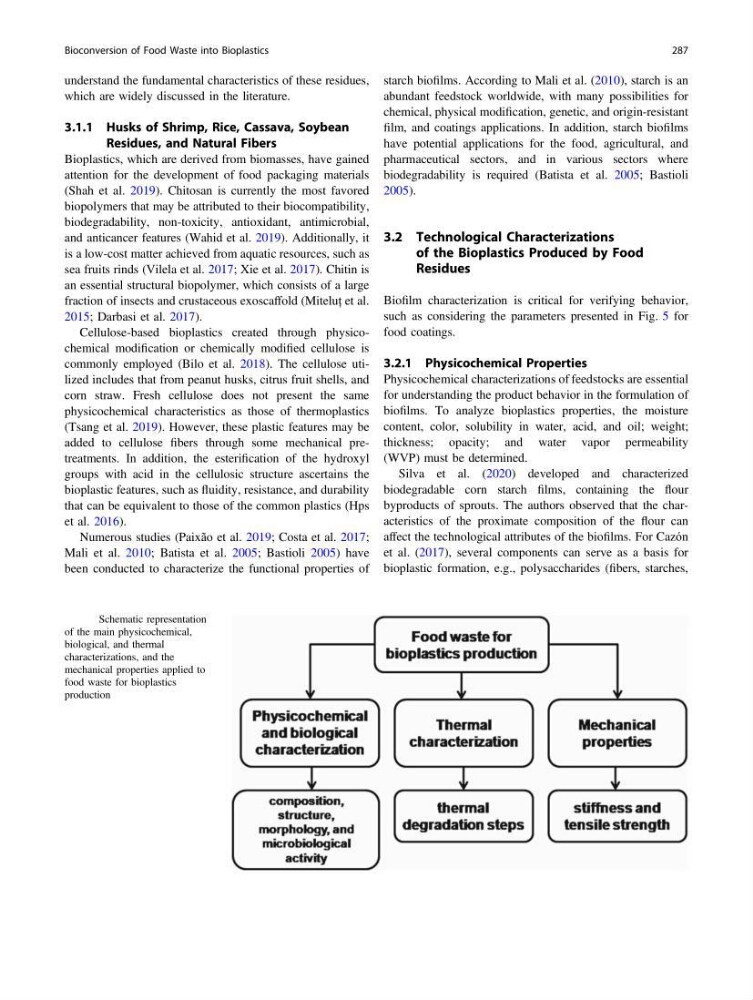
Biofilm characterization is critical for verifying behavior,
such as considering the parameters presented in Fig. 5 for
food coatings.
3.2.1 Physicochemical Properties
Physicochemical characterizations of feedstocks are essential
for understanding the product behavior in the formulation of
biofilms. To analyze bioplastics properties, the moisture
content, color, solubility in water, acid, and oil; weight;
thickness; opacity; and water vapor permeability
(WVP) must be determined.
Silva et al. (2020) developed and characterized
biodegradable corn starch films, containing the flour
byproducts of sprouts. The authors observed that the characteristics of the proximate composition of the flour can
affect the technological attributes of the biofilms. For Cazón
et al. (2017), several components can serve as a basis for
bioplastic formation, e.g., polysaccharides (fibers, starches,
Fig. 5 Schematic representation
of the main physicochemical,
biological, and thermal
characterizations, and the
mechanical properties applied to
food waste for bioplastics
production
Bioconversion of Food Waste into Bioplastics
287
which are widely discussed in the literature.
3.1.1 Husks of Shrimp, Rice, Cassava, Soybean
Residues, and Natural Fibers
Bioplastics, which are derived from biomasses, have gained
attention for the development of food packaging materials
(Shah et al. 2019). Chitosan is currently the most favored
biopolymers that may be attributed to their biocompatibility,
biodegradability, non-toxicity, antioxidant, antimicrobial,
and anticancer features (Wahid et al. 2019). Additionally, it
is a low-cost matter achieved from aquatic resources, such as
sea fruits rinds (Vilela et al. 2017; Xie et al. 2017). Chitin is
an essential structural biopolymer, which consists of a large
fraction of insects and crustaceous exoscaffold (Miteluț et al.
2015; Darbasi et al. 2017).
Cellulose-based bioplastics created through physicochemical modification or chemically modified cellulose is
commonly employed (Bilo et al. 2018). The cellulose utilized includes that from peanut husks, citrus fruit shells, and
corn straw. Fresh cellulose does not present the same
physicochemical characteristics as those of thermoplastics
(Tsang et al. 2019). However, these plastic features may be
added to cellulose fibers through some mechanical pretreatments. In addition, the esterification of the hydroxyl
groups with acid in the cellulosic structure ascertains the
bioplastic features, such as fluidity, resistance, and durability
that can be equivalent to those of the common plastics (Hps
et al. 2016).
Numerous studies (Paixão et al. 2019; Costa et al. 2017;
Mali et al. 2010; Batista et al. 2005; Bastioli 2005) have
been conducted to characterize the functional properties of
starch biofilms. According to Mali et al. (2010), starch is an
abundant feedstock worldwide, with many possibilities for
chemical, physical modification, genetic, and origin-resistant
film, and coatings applications. In addition, starch biofilms
have potential applications for the food, agricultural, and
pharmaceutical sectors, and in various sectors where
biodegradability is required (Batista et al. 2005; Bastioli
2005).
3.2 Technological Characterizations
of the Bioplastics Produced by Food
Residues
Biofilm characterization is critical for verifying behavior,
such as considering the parameters presented in Fig. 5 for
food coatings.
3.2.1 Physicochemical Properties
Physicochemical characterizations of feedstocks are essential
for understanding the product behavior in the formulation of
biofilms. To analyze bioplastics properties, the moisture
content, color, solubility in water, acid, and oil; weight;
thickness; opacity; and water vapor permeability
(WVP) must be determined.
Silva et al. (2020) developed and characterized
biodegradable corn starch films, containing the flour
byproducts of sprouts. The authors observed that the characteristics of the proximate composition of the flour can
affect the technological attributes of the biofilms. For Cazón
et al. (2017), several components can serve as a basis for
bioplastic formation, e.g., polysaccharides (fibers, starches,
Fig. 5 Schematic representation
of the main physicochemical,
biological, and thermal
characterizations, and the
mechanical properties applied to
food waste for bioplastics
production
Bioconversion of Food Waste into Bioplastics
287