

application of these charges generally has a better effect in
the micro- and nano-proportions. The fibers can be added to
matrices at these scales in a more controlled manner with
greater homogeneity. Technologies have been developed to
obtain these fibers as nano- or micro-charges either integrally or constituently (Paixão et al. 2019).
Fibrous residues from the different plants are available for
polymeric composite elaboration and bioplastic applications.
The fibers may be defined according to the portion of the
vegetable that these are extracted: fibers from the bark,
fibers, seeds, core, or reed. Bamboo, jute, kenaf, linen, sisal,
hemp, coconut, and sugarcane bagasse are the most commercialized fibers worldwide, especially, bamboo and sugarcane bagasse fibers, with 30 and 75 million tons traded
annually, respectively (Faruk et al. 2012).
The conditions of climate, weather, and vegetable cultivation influence not only the structure and morphology of
fibers, but also their chemical composition. The primary
plant fiber components are cellulose, lignin, and hemicellulose (Fig. 4). The variation of these components varies for
each vegetable; cellulose-rich fibers, such as kenaf, linen,
rice husk, and sisal are preferable for polymeric matrices
(Johar et al. 2012; Faruk et al. 2012).
Cellulose and lignin effect singular roles in the bioplastic
fabrication. Generally, cellulose enhances the mechanical
property of the bioplastics; however, lignin betters the
thermal stability, reduces the water uptake, and ensures the
sufficient dispersion of cellulose in the bioplastics (Ma et al.
2015; Yang et al. 2019). Both cellulose and lignin can affect
bioplastics Liu et al. (2014). Hemicellulose and lignin are
used as reinforcements in polylactic acid (PLA)-based bioplastics (Agustin-Salazar et al. 2018).
Various researches have related on the addition of natural
fibers to polymeric compositions according to their geographic
distributions and cultural employments worldwide (Pickering
et al. 2016; Väisänen et al. 2017; Müller et al. 2017).
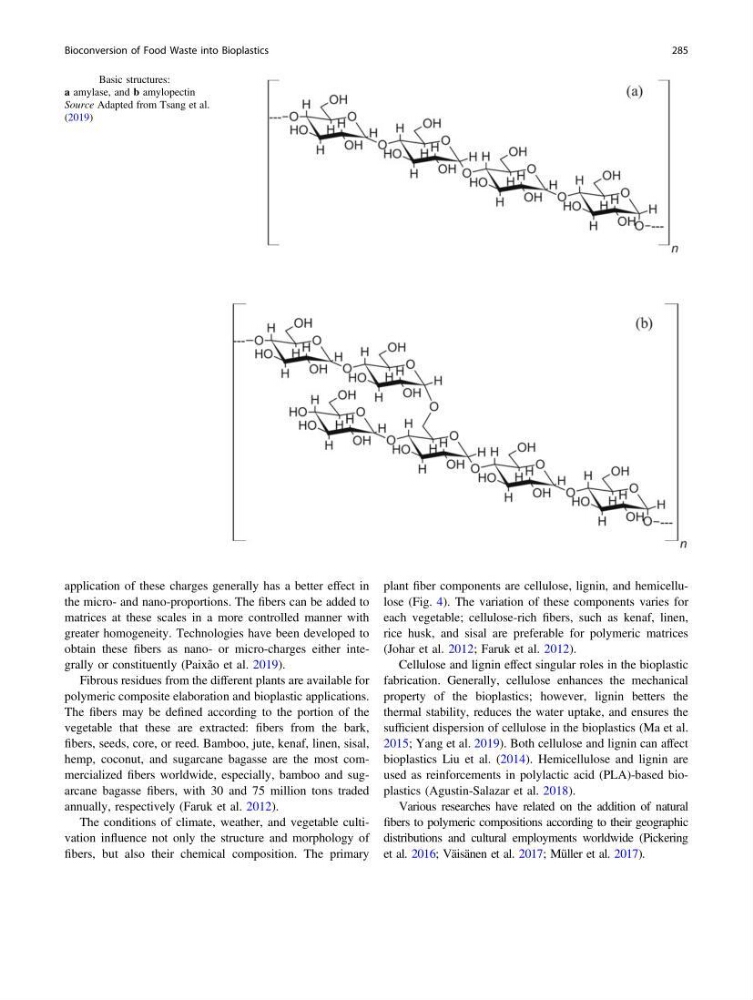
Fig. 3 Basic structures:
a amylase, and b amylopectin
Source Adapted from Tsang et al.
(2019)
Bioconversion of Food Waste into Bioplastics
285
the micro- and nano-proportions. The fibers can be added to
matrices at these scales in a more controlled manner with
greater homogeneity. Technologies have been developed to
obtain these fibers as nano- or micro-charges either integrally or constituently (Paixão et al. 2019).
Fibrous residues from the different plants are available for
polymeric composite elaboration and bioplastic applications.
The fibers may be defined according to the portion of the
vegetable that these are extracted: fibers from the bark,
fibers, seeds, core, or reed. Bamboo, jute, kenaf, linen, sisal,
hemp, coconut, and sugarcane bagasse are the most commercialized fibers worldwide, especially, bamboo and sugarcane bagasse fibers, with 30 and 75 million tons traded
annually, respectively (Faruk et al. 2012).
The conditions of climate, weather, and vegetable cultivation influence not only the structure and morphology of
fibers, but also their chemical composition. The primary
plant fiber components are cellulose, lignin, and hemicellulose (Fig. 4). The variation of these components varies for
each vegetable; cellulose-rich fibers, such as kenaf, linen,
rice husk, and sisal are preferable for polymeric matrices
(Johar et al. 2012; Faruk et al. 2012).
Cellulose and lignin effect singular roles in the bioplastic
fabrication. Generally, cellulose enhances the mechanical
property of the bioplastics; however, lignin betters the
thermal stability, reduces the water uptake, and ensures the
sufficient dispersion of cellulose in the bioplastics (Ma et al.
2015; Yang et al. 2019). Both cellulose and lignin can affect
bioplastics Liu et al. (2014). Hemicellulose and lignin are
used as reinforcements in polylactic acid (PLA)-based bioplastics (Agustin-Salazar et al. 2018).
Various researches have related on the addition of natural
fibers to polymeric compositions according to their geographic
distributions and cultural employments worldwide (Pickering
et al. 2016; Väisänen et al. 2017; Müller et al. 2017).
Fig. 3 Basic structures:
a amylase, and b amylopectin
Source Adapted from Tsang et al.
(2019)
Bioconversion of Food Waste into Bioplastics
285