

5.1 Thermochemical Routes for Hydrogen
Production from Biomass
Broadly, there are two ways of hydrogen production from
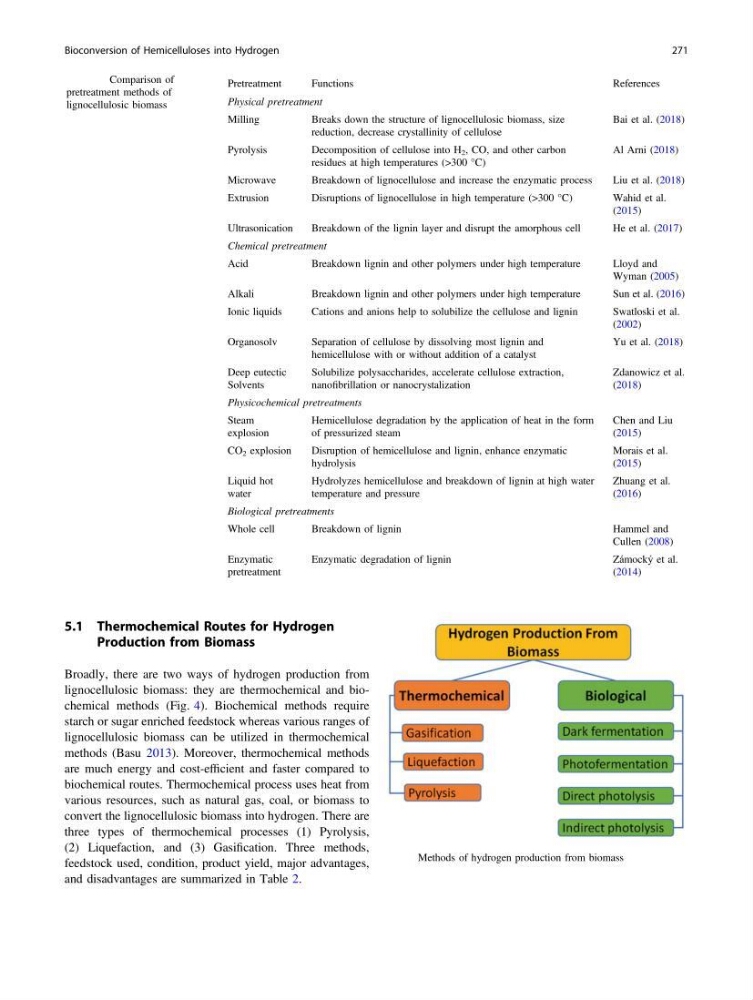
lignocellulosic biomass: they are thermochemical and biochemical methods (Fig. 4). Biochemical methods require
starch or sugar enriched feedstock whereas various ranges of
lignocellulosic biomass can be utilized in thermochemical
methods (Basu 2013). Moreover, thermochemical methods
are much energy and cost-efficient and faster compared to
biochemical routes. Thermochemical process uses heat from
various resources, such as natural gas, coal, or biomass to
convert the lignocellulosic biomass into hydrogen. There are
three types of thermochemical processes (1) Pyrolysis,
(2) Liquefaction, and (3) Gasification. Three methods,
feedstock used, condition, product yield, major advantages,
and disadvantages are summarized in Table 2.
Table 1 Comparison of
pretreatment methods of
lignocellulosic biomass
Pretreatment
Functions
References
Physical pretreatment
Milling
Breaks down the structure of lignocellulosic biomass, size
reduction, decrease crystallinity of cellulose
Bai et al. (2018)
Pyrolysis
Decomposition of cellulose into H 2 , CO, and other carbon
residues at high temperatures (>300 °C)
Al Arni (2018)
Microwave
Breakdown of lignocellulose and increase the enzymatic process
Liu et al. (2018)
Extrusion
Disruptions of lignocellulose in high temperature (>300 °C)
Wahid et al.
(2015)
Ultrasonication
Breakdown of the lignin layer and disrupt the amorphous cell
He et al. (2017)
Chemical pretreatment
Acid
Breakdown lignin and other polymers under high temperature
Lloyd and
Wyman (2005)
Alkali
Breakdown lignin and other polymers under high temperature
Sun et al. (2016)
Ionic liquids
Cations and anions help to solubilize the cellulose and lignin
Swatloski et al.
(2002)
Organosolv
Separation of cellulose by dissolving most lignin and
hemicellulose with or without addition of a catalyst
Yu et al. (2018)
Deep eutectic
Solvents
Solubilize polysaccharides, accelerate cellulose extraction,
nanofibrillation or nanocrystalization
Zdanowicz et al.
(2018)
Physicochemical pretreatments
Steam
explosion
Hemicellulose degradation by the application of heat in the form
of pressurized steam
Chen and Liu
(2015)
CO 2 explosion
Disruption of hemicellulose and lignin, enhance enzymatic
hydrolysis
Morais et al.
(2015)
Liquid hot
water
Hydrolyzes hemicellulose and breakdown of lignin at high water
temperature and pressure
Zhuang et al.
(2016)
Biological pretreatments
Whole cell
Breakdown of lignin
Hammel and
Cullen (2008)
Enzymatic
pretreatment
Enzymatic degradation of lignin
Zámocký et al.
(2014)
Fig. 4 Methods of hydrogen production from biomass
Bioconversion of Hemicelluloses into Hydrogen
271
Production from Biomass
Broadly, there are two ways of hydrogen production from
lignocellulosic biomass: they are thermochemical and biochemical methods (Fig. 4). Biochemical methods require
starch or sugar enriched feedstock whereas various ranges of
lignocellulosic biomass can be utilized in thermochemical
methods (Basu 2013). Moreover, thermochemical methods
are much energy and cost-efficient and faster compared to
biochemical routes. Thermochemical process uses heat from
various resources, such as natural gas, coal, or biomass to
convert the lignocellulosic biomass into hydrogen. There are
three types of thermochemical processes (1) Pyrolysis,
(2) Liquefaction, and (3) Gasification. Three methods,
feedstock used, condition, product yield, major advantages,
and disadvantages are summarized in Table 2.
Table 1 Comparison of
pretreatment methods of
lignocellulosic biomass
Pretreatment
Functions
References
Physical pretreatment
Milling
Breaks down the structure of lignocellulosic biomass, size
reduction, decrease crystallinity of cellulose
Bai et al. (2018)
Pyrolysis
Decomposition of cellulose into H 2 , CO, and other carbon
residues at high temperatures (>300 °C)
Al Arni (2018)
Microwave
Breakdown of lignocellulose and increase the enzymatic process
Liu et al. (2018)
Extrusion
Disruptions of lignocellulose in high temperature (>300 °C)
Wahid et al.
(2015)
Ultrasonication
Breakdown of the lignin layer and disrupt the amorphous cell
He et al. (2017)
Chemical pretreatment
Acid
Breakdown lignin and other polymers under high temperature
Lloyd and
Wyman (2005)
Alkali
Breakdown lignin and other polymers under high temperature
Sun et al. (2016)
Ionic liquids
Cations and anions help to solubilize the cellulose and lignin
Swatloski et al.
(2002)
Organosolv
Separation of cellulose by dissolving most lignin and
hemicellulose with or without addition of a catalyst
Yu et al. (2018)
Deep eutectic
Solvents
Solubilize polysaccharides, accelerate cellulose extraction,
nanofibrillation or nanocrystalization
Zdanowicz et al.
(2018)
Physicochemical pretreatments
Steam
explosion
Hemicellulose degradation by the application of heat in the form
of pressurized steam
Chen and Liu
(2015)
CO 2 explosion
Disruption of hemicellulose and lignin, enhance enzymatic
hydrolysis
Morais et al.
(2015)
Liquid hot
water
Hydrolyzes hemicellulose and breakdown of lignin at high water
temperature and pressure
Zhuang et al.
(2016)
Biological pretreatments
Whole cell
Breakdown of lignin
Hammel and
Cullen (2008)
Enzymatic
pretreatment
Enzymatic degradation of lignin
Zámocký et al.
(2014)
Fig. 4 Methods of hydrogen production from biomass
Bioconversion of Hemicelluloses into Hydrogen
271