

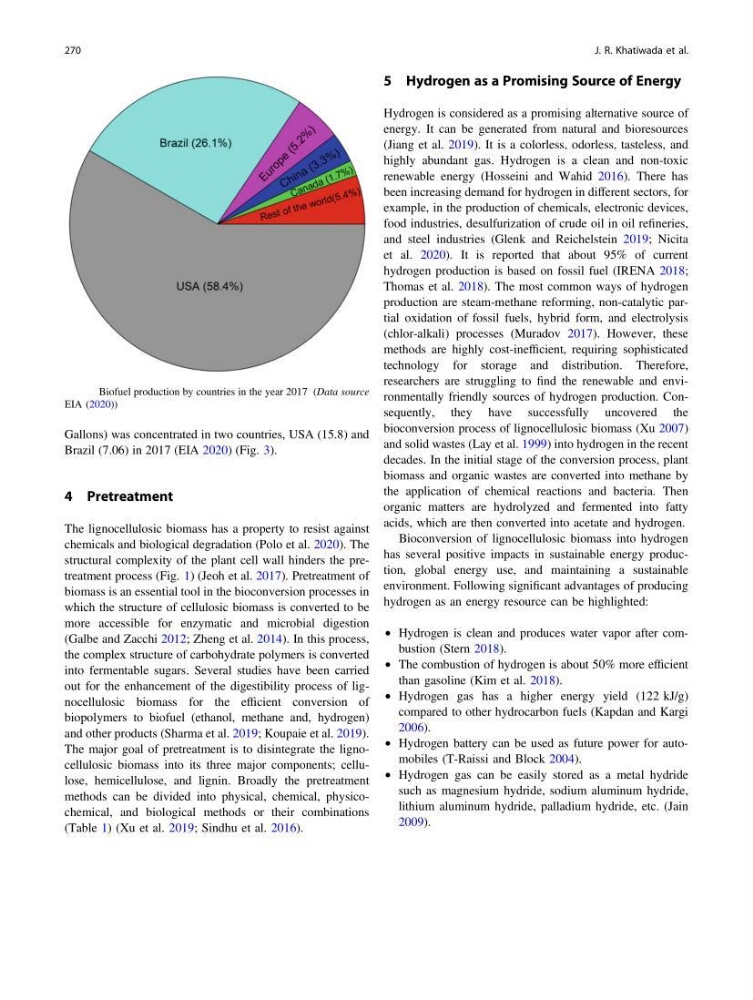
Gallons) was concentrated in two countries, USA (15.8) and
Brazil (7.06) in 2017 (EIA 2020) (Fig. 3).
4 Pretreatment
The lignocellulosic biomass has a property to resist against
chemicals and biological degradation (Polo et al. 2020). The
structural complexity of the plant cell wall hinders the pretreatment process (Fig. 1) (Jeoh et al. 2017). Pretreatment of
biomass is an essential tool in the bioconversion processes in
which the structure of cellulosic biomass is converted to be
more accessible for enzymatic and microbial digestion
(Galbe and Zacchi 2012; Zheng et al. 2014). In this process,
the complex structure of carbohydrate polymers is converted
into fermentable sugars. Several studies have been carried
out for the enhancement of the digestibility process of lignocellulosic biomass for the efficient conversion of
biopolymers to biofuel (ethanol, methane and, hydrogen)
and other products (Sharma et al. 2019; Koupaie et al. 2019).
The major goal of pretreatment is to disintegrate the lignocellulosic biomass into its three major components; cellulose, hemicellulose, and lignin. Broadly the pretreatment
methods can be divided into physical, chemical, physicochemical, and biological methods or their combinations
(Table 1) (Xu et al. 2019; Sindhu et al. 2016).
5 Hydrogen as a Promising Source of Energy
Hydrogen is considered as a promising alternative source of
energy. It can be generated from natural and bioresources
(Jiang et al. 2019). It is a colorless, odorless, tasteless, and
highly abundant gas. Hydrogen is a clean and non-toxic
renewable energy (Hosseini and Wahid 2016). There has
been increasing demand for hydrogen in different sectors, for
example, in the production of chemicals, electronic devices,
food industries, desulfurization of crude oil in oil refineries,
and steel industries (Glenk and Reichelstein 2019; Nicita
et al. 2020). It is reported that about 95% of current
hydrogen production is based on fossil fuel (IRENA 2018;
Thomas et al. 2018). The most common ways of hydrogen
production are steam-methane reforming, non-catalytic partial oxidation of fossil fuels, hybrid form, and electrolysis
(chlor-alkali) processes (Muradov 2017). However, these
methods are highly cost-inefficient, requiring sophisticated
technology for storage and distribution. Therefore,
researchers are struggling to find the renewable and environmentally friendly sources of hydrogen production. Consequently, they have successfully uncovered the
bioconversion process of lignocellulosic biomass (Xu 2007)
and solid wastes (Lay et al. 1999) into hydrogen in the recent
decades. In the initial stage of the conversion process, plant
biomass and organic wastes are converted into methane by
the application of chemical reactions and bacteria. Then
organic matters are hydrolyzed and fermented into fatty
acids, which are then converted into acetate and hydrogen.
Bioconversion of lignocellulosic biomass into hydrogen
has several positive impacts in sustainable energy production, global energy use, and maintaining a sustainable
environment. Following significant advantages of producing
hydrogen as an energy resource can be highlighted:
• Hydrogen is clean and produces water vapor after combustion (Stern 2018).
• The combustion of hydrogen is about 50% more efficient
than gasoline (Kim et al. 2018).
• Hydrogen gas has a higher energy yield (122 kJ/g)
compared to other hydrocarbon fuels (Kapdan and Kargi
2006).
• Hydrogen battery can be used as future power for automobiles (T-Raissi and Block 2004).
• Hydrogen gas can be easily stored as a metal hydride
such as magnesium hydride, sodium aluminum hydride,
lithium aluminum hydride, palladium hydride, etc. (Jain
2009).
Fig. 3 Biofuel production by countries in the year 2017 (Data source
EIA (2020))
270
J. R. Khatiwada et al.
Brazil (7.06) in 2017 (EIA 2020) (Fig. 3).
4 Pretreatment
The lignocellulosic biomass has a property to resist against
chemicals and biological degradation (Polo et al. 2020). The
structural complexity of the plant cell wall hinders the pretreatment process (Fig. 1) (Jeoh et al. 2017). Pretreatment of
biomass is an essential tool in the bioconversion processes in
which the structure of cellulosic biomass is converted to be
more accessible for enzymatic and microbial digestion
(Galbe and Zacchi 2012; Zheng et al. 2014). In this process,
the complex structure of carbohydrate polymers is converted
into fermentable sugars. Several studies have been carried
out for the enhancement of the digestibility process of lignocellulosic biomass for the efficient conversion of
biopolymers to biofuel (ethanol, methane and, hydrogen)
and other products (Sharma et al. 2019; Koupaie et al. 2019).
The major goal of pretreatment is to disintegrate the lignocellulosic biomass into its three major components; cellulose, hemicellulose, and lignin. Broadly the pretreatment
methods can be divided into physical, chemical, physicochemical, and biological methods or their combinations
(Table 1) (Xu et al. 2019; Sindhu et al. 2016).
5 Hydrogen as a Promising Source of Energy
Hydrogen is considered as a promising alternative source of
energy. It can be generated from natural and bioresources
(Jiang et al. 2019). It is a colorless, odorless, tasteless, and
highly abundant gas. Hydrogen is a clean and non-toxic
renewable energy (Hosseini and Wahid 2016). There has
been increasing demand for hydrogen in different sectors, for
example, in the production of chemicals, electronic devices,
food industries, desulfurization of crude oil in oil refineries,
and steel industries (Glenk and Reichelstein 2019; Nicita
et al. 2020). It is reported that about 95% of current
hydrogen production is based on fossil fuel (IRENA 2018;
Thomas et al. 2018). The most common ways of hydrogen
production are steam-methane reforming, non-catalytic partial oxidation of fossil fuels, hybrid form, and electrolysis
(chlor-alkali) processes (Muradov 2017). However, these
methods are highly cost-inefficient, requiring sophisticated
technology for storage and distribution. Therefore,
researchers are struggling to find the renewable and environmentally friendly sources of hydrogen production. Consequently, they have successfully uncovered the
bioconversion process of lignocellulosic biomass (Xu 2007)
and solid wastes (Lay et al. 1999) into hydrogen in the recent
decades. In the initial stage of the conversion process, plant
biomass and organic wastes are converted into methane by
the application of chemical reactions and bacteria. Then
organic matters are hydrolyzed and fermented into fatty
acids, which are then converted into acetate and hydrogen.
Bioconversion of lignocellulosic biomass into hydrogen
has several positive impacts in sustainable energy production, global energy use, and maintaining a sustainable
environment. Following significant advantages of producing
hydrogen as an energy resource can be highlighted:
• Hydrogen is clean and produces water vapor after combustion (Stern 2018).
• The combustion of hydrogen is about 50% more efficient
than gasoline (Kim et al. 2018).
• Hydrogen gas has a higher energy yield (122 kJ/g)
compared to other hydrocarbon fuels (Kapdan and Kargi
2006).
• Hydrogen battery can be used as future power for automobiles (T-Raissi and Block 2004).
• Hydrogen gas can be easily stored as a metal hydride
such as magnesium hydride, sodium aluminum hydride,
lithium aluminum hydride, palladium hydride, etc. (Jain
2009).
Fig. 3 Biofuel production by countries in the year 2017 (Data source
EIA (2020))
270
J. R. Khatiwada et al.