

of the intermediary GA3P or F6P results in ineffective
xylulose fermentation in S. cerevisiae (Chu and Lee 2007).
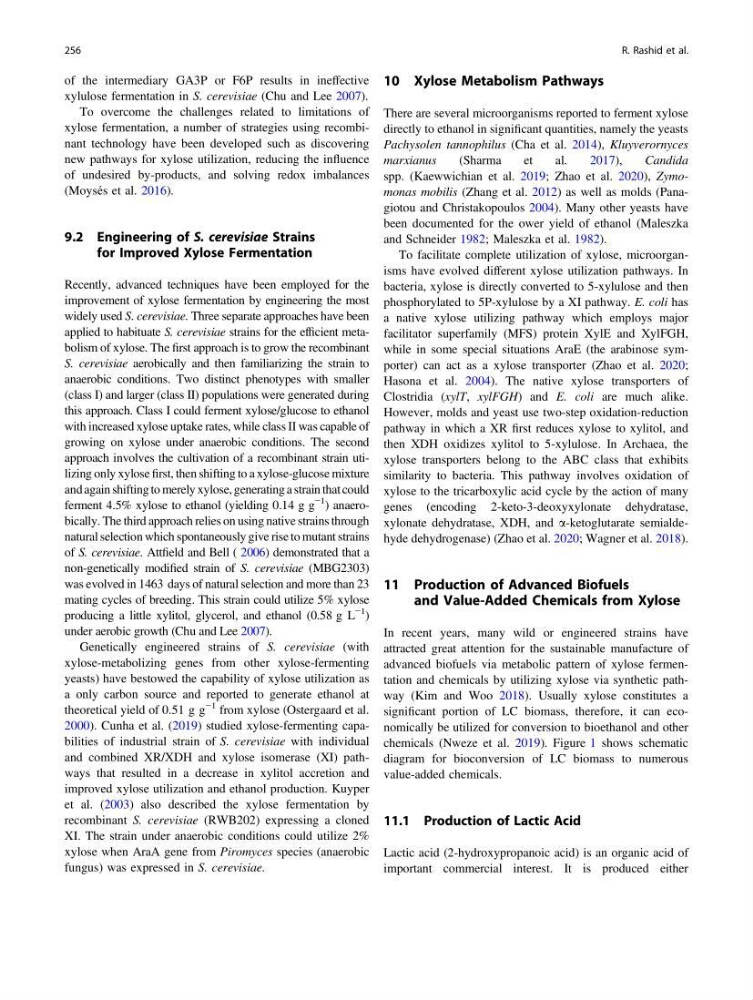
To overcome the challenges related to limitations of
xylose fermentation, a number of strategies using recombinant technology have been developed such as discovering
new pathways for xylose utilization, reducing the influence
of undesired by-products, and solving redox imbalances
(Moysés et al. 2016).
9.2 Engineering of S. cerevisiae Strains
for Improved Xylose Fermentation
Recently, advanced techniques have been employed for the
improvement of xylose fermentation by engineering the most
widely used S. cerevisiae. Three separate approaches have been
applied to habituate S. cerevisiae strains for the efficient metabolism of xylose. The first approach is to grow the recombinant
S. cerevisiae aerobically and then familiarizing the strain to
anaerobic conditions. Two distinct phenotypes with smaller
(class I) and larger (class II) populations were generated during
this approach. Class I could ferment xylose/glucose to ethanol
with increased xylose uptake rates, while class II was capable of
growing on xylose under anaerobic conditions. The second
approach involves the cultivation of a recombinant strain utilizing only xylose first, then shifting to a xylose-glucose mixture
and again shifting to merely xylose, generating a strain that could
ferment 4.5% xylose to ethanol (yielding 0.14 g g
−1
) anaerobically. The third approach relies on using native strains through
natural selection which spontaneously give rise to mutant strains
of S. cerevisiae. Attfield and Bell ( 2006) demonstrated that a
non-genetically modified strain of S. cerevisiae (MBG2303)
was evolved in 1463 days of natural selection and more than 23
mating cycles of breeding. This strain could utilize 5% xylose
producing a little xylitol, glycerol, and ethanol (0.58 g L
−1
)
under aerobic growth (Chu and Lee 2007).
Genetically engineered strains of S. cerevisiae (with
xylose-metabolizing genes from other xylose-fermenting
yeasts) have bestowed the capability of xylose utilization as
a only carbon source and reported to generate ethanol at
theoretical yield of 0.51 g g
−1 from xylose (Ostergaard et al.
2000). Cunha et al. (2019) studied xylose-fermenting capabilities of industrial strain of S. cerevisiae with individual
and combined XR/XDH and xylose isomerase (XI) pathways that resulted in a decrease in xylitol accretion and
improved xylose utilization and ethanol production. Kuyper
et al. (2003) also described the xylose fermentation by
recombinant S. cerevisiae (RWB202) expressing a cloned
XI. The strain under anaerobic conditions could utilize 2%
xylose when AraA gene from Piromyces species (anaerobic
fungus) was expressed in S. cerevisiae.
10 Xylose Metabolism Pathways
There are several microorganisms reported to ferment xylose
directly to ethanol in significant quantities, namely the yeasts
Pachysolen tannophilus (Cha et al. 2014), Kluyverornyces
marxianus
(Sharma
et
al.
2017),
Candida
spp. (Kaewwichian et al. 2019; Zhao et al. 2020), Zymomonas mobilis (Zhang et al. 2012) as well as molds (Panagiotou and Christakopoulos 2004). Many other yeasts have
been documented for the ower yield of ethanol (Maleszka
and Schneider 1982; Maleszka et al. 1982).
To facilitate complete utilization of xylose, microorganisms have evolved different xylose utilization pathways. In
bacteria, xylose is directly converted to 5-xylulose and then
phosphorylated to 5P-xylulose by a XI pathway. E. coli has
a native xylose utilizing pathway which employs major
facilitator superfamily (MFS) protein XylE and XylFGH,
while in some special situations AraE (the arabinose symporter) can act as a xylose transporter (Zhao et al. 2020;
Hasona et al. 2004). The native xylose transporters of
Clostridia (xylT, xylFGH) and E. coli are much alike.
However, molds and yeast use two-step oxidation-reduction
pathway in which a XR first reduces xylose to xylitol, and
then XDH oxidizes xylitol to 5-xylulose. In Archaea, the
xylose transporters belong to the ABC class that exhibits
similarity to bacteria. This pathway involves oxidation of
xylose to the tricarboxylic acid cycle by the action of many
genes (encoding 2-keto-3-deoxyxylonate dehydratase,
xylonate dehydratase, XDH, and a-ketoglutarate semialdehyde dehydrogenase) (Zhao et al. 2020; Wagner et al. 2018).
11 Production of Advanced Biofuels
and Value-Added Chemicals from Xylose
In recent years, many wild or engineered strains have
attracted great attention for the sustainable manufacture of
advanced biofuels via metabolic pattern of xylose fermentation and chemicals by utilizing xylose via synthetic pathway (Kim and Woo 2018). Usually xylose constitutes a
significant portion of LC biomass, therefore, it can economically be utilized for conversion to bioethanol and other
chemicals (Nweze et al. 2019). Figure 1 shows schematic
diagram for bioconversion of LC biomass to numerous
value-added chemicals.
11.1 Production of Lactic Acid
Lactic acid (2-hydroxypropanoic acid) is an organic acid of
important commercial interest. It is produced either
256
R. Rashid et al.
xylulose fermentation in S. cerevisiae (Chu and Lee 2007).
To overcome the challenges related to limitations of
xylose fermentation, a number of strategies using recombinant technology have been developed such as discovering
new pathways for xylose utilization, reducing the influence
of undesired by-products, and solving redox imbalances
(Moysés et al. 2016).
9.2 Engineering of S. cerevisiae Strains
for Improved Xylose Fermentation
Recently, advanced techniques have been employed for the
improvement of xylose fermentation by engineering the most
widely used S. cerevisiae. Three separate approaches have been
applied to habituate S. cerevisiae strains for the efficient metabolism of xylose. The first approach is to grow the recombinant
S. cerevisiae aerobically and then familiarizing the strain to
anaerobic conditions. Two distinct phenotypes with smaller
(class I) and larger (class II) populations were generated during
this approach. Class I could ferment xylose/glucose to ethanol
with increased xylose uptake rates, while class II was capable of
growing on xylose under anaerobic conditions. The second
approach involves the cultivation of a recombinant strain utilizing only xylose first, then shifting to a xylose-glucose mixture
and again shifting to merely xylose, generating a strain that could
ferment 4.5% xylose to ethanol (yielding 0.14 g g
−1
) anaerobically. The third approach relies on using native strains through
natural selection which spontaneously give rise to mutant strains
of S. cerevisiae. Attfield and Bell ( 2006) demonstrated that a
non-genetically modified strain of S. cerevisiae (MBG2303)
was evolved in 1463 days of natural selection and more than 23
mating cycles of breeding. This strain could utilize 5% xylose
producing a little xylitol, glycerol, and ethanol (0.58 g L
−1
)
under aerobic growth (Chu and Lee 2007).
Genetically engineered strains of S. cerevisiae (with
xylose-metabolizing genes from other xylose-fermenting
yeasts) have bestowed the capability of xylose utilization as
a only carbon source and reported to generate ethanol at
theoretical yield of 0.51 g g
−1 from xylose (Ostergaard et al.
2000). Cunha et al. (2019) studied xylose-fermenting capabilities of industrial strain of S. cerevisiae with individual
and combined XR/XDH and xylose isomerase (XI) pathways that resulted in a decrease in xylitol accretion and
improved xylose utilization and ethanol production. Kuyper
et al. (2003) also described the xylose fermentation by
recombinant S. cerevisiae (RWB202) expressing a cloned
XI. The strain under anaerobic conditions could utilize 2%
xylose when AraA gene from Piromyces species (anaerobic
fungus) was expressed in S. cerevisiae.
10 Xylose Metabolism Pathways
There are several microorganisms reported to ferment xylose
directly to ethanol in significant quantities, namely the yeasts
Pachysolen tannophilus (Cha et al. 2014), Kluyverornyces
marxianus
(Sharma
et
al.
2017),
Candida
spp. (Kaewwichian et al. 2019; Zhao et al. 2020), Zymomonas mobilis (Zhang et al. 2012) as well as molds (Panagiotou and Christakopoulos 2004). Many other yeasts have
been documented for the ower yield of ethanol (Maleszka
and Schneider 1982; Maleszka et al. 1982).
To facilitate complete utilization of xylose, microorganisms have evolved different xylose utilization pathways. In
bacteria, xylose is directly converted to 5-xylulose and then
phosphorylated to 5P-xylulose by a XI pathway. E. coli has
a native xylose utilizing pathway which employs major
facilitator superfamily (MFS) protein XylE and XylFGH,
while in some special situations AraE (the arabinose symporter) can act as a xylose transporter (Zhao et al. 2020;
Hasona et al. 2004). The native xylose transporters of
Clostridia (xylT, xylFGH) and E. coli are much alike.
However, molds and yeast use two-step oxidation-reduction
pathway in which a XR first reduces xylose to xylitol, and
then XDH oxidizes xylitol to 5-xylulose. In Archaea, the
xylose transporters belong to the ABC class that exhibits
similarity to bacteria. This pathway involves oxidation of
xylose to the tricarboxylic acid cycle by the action of many
genes (encoding 2-keto-3-deoxyxylonate dehydratase,
xylonate dehydratase, XDH, and a-ketoglutarate semialdehyde dehydrogenase) (Zhao et al. 2020; Wagner et al. 2018).
11 Production of Advanced Biofuels
and Value-Added Chemicals from Xylose
In recent years, many wild or engineered strains have
attracted great attention for the sustainable manufacture of
advanced biofuels via metabolic pattern of xylose fermentation and chemicals by utilizing xylose via synthetic pathway (Kim and Woo 2018). Usually xylose constitutes a
significant portion of LC biomass, therefore, it can economically be utilized for conversion to bioethanol and other
chemicals (Nweze et al. 2019). Figure 1 shows schematic
diagram for bioconversion of LC biomass to numerous
value-added chemicals.
11.1 Production of Lactic Acid
Lactic acid (2-hydroxypropanoic acid) is an organic acid of
important commercial interest. It is produced either
256
R. Rashid et al.