

at a concentration of 2% xylose, glucose transporters with
high affinity (galactose transporter [Gal2] and Hxt7) and
intermediate affinity (Hxt4 and Hxt5) are required for
xylose uptake. Hxt5 and Hxt7 are expressed by native S.
cerevisiae when xylose is given as sole carbon source and
hence considered to be predominantly important for xylose
metabolism (Chu and Lee 2007).
The specificity of XR for Nicotinamide adenine dinucleotide phosphate (NADPH) and strong preference of XDH
for Nicotinamide adenine dinucleotide (NAD) causes a
redox imbalance leading to excessive xylitol accumulation
consequently ethanol yield is decreased (Zhang et al. 2012);
the phenomenon has been broadly studied in native
xylose-fermenting yeasts. Therefore, availability of oxygen
is also attributed to regulate xylose metabolism in yeasts.
Lesser amount of oxygen (1.5–5 mmol L
−1 h
−1 ) is required
for conversion of xylose to ethanol at higher yield (Agbogbo
et al. 2007). Therefore careful regulation of oxygen is
required. Under anaerobic conditions, cell growth and
ethanol production are rigorously limited (Maitan-Alfenas
et al. 2015).
Xylulose, a product of XR and XDH is metabolized to
ethanol by S. cerevisiae but at a low rate. Metabolism of
xylulose is limited by the expression level of XK in S.
cerevisiae. Hence, a slower rate of xylulose consumption is
linked with the slower XK activity leading to limiting xylose
metabolism. Yu et al. (Yu et al. 1995) reported lower yield
of ethanol when xylulose (50 g L
−1 ) was supplied as a sole
carbon source while significantly higher ethanol yield was
observed in the presence of glucose (50 g L
−1 ) by the strain
ATCC 24860 of S. cerevisiae (Chu and Lee 2007).
The rate of xylulose fermentation is partly controlled by
non-oxidative PPP (Johansson and Hahn-Hägerdal 2002).
The activity of important enzymes transaldolase (TAL) and
transketolase (TKL) in the non-oxidative PPP has been
associated with rate-limiting steps for xylose and xylulose
utilization
in
recombinant S.
cerevisiae. Xylulose-5-phosphate (X5P) and ribose-5-phosphate (R5P) is
converted to sedoheptulose 7-phosphate (S7P) and
glyceraldehydes-3-phosphate (GA3P) by the action of TKL.
While TAL converts S7P and GA3P to fructose-6-phosphate
(F6P) and erythrose-4-phosphate (E4P). Depletion of either
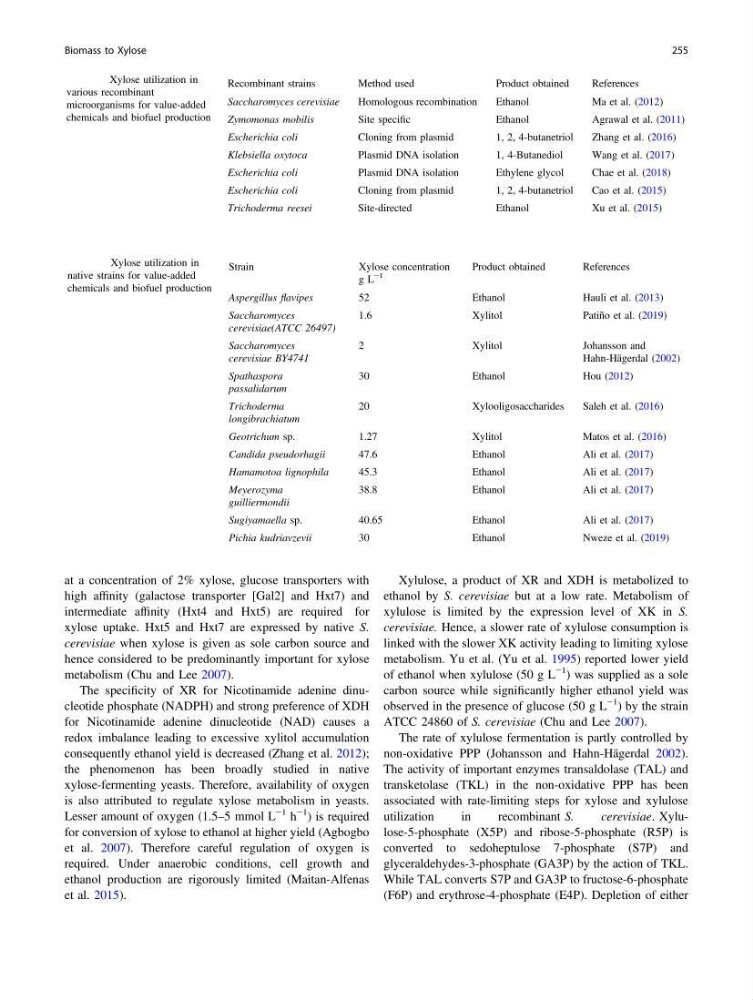
Table 7 Xylose utilization in
various recombinant
microorganisms for value-added
chemicals and biofuel production
Recombinant strains
Method used
Product obtained
References
Saccharomyces cerevisiae
Homologous recombination
Ethanol
Ma et al. (2012)
Zymomonas mobilis
Site specific
Ethanol
Agrawal et al. (2011)
Escherichia coli
Cloning from plasmid
1, 2, 4-butanetriol
Zhang et al. (2016)
Klebsiella oxytoca
Plasmid DNA isolation
1, 4-Butanediol
Wang et al. (2017)
Escherichia coli
Plasmid DNA isolation
Ethylene glycol
Chae et al. (2018)
Escherichia coli
Cloning from plasmid
1, 2, 4-butanetriol
Cao et al. (2015)
Trichoderma reesei
Site-directed
Ethanol
Xu et al. (2015)
Table 8 Xylose utilization in
native strains for value-added
chemicals and biofuel production
Strain
Xylose concentration
g L
−1
Product obtained
References
Aspergillus flavipes
52
Ethanol
Hauli et al. (2013)
Saccharomyces
cerevisiae(ATCC 26497)
1.6
Xylitol
Patiño et al. (2019)
Saccharomyces
cerevisiae BY4741
2
Xylitol
Johansson and
Hahn-Hägerdal (2002)
Spathaspora
passalidarum
30
Ethanol
Hou (2012)
Trichoderma
longibrachiatum
20
Xylooligosaccharides
Saleh et al. (2016)
Geotrichum sp.
1.27
Xylitol
Matos et al. (2016)
Candida pseudorhagii
47.6
Ethanol
Ali et al. (2017)
Hamamotoa lignophila
45.3
Ethanol
Ali et al. (2017)
Meyerozyma
guilliermondii
38.8
Ethanol
Ali et al. (2017)
Sugiyamaella sp.
40.65
Ethanol
Ali et al. (2017)
Pichia kudriavzevii
30
Ethanol
Nweze et al. (2019)
Biomass to Xylose
255
high affinity (galactose transporter [Gal2] and Hxt7) and
intermediate affinity (Hxt4 and Hxt5) are required for
xylose uptake. Hxt5 and Hxt7 are expressed by native S.
cerevisiae when xylose is given as sole carbon source and
hence considered to be predominantly important for xylose
metabolism (Chu and Lee 2007).
The specificity of XR for Nicotinamide adenine dinucleotide phosphate (NADPH) and strong preference of XDH
for Nicotinamide adenine dinucleotide (NAD) causes a
redox imbalance leading to excessive xylitol accumulation
consequently ethanol yield is decreased (Zhang et al. 2012);
the phenomenon has been broadly studied in native
xylose-fermenting yeasts. Therefore, availability of oxygen
is also attributed to regulate xylose metabolism in yeasts.
Lesser amount of oxygen (1.5–5 mmol L
−1 h
−1 ) is required
for conversion of xylose to ethanol at higher yield (Agbogbo
et al. 2007). Therefore careful regulation of oxygen is
required. Under anaerobic conditions, cell growth and
ethanol production are rigorously limited (Maitan-Alfenas
et al. 2015).
Xylulose, a product of XR and XDH is metabolized to
ethanol by S. cerevisiae but at a low rate. Metabolism of
xylulose is limited by the expression level of XK in S.
cerevisiae. Hence, a slower rate of xylulose consumption is
linked with the slower XK activity leading to limiting xylose
metabolism. Yu et al. (Yu et al. 1995) reported lower yield
of ethanol when xylulose (50 g L
−1 ) was supplied as a sole
carbon source while significantly higher ethanol yield was
observed in the presence of glucose (50 g L
−1 ) by the strain
ATCC 24860 of S. cerevisiae (Chu and Lee 2007).
The rate of xylulose fermentation is partly controlled by
non-oxidative PPP (Johansson and Hahn-Hägerdal 2002).
The activity of important enzymes transaldolase (TAL) and
transketolase (TKL) in the non-oxidative PPP has been
associated with rate-limiting steps for xylose and xylulose
utilization
in
recombinant S.
cerevisiae. Xylulose-5-phosphate (X5P) and ribose-5-phosphate (R5P) is
converted to sedoheptulose 7-phosphate (S7P) and
glyceraldehydes-3-phosphate (GA3P) by the action of TKL.
While TAL converts S7P and GA3P to fructose-6-phosphate
(F6P) and erythrose-4-phosphate (E4P). Depletion of either
Table 7 Xylose utilization in
various recombinant
microorganisms for value-added
chemicals and biofuel production
Recombinant strains
Method used
Product obtained
References
Saccharomyces cerevisiae
Homologous recombination
Ethanol
Ma et al. (2012)
Zymomonas mobilis
Site specific
Ethanol
Agrawal et al. (2011)
Escherichia coli
Cloning from plasmid
1, 2, 4-butanetriol
Zhang et al. (2016)
Klebsiella oxytoca
Plasmid DNA isolation
1, 4-Butanediol
Wang et al. (2017)
Escherichia coli
Plasmid DNA isolation
Ethylene glycol
Chae et al. (2018)
Escherichia coli
Cloning from plasmid
1, 2, 4-butanetriol
Cao et al. (2015)
Trichoderma reesei
Site-directed
Ethanol
Xu et al. (2015)
Table 8 Xylose utilization in
native strains for value-added
chemicals and biofuel production
Strain
Xylose concentration
g L
−1
Product obtained
References
Aspergillus flavipes
52
Ethanol
Hauli et al. (2013)
Saccharomyces
cerevisiae(ATCC 26497)
1.6
Xylitol
Patiño et al. (2019)
Saccharomyces
cerevisiae BY4741
2
Xylitol
Johansson and
Hahn-Hägerdal (2002)
Spathaspora
passalidarum
30
Ethanol
Hou (2012)
Trichoderma
longibrachiatum
20
Xylooligosaccharides
Saleh et al. (2016)
Geotrichum sp.
1.27
Xylitol
Matos et al. (2016)
Candida pseudorhagii
47.6
Ethanol
Ali et al. (2017)
Hamamotoa lignophila
45.3
Ethanol
Ali et al. (2017)
Meyerozyma
guilliermondii
38.8
Ethanol
Ali et al. (2017)
Sugiyamaella sp.
40.65
Ethanol
Ali et al. (2017)
Pichia kudriavzevii
30
Ethanol
Nweze et al. (2019)
Biomass to Xylose
255