

xylose) usually with lower efficiency (Maitan-Alfenas et al.
2015) (Table 8).
Utilization of xylose-fermenting microorganisms at
commercial scale is often restricted because of slow fermentation rates. S. cerevisiae, a “GRAS” (Generally
Regarded as Safe) (Ostergaard et al. 2000) organism is
preferred over the native xylose utilizing microorganisms for
ethanol production regarding sturdiness against various
industrial environments such as high osmotic pressure, low
pH, phage contamination, and high alcohol concentration.
However, this yeast is incapable to efficiently consume
xylose as a sole carbon source (Kwak and Jin 2017; Eliasson
et al. 2001). Though some bacteria, like Zymomonas mobilis
and genetically modified Escherichia coli, have the ability to
ferment sugars, S. cerevisiae because of its elevated ethanol
tolerance and wide public acceptance is still the organism of
choice and has been a main focus to improve its xylose
fermentation for industrial production of ethanol (Moysés
et al. 2016; Chu and Lee 2007).
9.1 Limitations of Xylose Metabolism
in S. cerevisiae
Ideally microorganisms foreseen for biomass conversion
should have the abilities to (1) assimilate a wide range of
substrates, (2) readily ferment concentrated substrates, and
(3) tolerate the inhibitory by-products and ethanol.
The lack of ability of S. cerevisiae to utilize xylose for
growth has been credited to many reasons including
incompetent uptake of xylose (Kötter and Ciriacy 1993), a
redox imbalance caused by xylitol dehydrogenase
(XDH) and xylose reductase (XR) (Bruinenberg 1986), scant
activity of xylulose kinase (XK), and an ineffective pentose
phosphate pathway (PPP) (Walfridsson et al. 1995). Xylose
uptake in S. cerevisiae takes place by facilitated diffusion via
hexose transporters (Hxt) gene family, but with much lesser
affinities than glucose. In a study by Hamacher et al. ( 2002),
individual Hxt genes were introduced and constitutively
expressed in S. cerevisiae TMB3201 and it was revealed that
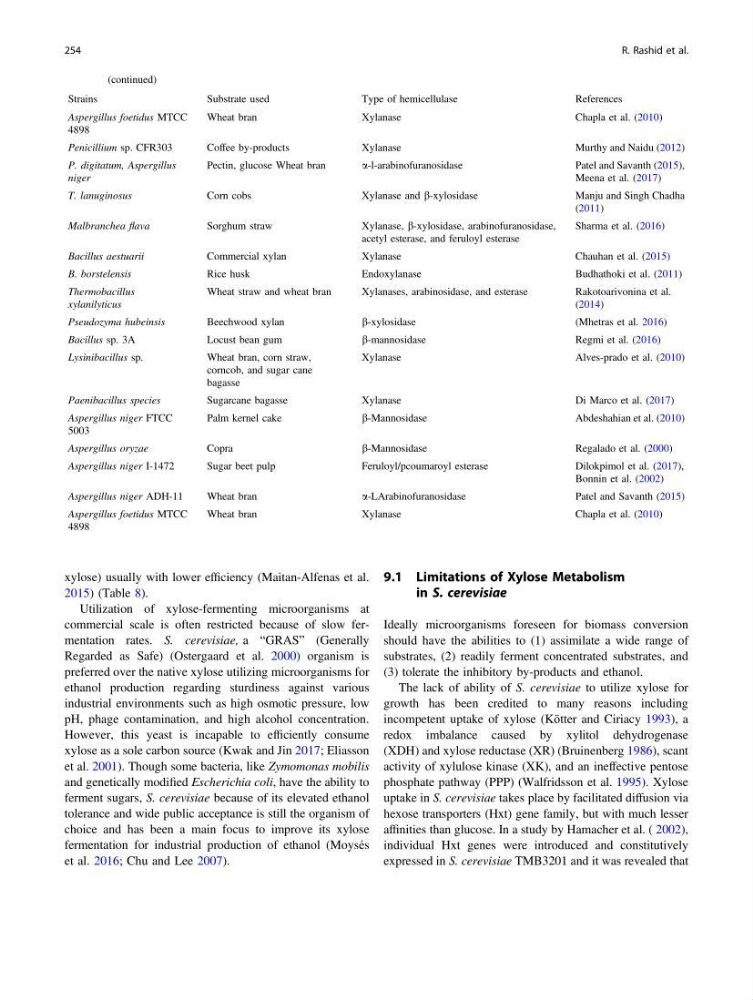
Table 6 (continued)
Strains
Substrate used
Type of hemicellulase
References
Aspergillus foetidus MTCC
4898
Wheat bran
Xylanase
Chapla et al. (2010)
Penicillium sp. CFR303
Coffee by-products
Xylanase
Murthy and Naidu (2012)
P. digitatum, Aspergillus
niger
Pectin, glucose Wheat bran
a-l-arabinofuranosidase
Patel and Savanth (2015),
Meena et al. (2017)
T. lanuginosus
Corn cobs
Xylanase and b-xylosidase
Manju and Singh Chadha
(2011)
Malbranchea flava
Sorghum straw
Xylanase, b-xylosidase, arabinofuranosidase,
acetyl esterase, and feruloyl esterase
Sharma et al. (2016)
Bacillus aestuarii
Commercial xylan
Xylanase
Chauhan et al. (2015)
B. borstelensis
Rice husk
Endoxylanase
Budhathoki et al. (2011)
Thermobacillus
xylanilyticus
Wheat straw and wheat bran
Xylanases, arabinosidase, and esterase
Rakotoarivonina et al.
(2014)
Pseudozyma hubeinsis
Beechwood xylan
b-xylosidase
(Mhetras et al. 2016)
Bacillus sp. 3A
Locust bean gum
b-mannosidase
Regmi et al. (2016)
Lysinibacillus sp.
Wheat bran, corn straw,
corncob, and sugar cane
bagasse
Xylanase
Alves-prado et al. (2010)
Paenibacillus species
Sugarcane bagasse
Xylanase
Di Marco et al. (2017)
Aspergillus niger FTCC
5003
Palm kernel cake
b-Mannosidase
Abdeshahian et al. (2010)
Aspergillus oryzae
Copra
b-Mannosidase
Regalado et al. (2000)
Aspergillus niger I-1472
Sugar beet pulp
Feruloyl/pcoumaroyl esterase
Dilokpimol et al. (2017),
Bonnin et al. (2002)
Aspergillus niger ADH-11
Wheat bran
a-LArabinofuranosidase
Patel and Savanth (2015)
Aspergillus foetidus MTCC
4898
Wheat bran
Xylanase
Chapla et al. (2010)
254
R. Rashid et al.
2015) (Table 8).
Utilization of xylose-fermenting microorganisms at
commercial scale is often restricted because of slow fermentation rates. S. cerevisiae, a “GRAS” (Generally
Regarded as Safe) (Ostergaard et al. 2000) organism is
preferred over the native xylose utilizing microorganisms for
ethanol production regarding sturdiness against various
industrial environments such as high osmotic pressure, low
pH, phage contamination, and high alcohol concentration.
However, this yeast is incapable to efficiently consume
xylose as a sole carbon source (Kwak and Jin 2017; Eliasson
et al. 2001). Though some bacteria, like Zymomonas mobilis
and genetically modified Escherichia coli, have the ability to
ferment sugars, S. cerevisiae because of its elevated ethanol
tolerance and wide public acceptance is still the organism of
choice and has been a main focus to improve its xylose
fermentation for industrial production of ethanol (Moysés
et al. 2016; Chu and Lee 2007).
9.1 Limitations of Xylose Metabolism
in S. cerevisiae
Ideally microorganisms foreseen for biomass conversion
should have the abilities to (1) assimilate a wide range of
substrates, (2) readily ferment concentrated substrates, and
(3) tolerate the inhibitory by-products and ethanol.
The lack of ability of S. cerevisiae to utilize xylose for
growth has been credited to many reasons including
incompetent uptake of xylose (Kötter and Ciriacy 1993), a
redox imbalance caused by xylitol dehydrogenase
(XDH) and xylose reductase (XR) (Bruinenberg 1986), scant
activity of xylulose kinase (XK), and an ineffective pentose
phosphate pathway (PPP) (Walfridsson et al. 1995). Xylose
uptake in S. cerevisiae takes place by facilitated diffusion via
hexose transporters (Hxt) gene family, but with much lesser
affinities than glucose. In a study by Hamacher et al. ( 2002),
individual Hxt genes were introduced and constitutively
expressed in S. cerevisiae TMB3201 and it was revealed that
Table 6 (continued)
Strains
Substrate used
Type of hemicellulase
References
Aspergillus foetidus MTCC
4898
Wheat bran
Xylanase
Chapla et al. (2010)
Penicillium sp. CFR303
Coffee by-products
Xylanase
Murthy and Naidu (2012)
P. digitatum, Aspergillus
niger
Pectin, glucose Wheat bran
a-l-arabinofuranosidase
Patel and Savanth (2015),
Meena et al. (2017)
T. lanuginosus
Corn cobs
Xylanase and b-xylosidase
Manju and Singh Chadha
(2011)
Malbranchea flava
Sorghum straw
Xylanase, b-xylosidase, arabinofuranosidase,
acetyl esterase, and feruloyl esterase
Sharma et al. (2016)
Bacillus aestuarii
Commercial xylan
Xylanase
Chauhan et al. (2015)
B. borstelensis
Rice husk
Endoxylanase
Budhathoki et al. (2011)
Thermobacillus
xylanilyticus
Wheat straw and wheat bran
Xylanases, arabinosidase, and esterase
Rakotoarivonina et al.
(2014)
Pseudozyma hubeinsis
Beechwood xylan
b-xylosidase
(Mhetras et al. 2016)
Bacillus sp. 3A
Locust bean gum
b-mannosidase
Regmi et al. (2016)
Lysinibacillus sp.
Wheat bran, corn straw,
corncob, and sugar cane
bagasse
Xylanase
Alves-prado et al. (2010)
Paenibacillus species
Sugarcane bagasse
Xylanase
Di Marco et al. (2017)
Aspergillus niger FTCC
5003
Palm kernel cake
b-Mannosidase
Abdeshahian et al. (2010)
Aspergillus oryzae
Copra
b-Mannosidase
Regalado et al. (2000)
Aspergillus niger I-1472
Sugar beet pulp
Feruloyl/pcoumaroyl esterase
Dilokpimol et al. (2017),
Bonnin et al. (2002)
Aspergillus niger ADH-11
Wheat bran
a-LArabinofuranosidase
Patel and Savanth (2015)
Aspergillus foetidus MTCC
4898
Wheat bran
Xylanase
Chapla et al. (2010)
254
R. Rashid et al.