

b-D-1, 4-manno-oligomers. b-mannosidases (EC 3.2.1.25)
further hydrolyze b-D-1, 4-manno-oligomers to mannose.
The manno-oligosaccharides, the foremost hydrolysis product of mannan are also considered as potential prebiotics.
The b-mannanases are classified in 5, 26, and 113 GH
families (Xia et al. 2016).
8 Microorganisms Involved in Hemicellulase
Production
Microorganisms play a vital role in the production of enzymes
necessary for biomass saccharification. Substantial research
has been conducted on the isolation of numerous microorganisms belonging to molds, yeasts, bacteria, and actinomycetes involved in cellulase and hemicellulase production
(Ravindran and Jaiswal 2016). For that reason, different
strategies like bioprospecting of microorganisms are used to
explore more efficient microbes to hydrolyze crude substrates,
followed by screening of the best candidates that produce
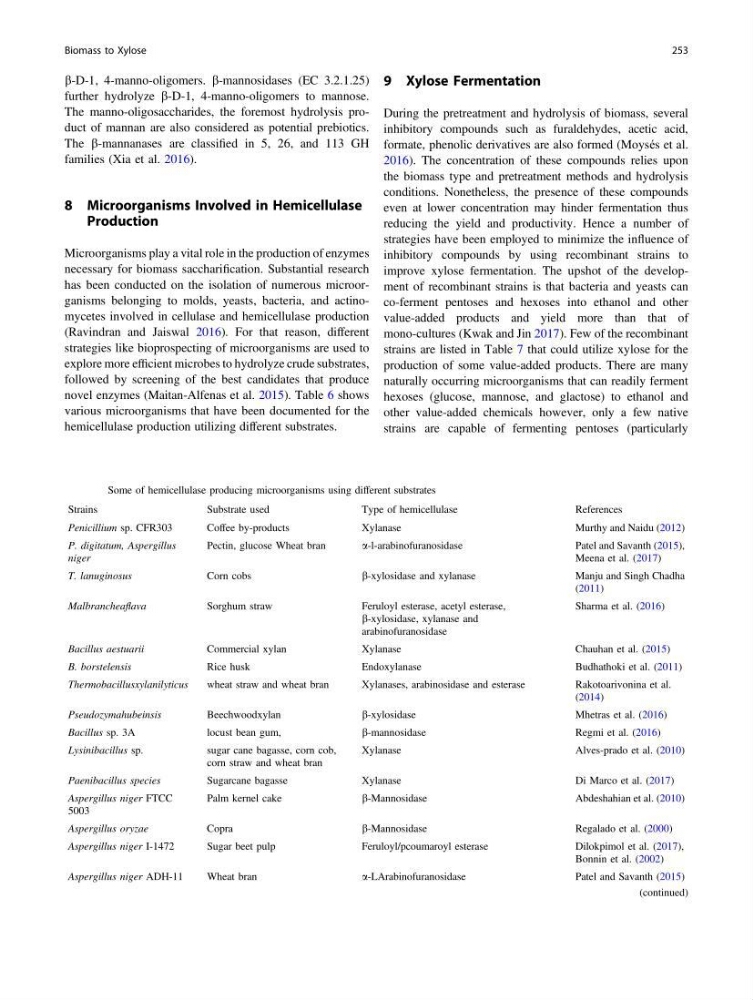
novel enzymes (Maitan-Alfenas et al. 2015). Table 6 shows
various microorganisms that have been documented for the
hemicellulase production utilizing different substrates.
9 Xylose Fermentation
During the pretreatment and hydrolysis of biomass, several
inhibitory compounds such as furaldehydes, acetic acid,
formate, phenolic derivatives are also formed (Moysés et al.
2016). The concentration of these compounds relies upon
the biomass type and pretreatment methods and hydrolysis
conditions. Nonetheless, the presence of these compounds
even at lower concentration may hinder fermentation thus
reducing the yield and productivity. Hence a number of
strategies have been employed to minimize the influence of
inhibitory compounds by using recombinant strains to
improve xylose fermentation. The upshot of the development of recombinant strains is that bacteria and yeasts can
co-ferment pentoses and hexoses into ethanol and other
value-added products and yield more than that of
mono-cultures (Kwak and Jin 2017). Few of the recombinant
strains are listed in Table 7 that could utilize xylose for the
production of some value-added products. There are many
naturally occurring microorganisms that can readily ferment
hexoses (glucose, mannose, and glactose) to ethanol and
other value-added chemicals however, only a few native
strains are capable of fermenting pentoses (particularly
Table 6 Some of hemicellulase producing microorganisms using different substrates
Strains
Substrate used
Type of hemicellulase
References
Penicillium sp. CFR303
Coffee by-products
Xylanase
Murthy and Naidu (2012)
P. digitatum, Aspergillus
niger
Pectin, glucose Wheat bran
a-l-arabinofuranosidase
Patel and Savanth (2015),
Meena et al. (2017)
T. lanuginosus
Corn cobs
b-xylosidase and xylanase
Manju and Singh Chadha
(2011)
Malbrancheaflava
Sorghum straw
Feruloyl esterase, acetyl esterase,
b-xylosidase, xylanase and
arabinofuranosidase
Sharma et al. (2016)
Bacillus aestuarii
Commercial xylan
Xylanase
Chauhan et al. (2015)
B. borstelensis
Rice husk
Endoxylanase
Budhathoki et al. (2011)
Thermobacillusxylanilyticus
wheat straw and wheat bran
Xylanases, arabinosidase and esterase
Rakotoarivonina et al.
(2014)
Pseudozymahubeinsis
Beechwoodxylan
b-xylosidase
Mhetras et al. (2016)
Bacillus sp. 3A
locust bean gum,
b-mannosidase
Regmi et al. (2016)
Lysinibacillus sp.
sugar cane bagasse, corn cob,
corn straw and wheat bran
Xylanase
Alves-prado et al. (2010)
Paenibacillus species
Sugarcane bagasse
Xylanase
Di Marco et al. (2017)
Aspergillus niger FTCC
5003
Palm kernel cake
b-Mannosidase
Abdeshahian et al. (2010)
Aspergillus oryzae
Copra
b-Mannosidase
Regalado et al. (2000)
Aspergillus niger I-1472
Sugar beet pulp
Feruloyl/pcoumaroyl esterase
Dilokpimol et al. (2017),
Bonnin et al. (2002)
Aspergillus niger ADH-11
Wheat bran
a-LArabinofuranosidase
Patel and Savanth (2015)
(continued)
Biomass to Xylose
253
further hydrolyze b-D-1, 4-manno-oligomers to mannose.
The manno-oligosaccharides, the foremost hydrolysis product of mannan are also considered as potential prebiotics.
The b-mannanases are classified in 5, 26, and 113 GH
families (Xia et al. 2016).
8 Microorganisms Involved in Hemicellulase
Production
Microorganisms play a vital role in the production of enzymes
necessary for biomass saccharification. Substantial research
has been conducted on the isolation of numerous microorganisms belonging to molds, yeasts, bacteria, and actinomycetes involved in cellulase and hemicellulase production
(Ravindran and Jaiswal 2016). For that reason, different
strategies like bioprospecting of microorganisms are used to
explore more efficient microbes to hydrolyze crude substrates,
followed by screening of the best candidates that produce
novel enzymes (Maitan-Alfenas et al. 2015). Table 6 shows
various microorganisms that have been documented for the
hemicellulase production utilizing different substrates.
9 Xylose Fermentation
During the pretreatment and hydrolysis of biomass, several
inhibitory compounds such as furaldehydes, acetic acid,
formate, phenolic derivatives are also formed (Moysés et al.
2016). The concentration of these compounds relies upon
the biomass type and pretreatment methods and hydrolysis
conditions. Nonetheless, the presence of these compounds
even at lower concentration may hinder fermentation thus
reducing the yield and productivity. Hence a number of
strategies have been employed to minimize the influence of
inhibitory compounds by using recombinant strains to
improve xylose fermentation. The upshot of the development of recombinant strains is that bacteria and yeasts can
co-ferment pentoses and hexoses into ethanol and other
value-added products and yield more than that of
mono-cultures (Kwak and Jin 2017). Few of the recombinant
strains are listed in Table 7 that could utilize xylose for the
production of some value-added products. There are many
naturally occurring microorganisms that can readily ferment
hexoses (glucose, mannose, and glactose) to ethanol and
other value-added chemicals however, only a few native
strains are capable of fermenting pentoses (particularly
Table 6 Some of hemicellulase producing microorganisms using different substrates
Strains
Substrate used
Type of hemicellulase
References
Penicillium sp. CFR303
Coffee by-products
Xylanase
Murthy and Naidu (2012)
P. digitatum, Aspergillus
niger
Pectin, glucose Wheat bran
a-l-arabinofuranosidase
Patel and Savanth (2015),
Meena et al. (2017)
T. lanuginosus
Corn cobs
b-xylosidase and xylanase
Manju and Singh Chadha
(2011)
Malbrancheaflava
Sorghum straw
Feruloyl esterase, acetyl esterase,
b-xylosidase, xylanase and
arabinofuranosidase
Sharma et al. (2016)
Bacillus aestuarii
Commercial xylan
Xylanase
Chauhan et al. (2015)
B. borstelensis
Rice husk
Endoxylanase
Budhathoki et al. (2011)
Thermobacillusxylanilyticus
wheat straw and wheat bran
Xylanases, arabinosidase and esterase
Rakotoarivonina et al.
(2014)
Pseudozymahubeinsis
Beechwoodxylan
b-xylosidase
Mhetras et al. (2016)
Bacillus sp. 3A
locust bean gum,
b-mannosidase
Regmi et al. (2016)
Lysinibacillus sp.
sugar cane bagasse, corn cob,
corn straw and wheat bran
Xylanase
Alves-prado et al. (2010)
Paenibacillus species
Sugarcane bagasse
Xylanase
Di Marco et al. (2017)
Aspergillus niger FTCC
5003
Palm kernel cake
b-Mannosidase
Abdeshahian et al. (2010)
Aspergillus oryzae
Copra
b-Mannosidase
Regalado et al. (2000)
Aspergillus niger I-1472
Sugar beet pulp
Feruloyl/pcoumaroyl esterase
Dilokpimol et al. (2017),
Bonnin et al. (2002)
Aspergillus niger ADH-11
Wheat bran
a-LArabinofuranosidase
Patel and Savanth (2015)
(continued)
Biomass to Xylose
253