

7.1.2 b-Xylosidase
b-xylosidase (EC 3.2.1.37) is the main enzyme responsible
for hydrolysis from non-reducing ends of xylooligosaccharides and xylobiose to liberate monosaccharides (Kumar and
Murthy 2013; Van Dyk and Pletschke 2012). Purified
b-xylosidase usually prefers xylobiose as substrate than
xylan. b-xylosidases attribute to a significant role after xylan
has undergone a sequential hydrolysis by accumulating short
oligomers of b-D-xylopyranosyl that may act as inhibitor for
endo-b-1, 4-xylanase. b-xylosidases then remove the cause
of inhibition leading to efficient hydrolysis of xylan (Zanoelo
et al. 2004). These enzymes are placed into five GH families;
3, 39, 43, 52, and 54 among which GH3 and GH43 are the
well-characterized b-xylosidases so far (Dodd and Cann
2009).
7.1.3 a-L-Arabinofuranosidase
The side chain groups of arabinans, arabinoxylans, and
arabinogalactans are liberated by the supplementary
enzymes, a-arabinofuranosidases. These enzymes act synergistically with other arabinohydrolases, such as endo-(1,
5)-a-L-arabinanases (EC 3.2.1.99) for the complete hydrolysis of hemicelluloses. First a-L-arabinofuranosidases (EC
3.2.1.55)
catalyze
the
non-reducing
end
of
L-arabinofuranosyl residues from arabinan then endo-(1,5)a-L-arabinanases
produce
a
variety
of
arabino-oligosaccharides by efficient hydrolysis of the
resulting debranched backbone (Dimarogona and Topakas
2016). These arabinohydrolases produced by several fungi
and bacteria belong to the GH family 43, 51, 54, 62, and 93
(Manju and Singh Chadha 2011; Wefers et al. 2017).
7.1.4 Acetyl Xylan Esterases
Acetyl xylan esterases (3.1.1.72) play a vital role to degrade
xylan. It breaks the ester bonds between xylose and acetyl
residues which facilitates degradation of xylopyranosyl
residues by endo-b-1, 4-xylanases (Kim et al. 2020;
Hettiarachchi et al. 2019). The action of these enzymes on
polysaccharide substrate leads to exposure of new sites on
xylan chain and subsequently improves binding with
depolymerizing endoxylanases (Manju and Singh Chadha
2011).
Biely et al. (1985) described acetyl xylan esterases produced from many fungi and bacteria. Aspergillus niger,
Schizophyllum commune, Trichoderma reesei, and Aureobasidium pullulans have been widely reported for their
esterases production. More precise activities are exhibited
towards acetylated glucuronoxylan by these fungal esterases
than plant and animal esterase, and hence are termed as
acetyl xylan esterases (Bajpai 2014).
Feruloyl esterases (EC 3.1.1.73) degrade the ester linkages between the ferulic acid and arabinose substitutions
which also affects cross linking of xylan with lignin. These
feruloyl esterases act by cleaving xylan or oligosaccharides
derived from xylan and release ferulic acid. Feruloyl
esterases are members of carbohydrate esterase (CE) family
1, while acetyl xylan esterase is reported as a members of EC
family 1–7, 12, and 16 (Manju and Singh Chadha 2011).
7.1.5 a-D-Glucuronidases
a-D-Glucuronidases (EC 3.2.1.131) degrade a-1,2 bonds
between xylose residues and glucuronic acid present in glucuronoxylan. Nevertheless, the action of enzymes on a
specific substrate varies depending on microbial source. It has
been observed that to some extent a-glucuronidase activity is
obstructed by the acetyl groups close to the glucuronosyl
substituents (Bajpai 2014). So far, all the a-glucuronidases
have been classified as members of family 67.
7.1.6 Endo-1, 4-b-D-Mannanase
Endo-1, 4-b-D-mannanases (EC 3.2.1.78) are the enzymes
that degrade the linkages of b-D-1,4 mannopyranosyl present within the major chain of galactomannan, glucomannan,
galactoglucomannan, and mannan to release short chains of
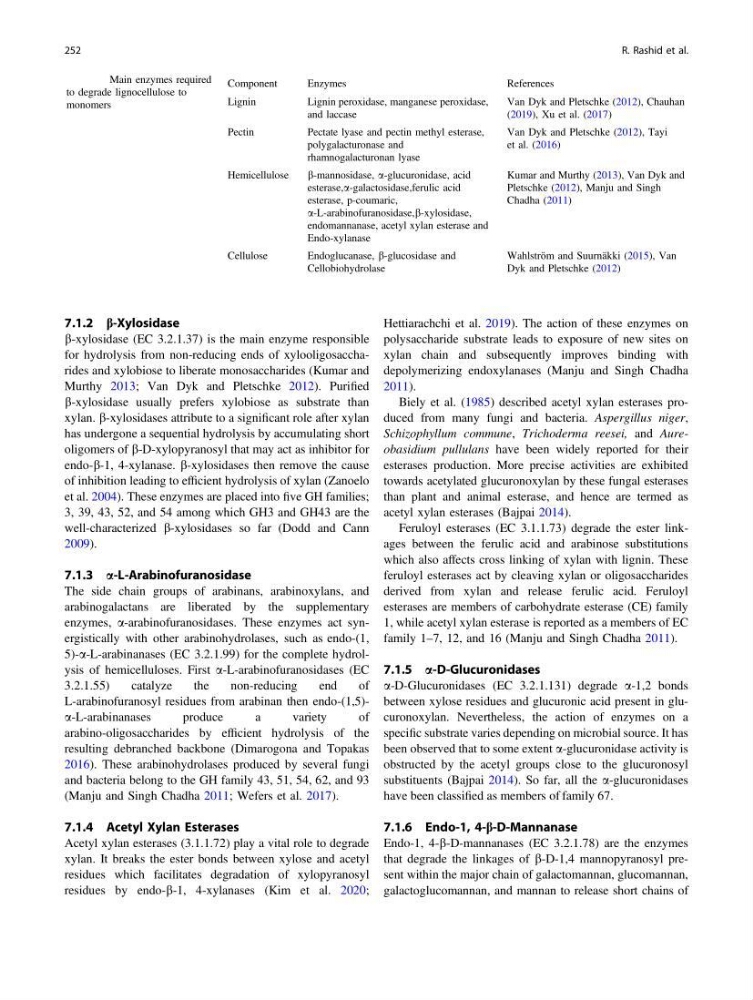
Table 5 Main enzymes required
to degrade lignocellulose to
monomers
Component
Enzymes
References
Lignin
Lignin peroxidase, manganese peroxidase,
and laccase
Van Dyk and Pletschke (2012), Chauhan
(2019), Xu et al. (2017)
Pectin
Pectate lyase and pectin methyl esterase,
polygalacturonase and
rhamnogalacturonan lyase
Van Dyk and Pletschke (2012), Tayi
et al. (2016)
Hemicellulose
b-mannosidase, a-glucuronidase, acid
esterase,a-galactosidase,ferulic acid
esterase, p-coumaric,
a-L-arabinofuranosidase,b-xylosidase,
endomannanase, acetyl xylan esterase and
Endo-xylanase
Kumar and Murthy (2013), Van Dyk and
Pletschke (2012), Manju and Singh
Chadha (2011)
Cellulose
Endoglucanase, b-glucosidase and
Cellobiohydrolase
Wahlström and Suurnäkki (2015), Van
Dyk and Pletschke (2012)
252
R. Rashid et al.
b-xylosidase (EC 3.2.1.37) is the main enzyme responsible
for hydrolysis from non-reducing ends of xylooligosaccharides and xylobiose to liberate monosaccharides (Kumar and
Murthy 2013; Van Dyk and Pletschke 2012). Purified
b-xylosidase usually prefers xylobiose as substrate than
xylan. b-xylosidases attribute to a significant role after xylan
has undergone a sequential hydrolysis by accumulating short
oligomers of b-D-xylopyranosyl that may act as inhibitor for
endo-b-1, 4-xylanase. b-xylosidases then remove the cause
of inhibition leading to efficient hydrolysis of xylan (Zanoelo
et al. 2004). These enzymes are placed into five GH families;
3, 39, 43, 52, and 54 among which GH3 and GH43 are the
well-characterized b-xylosidases so far (Dodd and Cann
2009).
7.1.3 a-L-Arabinofuranosidase
The side chain groups of arabinans, arabinoxylans, and
arabinogalactans are liberated by the supplementary
enzymes, a-arabinofuranosidases. These enzymes act synergistically with other arabinohydrolases, such as endo-(1,
5)-a-L-arabinanases (EC 3.2.1.99) for the complete hydrolysis of hemicelluloses. First a-L-arabinofuranosidases (EC
3.2.1.55)
catalyze
the
non-reducing
end
of
L-arabinofuranosyl residues from arabinan then endo-(1,5)a-L-arabinanases
produce
a
variety
of
arabino-oligosaccharides by efficient hydrolysis of the
resulting debranched backbone (Dimarogona and Topakas
2016). These arabinohydrolases produced by several fungi
and bacteria belong to the GH family 43, 51, 54, 62, and 93
(Manju and Singh Chadha 2011; Wefers et al. 2017).
7.1.4 Acetyl Xylan Esterases
Acetyl xylan esterases (3.1.1.72) play a vital role to degrade
xylan. It breaks the ester bonds between xylose and acetyl
residues which facilitates degradation of xylopyranosyl
residues by endo-b-1, 4-xylanases (Kim et al. 2020;
Hettiarachchi et al. 2019). The action of these enzymes on
polysaccharide substrate leads to exposure of new sites on
xylan chain and subsequently improves binding with
depolymerizing endoxylanases (Manju and Singh Chadha
2011).
Biely et al. (1985) described acetyl xylan esterases produced from many fungi and bacteria. Aspergillus niger,
Schizophyllum commune, Trichoderma reesei, and Aureobasidium pullulans have been widely reported for their
esterases production. More precise activities are exhibited
towards acetylated glucuronoxylan by these fungal esterases
than plant and animal esterase, and hence are termed as
acetyl xylan esterases (Bajpai 2014).
Feruloyl esterases (EC 3.1.1.73) degrade the ester linkages between the ferulic acid and arabinose substitutions
which also affects cross linking of xylan with lignin. These
feruloyl esterases act by cleaving xylan or oligosaccharides
derived from xylan and release ferulic acid. Feruloyl
esterases are members of carbohydrate esterase (CE) family
1, while acetyl xylan esterase is reported as a members of EC
family 1–7, 12, and 16 (Manju and Singh Chadha 2011).
7.1.5 a-D-Glucuronidases
a-D-Glucuronidases (EC 3.2.1.131) degrade a-1,2 bonds
between xylose residues and glucuronic acid present in glucuronoxylan. Nevertheless, the action of enzymes on a
specific substrate varies depending on microbial source. It has
been observed that to some extent a-glucuronidase activity is
obstructed by the acetyl groups close to the glucuronosyl
substituents (Bajpai 2014). So far, all the a-glucuronidases
have been classified as members of family 67.
7.1.6 Endo-1, 4-b-D-Mannanase
Endo-1, 4-b-D-mannanases (EC 3.2.1.78) are the enzymes
that degrade the linkages of b-D-1,4 mannopyranosyl present within the major chain of galactomannan, glucomannan,
galactoglucomannan, and mannan to release short chains of
Table 5 Main enzymes required
to degrade lignocellulose to
monomers
Component
Enzymes
References
Lignin
Lignin peroxidase, manganese peroxidase,
and laccase
Van Dyk and Pletschke (2012), Chauhan
(2019), Xu et al. (2017)
Pectin
Pectate lyase and pectin methyl esterase,
polygalacturonase and
rhamnogalacturonan lyase
Van Dyk and Pletschke (2012), Tayi
et al. (2016)
Hemicellulose
b-mannosidase, a-glucuronidase, acid
esterase,a-galactosidase,ferulic acid
esterase, p-coumaric,
a-L-arabinofuranosidase,b-xylosidase,
endomannanase, acetyl xylan esterase and
Endo-xylanase
Kumar and Murthy (2013), Van Dyk and
Pletschke (2012), Manju and Singh
Chadha (2011)
Cellulose
Endoglucanase, b-glucosidase and
Cellobiohydrolase
Wahlström and Suurnäkki (2015), Van
Dyk and Pletschke (2012)
252
R. Rashid et al.