

The heating value of cow dung is much lower
(10000 kJ/kg to 18000 kJ/kg) than wood because of its high
moisture content (Witt et al. 2006). While comparing the
carbon content, coal and wood have a proportion of (70%–
90%) and 50%, respectively. In contrast, dried cow dung has
roughly 25% carbon content, because of which large amount
of ash remains in the burner as an end product of dung-fire.
Although burning cow dung for cooking purposes is one of
the renewable and sustainable sources for many poverty
prone people throughout the world, the practice must be
prohibited as Masud et al. (2020)
• Dung has a significantly higher value as a bio-fertiliser;
therefore, if it is used as fuel, then there will not be a
sufficient amount to be used as fertiliser that will consequently affect the soil fertility.
• Compared to the combustion of wood; burning dung
releases more dioxins and chlorophenols that may substantially affect human health (Masud et al. 2020).
• Although, using dried cow dung as a source of solid fuel
is an example of reusing excreta, but one of the major
drawbacks is the increased air pollution (Mudway et al.
2005). However, the methanization of dung in a biogas
digester is a better alternative from the energy perspective
(Masud et al. 2020).
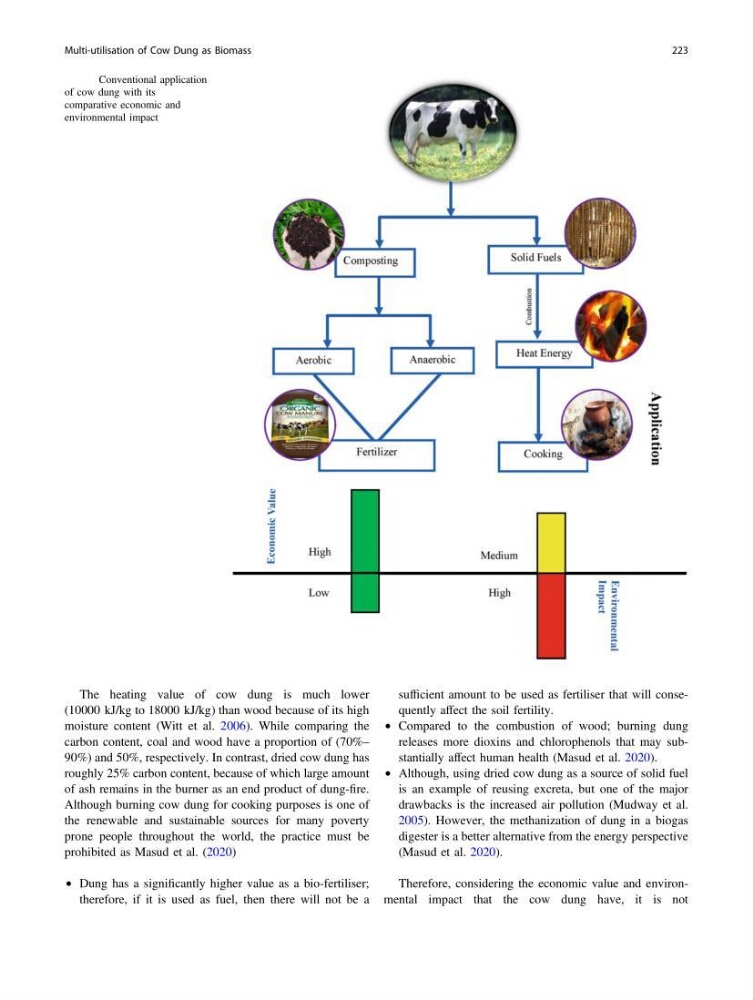
Therefore, considering the economic value and environmental impact that the cow dung have, it is not
Fig. 7 Conventional application
of cow dung with its
comparative economic and
environmental impact
Multi-utilisation of Cow Dung as Biomass
223
(10000 kJ/kg to 18000 kJ/kg) than wood because of its high
moisture content (Witt et al. 2006). While comparing the
carbon content, coal and wood have a proportion of (70%–
90%) and 50%, respectively. In contrast, dried cow dung has
roughly 25% carbon content, because of which large amount
of ash remains in the burner as an end product of dung-fire.
Although burning cow dung for cooking purposes is one of
the renewable and sustainable sources for many poverty
prone people throughout the world, the practice must be
prohibited as Masud et al. (2020)
• Dung has a significantly higher value as a bio-fertiliser;
therefore, if it is used as fuel, then there will not be a
sufficient amount to be used as fertiliser that will consequently affect the soil fertility.
• Compared to the combustion of wood; burning dung
releases more dioxins and chlorophenols that may substantially affect human health (Masud et al. 2020).
• Although, using dried cow dung as a source of solid fuel
is an example of reusing excreta, but one of the major
drawbacks is the increased air pollution (Mudway et al.
2005). However, the methanization of dung in a biogas
digester is a better alternative from the energy perspective
(Masud et al. 2020).
Therefore, considering the economic value and environmental impact that the cow dung have, it is not
Fig. 7 Conventional application
of cow dung with its
comparative economic and
environmental impact
Multi-utilisation of Cow Dung as Biomass
223