

recommended to use as solid fuel (Masud et al. 2020). There
are plenty of advanced techniques that can utilise cow dung
as a source of sustainable green energy which is proposed in
the next section.
5 Advanced Utilisation of Cow Dung
as Biomass
Cow dung is one of the most promising biomass resources
due to its abundance irrespective of geological position
(discussed in Sect. 2). In response to the global warming
crisis, the world is shifting towards sustainable energy
technologies, which has encouraged numerous biomass
innovations (Masud et al. 2019). Not only these technologies
are environmental friendly, but they are also inexpensive to
operate since the biomass feed material is comparatively
cheap. Through rigorous experimentation of different
physio-chemical properties of cow dung, researchers have
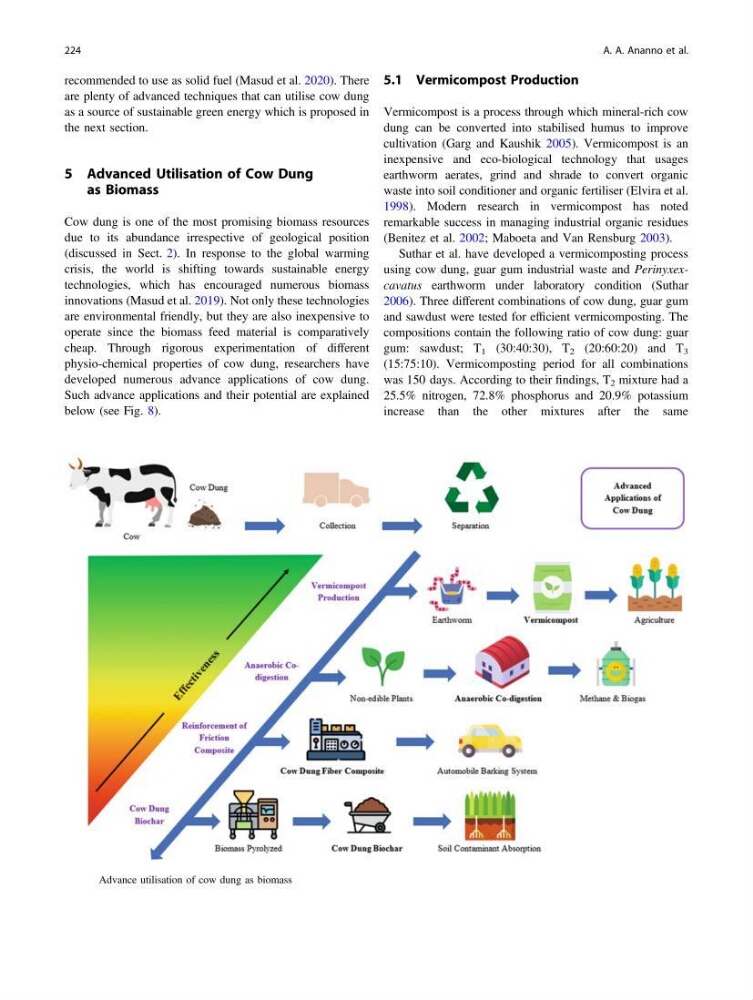
developed numerous advance applications of cow dung.
Such advance applications and their potential are explained
below (see Fig. 8).
5.1 Vermicompost Production
Vermicompost is a process through which mineral-rich cow
dung can be converted into stabilised humus to improve
cultivation (Garg and Kaushik 2005). Vermicompost is an
inexpensive and eco-biological technology that usages
earthworm aerates, grind and shrade to convert organic
waste into soil conditioner and organic fertiliser (Elvira et al.
1998). Modern research in vermicompost has noted
remarkable success in managing industrial organic residues
(Benitez et al. 2002; Maboeta and Van Rensburg 2003).
Suthar et al. have developed a vermicomposting process
using cow dung, guar gum industrial waste and Perinyxexcavatus earthworm under laboratory condition (Suthar
2006). Three different combinations of cow dung, guar gum
and sawdust were tested for efficient vermicomposting. The
compositions contain the following ratio of cow dung: guar
gum: sawdust; T 1 (30:40:30), T 2 (20:60:20) and T 3
(15:75:10). Vermicomposting period for all combinations
was 150 days. According to their findings, T 2 mixture had a
25.5% nitrogen, 72.8% phosphorus and 20.9% potassium
increase than the other mixtures after the same
Fig. 8 Advance utilisation of cow dung as biomass
224
A. A. Ananno et al.
are plenty of advanced techniques that can utilise cow dung
as a source of sustainable green energy which is proposed in
the next section.
5 Advanced Utilisation of Cow Dung
as Biomass
Cow dung is one of the most promising biomass resources
due to its abundance irrespective of geological position
(discussed in Sect. 2). In response to the global warming
crisis, the world is shifting towards sustainable energy
technologies, which has encouraged numerous biomass
innovations (Masud et al. 2019). Not only these technologies
are environmental friendly, but they are also inexpensive to
operate since the biomass feed material is comparatively
cheap. Through rigorous experimentation of different
physio-chemical properties of cow dung, researchers have
developed numerous advance applications of cow dung.
Such advance applications and their potential are explained
below (see Fig. 8).
5.1 Vermicompost Production
Vermicompost is a process through which mineral-rich cow
dung can be converted into stabilised humus to improve
cultivation (Garg and Kaushik 2005). Vermicompost is an
inexpensive and eco-biological technology that usages
earthworm aerates, grind and shrade to convert organic
waste into soil conditioner and organic fertiliser (Elvira et al.
1998). Modern research in vermicompost has noted
remarkable success in managing industrial organic residues
(Benitez et al. 2002; Maboeta and Van Rensburg 2003).
Suthar et al. have developed a vermicomposting process
using cow dung, guar gum industrial waste and Perinyxexcavatus earthworm under laboratory condition (Suthar
2006). Three different combinations of cow dung, guar gum
and sawdust were tested for efficient vermicomposting. The
compositions contain the following ratio of cow dung: guar
gum: sawdust; T 1 (30:40:30), T 2 (20:60:20) and T 3
(15:75:10). Vermicomposting period for all combinations
was 150 days. According to their findings, T 2 mixture had a
25.5% nitrogen, 72.8% phosphorus and 20.9% potassium
increase than the other mixtures after the same
Fig. 8 Advance utilisation of cow dung as biomass
224
A. A. Ananno et al.