

in the reduction of 4-nitrophenol to 4-aminophenol in the
presence of NaBH 4 was evaluated and 98% of the reduction
occurred within 40 min.
Agar was used as a support to obviate the recycling
problem of CuO nanoparticles in the catalytic reactions
(Kamal 2019). For this aim, CuO was prepared ex situ
during a microwave heating route and then its nanocomposite with agar/CuO weight ratio of 9/1 was fabricated. The
catalytic efficiency of the nanocomposite in reducing a series
of nitroarenes including 4-nitrophenol, 2, 6-dinitrophenol
and 2-nitrophenol was investigated and acceptable results
were observed. However, it showed lower activity compared
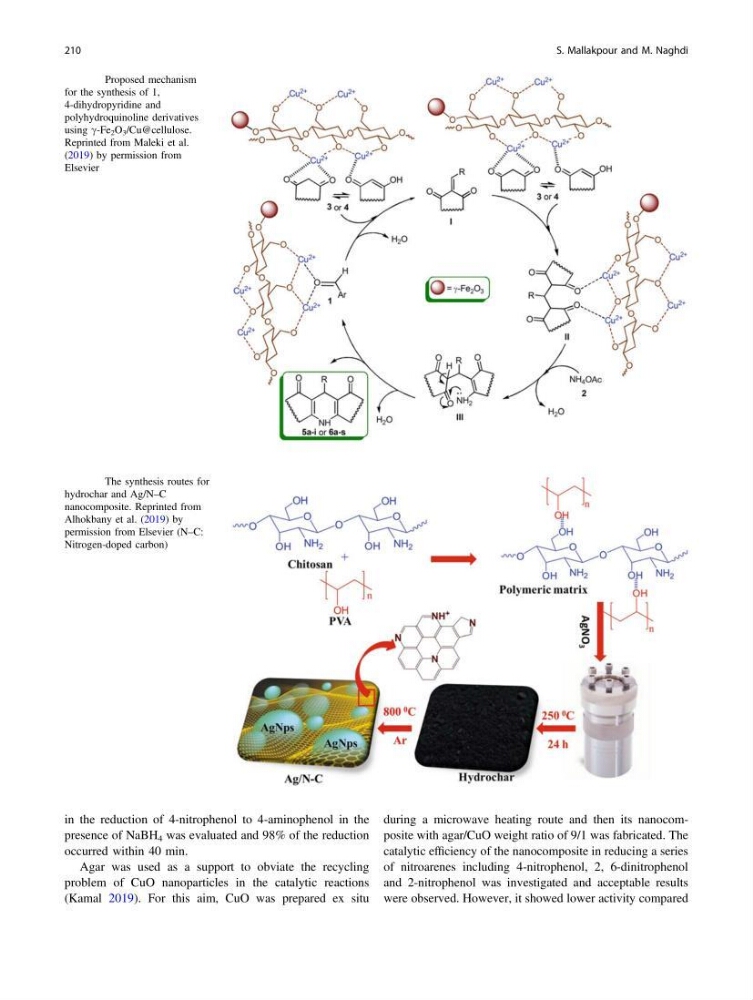
Fig. 16 Proposed mechanism
for the synthesis of 1,
4-dihydropyridine and
polyhydroquinoline derivatives
using c-Fe 2 O 3 /Cu@cellulose.
Reprinted from Maleki et al.
(2019) by permission from
Elsevier
Fig. 17 The synthesis routes for
hydrochar and Ag/N–C
nanocomposite. Reprinted from
Alhokbany et al. (2019) by
permission from Elsevier (N–C:
Nitrogen-doped carbon)
210
S. Mallakpour and M. Naghdi
presence of NaBH 4 was evaluated and 98% of the reduction
occurred within 40 min.
Agar was used as a support to obviate the recycling
problem of CuO nanoparticles in the catalytic reactions
(Kamal 2019). For this aim, CuO was prepared ex situ
during a microwave heating route and then its nanocomposite with agar/CuO weight ratio of 9/1 was fabricated. The
catalytic efficiency of the nanocomposite in reducing a series
of nitroarenes including 4-nitrophenol, 2, 6-dinitrophenol
and 2-nitrophenol was investigated and acceptable results
were observed. However, it showed lower activity compared
Fig. 16 Proposed mechanism
for the synthesis of 1,
4-dihydropyridine and
polyhydroquinoline derivatives
using c-Fe 2 O 3 /Cu@cellulose.
Reprinted from Maleki et al.
(2019) by permission from
Elsevier
Fig. 17 The synthesis routes for
hydrochar and Ag/N–C
nanocomposite. Reprinted from
Alhokbany et al. (2019) by
permission from Elsevier (N–C:
Nitrogen-doped carbon)
210
S. Mallakpour and M. Naghdi