

Javaid et al. (2018) used the potential of chitosan to add
antibacterial feature to polyurethane. For this aim, they
prepared bionanocomposite films by applying different mole
ratios of chitosan and 1, 4-butane diol during a step-growth
polymerization. Antibacterial activity showed an uptrend by
enhancing the amount of chitosan. They commentated
interaction between chitosan molecules with the positive
charge and microbial cell wall with negative charge leads to
the hydrolysis of peptidogycans in the bacterial wall, and
consequently outflowing the intracellular electrolytes. In
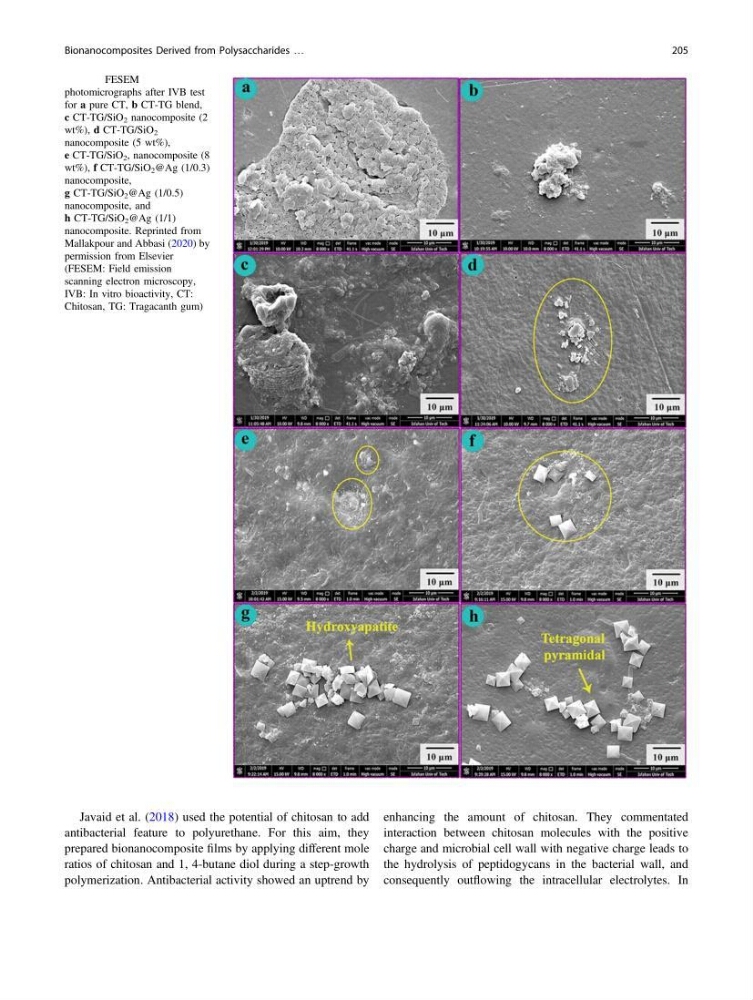
Fig. 12 FESEM
photomicrographs after IVB test
for a pure CT, b CT-TG blend,
c CT-TG/SiO 2 nanocomposite (2
wt%), d CT-TG/SiO 2
nanocomposite (5 wt%),
e CT-TG/SiO 2 , nanocomposite (8
wt%), f CT-TG/SiO 2 @Ag (1/0.3)
nanocomposite,
g CT-TG/SiO 2 @Ag (1/0.5)
nanocomposite, and
h CT-TG/SiO 2 @Ag (1/1)
nanocomposite. Reprinted from
Mallakpour and Abbasi (2020) by
permission from Elsevier
(FESEM: Field emission
scanning electron microscopy,
IVB: In vitro bioactivity, CT:
Chitosan, TG: Tragacanth gum)
Bionanocomposites Derived from Polysaccharides …
205
antibacterial feature to polyurethane. For this aim, they
prepared bionanocomposite films by applying different mole
ratios of chitosan and 1, 4-butane diol during a step-growth
polymerization. Antibacterial activity showed an uptrend by
enhancing the amount of chitosan. They commentated
interaction between chitosan molecules with the positive
charge and microbial cell wall with negative charge leads to
the hydrolysis of peptidogycans in the bacterial wall, and
consequently outflowing the intracellular electrolytes. In
Fig. 12 FESEM
photomicrographs after IVB test
for a pure CT, b CT-TG blend,
c CT-TG/SiO 2 nanocomposite (2
wt%), d CT-TG/SiO 2
nanocomposite (5 wt%),
e CT-TG/SiO 2 , nanocomposite (8
wt%), f CT-TG/SiO 2 @Ag (1/0.3)
nanocomposite,
g CT-TG/SiO 2 @Ag (1/0.5)
nanocomposite, and
h CT-TG/SiO 2 @Ag (1/1)
nanocomposite. Reprinted from
Mallakpour and Abbasi (2020) by
permission from Elsevier
(FESEM: Field emission
scanning electron microscopy,
IVB: In vitro bioactivity, CT:
Chitosan, TG: Tragacanth gum)
Bionanocomposites Derived from Polysaccharides …
205