

Pectin/Ag nanocomposite films were proposed by Kodoth
et al. (2019) to be used for transdermal delivery of Donepezil. Oral therapy of Donepezil has some problems for
patients, so its transdermal delivery could be a proper way to
overcome the problems. Toxicity of the drug-loaded
nanocomposite was studied and results showed compatibility with blood cells. Cumulative drug release within 120 min
was reported to be 94%. Totally, taking the antibacterial
activity of the nanocomposite film into account, it could be
proper for the transdermal delivery of drugs.
Abbasian et al. (2020) developed nanocarriers to enhance
the solubility of drugs and consequently enhance its circulation time. For this aim, microcrystalline cellulose was
modified using xanthate and then it was coated with dimethyl amino ethyl methacrylate quaternary ammonium alkyl
halide as well as polyacrylates-coated nanoparticles. ZnO
and Fe 3 O 4 nanoparticles were used to inhibit drug afflux and
enhance its intracellular cumulation. The prepared
nanocomposite was conjugated with methotrexate to be used
for targeted therapy of breast cancer cell line. The release
behavior of the prepared nanocomposite was studied in vitro
and it seemed to be a pH-responsive phenomenon. The
releasing rate in simulated physicochemical conditions, i.e.,
pH = 7.4 and temperature of 37 °C was slow, while in
pH = 5.4 and temperature of 40 °C, which is known as the
cancerous simulated conditions it showed faster release.
They declared this method could be an alternative for conventional chemotherapy.
Encapsulation of 5-fluorouracil in ZnO/carboxymethyl
cellulose/chitosan nanocomposites has been proposed for
effective delivery of this drug to the colon (Sun et al. 2019).
In this methodology, at first, nanocomposite beads based on
carboxymethyl cellulose embedded with small quantities of
ZnO nanoparticles were prepared. In order to create a protective layer against acidic gastric juice, chitosan was
assembled onto the carboxymethyl cellulose using electrostatic interactions between two polysaccharides. The
drug-release behavior of the prepared nanocomposite in
conditions similar to gastrointestinal was studied and <20%
of 5-fluorouracil was released during 2 h at pH = 1.2, which
was similar to gastric fluid. However, in higher pHs, the rate
of drug release enhanced and 80% of 5-fluorouracil released
at pH = 6.8 after 5 h. Finally, it was observed in pH = 7.4
release rate was even higher. The probable mechanism for
these observations may be ionization of amino functional
groups of the external chitosan layer and presence of ZnO
nanoparticles, which provides a pathway allowing the drug
to release. However, over the time and exhaustion of the
chitosan layer, exposure to higher pHs led to protonation of
the carboxymethyl cellulose layer and facilitate the drug
release.
In a study by Mallakpour and Khodadadzadeh (2018), the
ability
of
starch/multi-walled
carbon
nanotubes
nanocomposites for delivery of zolpidem was studied. At
first, multi-walled carbon nanotubes were modified using
D-glucose to make it hydrophilic. Afterward, starch-based
nanocomposite films containing different amounts of
multi-walled carbon nanotubes were prepared. They were
reacted with oleic acid to make them amphiphilic and prepare starch nanoparticles. It is worth to note that nanoparticles were formed only when multi-walled carbon
nanotubes were present and without them, i.e., in the presence of just starch, no nanoparticles were formed. Finally
based on dynamic light scattering results, nanocomposite
embedded with 2 wt% of multi-walled carbon nanotubes
loaded with the intended drug had the lowest mean diameter.
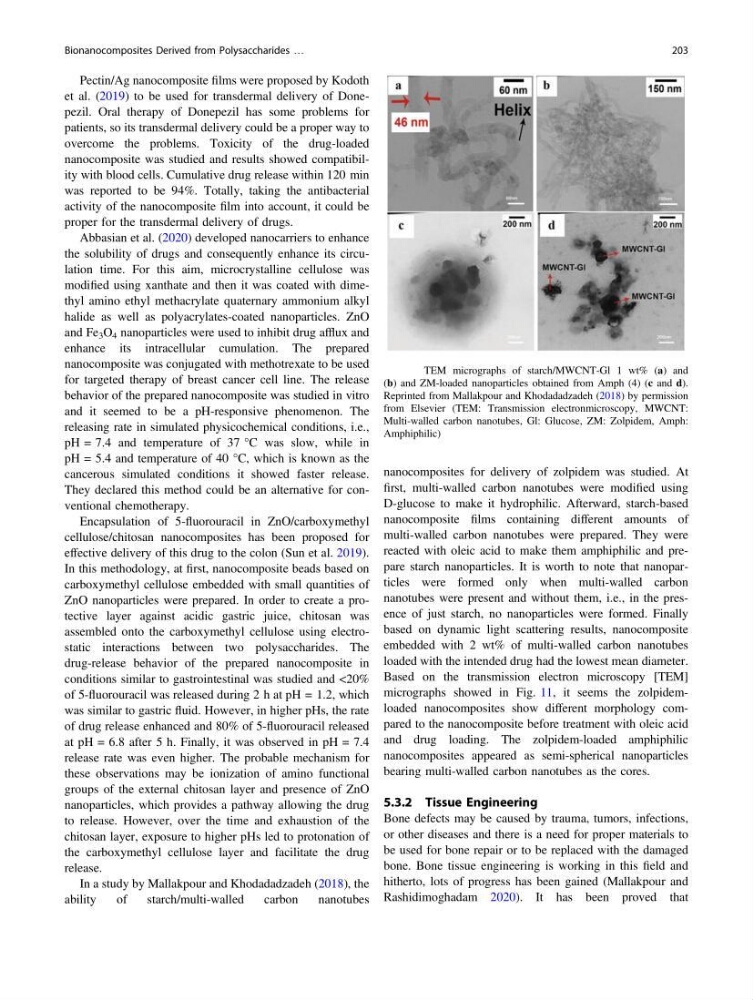
Based on the transmission electron microscopy [TEM]
micrographs showed in Fig. 11, it seems the zolpidemloaded nanocomposites show different morphology compared to the nanocomposite before treatment with oleic acid
and drug loading. The zolpidem-loaded amphiphilic
nanocomposites appeared as semi-spherical nanoparticles
bearing multi-walled carbon nanotubes as the cores.
5.3.2 Tissue Engineering
Bone defects may be caused by trauma, tumors, infections,
or other diseases and there is a need for proper materials to
be used for bone repair or to be replaced with the damaged
bone. Bone tissue engineering is working in this field and
hitherto, lots of progress has been gained (Mallakpour and
Rashidimoghadam 2020). It has been proved that
Fig. 11 TEM micrographs of starch/MWCNT-Gl 1 wt% (a) and
(b) and ZM-loaded nanoparticles obtained from Amph (4) (c and d).
Reprinted from Mallakpour and Khodadadzadeh (2018) by permission
from Elsevier (TEM: Transmission electronmicroscopy, MWCNT:
Multi-walled carbon nanotubes, Gl: Glucose, ZM: Zolpidem, Amph:
Amphiphilic)
Bionanocomposites Derived from Polysaccharides …
203
et al. (2019) to be used for transdermal delivery of Donepezil. Oral therapy of Donepezil has some problems for
patients, so its transdermal delivery could be a proper way to
overcome the problems. Toxicity of the drug-loaded
nanocomposite was studied and results showed compatibility with blood cells. Cumulative drug release within 120 min
was reported to be 94%. Totally, taking the antibacterial
activity of the nanocomposite film into account, it could be
proper for the transdermal delivery of drugs.
Abbasian et al. (2020) developed nanocarriers to enhance
the solubility of drugs and consequently enhance its circulation time. For this aim, microcrystalline cellulose was
modified using xanthate and then it was coated with dimethyl amino ethyl methacrylate quaternary ammonium alkyl
halide as well as polyacrylates-coated nanoparticles. ZnO
and Fe 3 O 4 nanoparticles were used to inhibit drug afflux and
enhance its intracellular cumulation. The prepared
nanocomposite was conjugated with methotrexate to be used
for targeted therapy of breast cancer cell line. The release
behavior of the prepared nanocomposite was studied in vitro
and it seemed to be a pH-responsive phenomenon. The
releasing rate in simulated physicochemical conditions, i.e.,
pH = 7.4 and temperature of 37 °C was slow, while in
pH = 5.4 and temperature of 40 °C, which is known as the
cancerous simulated conditions it showed faster release.
They declared this method could be an alternative for conventional chemotherapy.
Encapsulation of 5-fluorouracil in ZnO/carboxymethyl
cellulose/chitosan nanocomposites has been proposed for
effective delivery of this drug to the colon (Sun et al. 2019).
In this methodology, at first, nanocomposite beads based on
carboxymethyl cellulose embedded with small quantities of
ZnO nanoparticles were prepared. In order to create a protective layer against acidic gastric juice, chitosan was
assembled onto the carboxymethyl cellulose using electrostatic interactions between two polysaccharides. The
drug-release behavior of the prepared nanocomposite in
conditions similar to gastrointestinal was studied and <20%
of 5-fluorouracil was released during 2 h at pH = 1.2, which
was similar to gastric fluid. However, in higher pHs, the rate
of drug release enhanced and 80% of 5-fluorouracil released
at pH = 6.8 after 5 h. Finally, it was observed in pH = 7.4
release rate was even higher. The probable mechanism for
these observations may be ionization of amino functional
groups of the external chitosan layer and presence of ZnO
nanoparticles, which provides a pathway allowing the drug
to release. However, over the time and exhaustion of the
chitosan layer, exposure to higher pHs led to protonation of
the carboxymethyl cellulose layer and facilitate the drug
release.
In a study by Mallakpour and Khodadadzadeh (2018), the
ability
of
starch/multi-walled
carbon
nanotubes
nanocomposites for delivery of zolpidem was studied. At
first, multi-walled carbon nanotubes were modified using
D-glucose to make it hydrophilic. Afterward, starch-based
nanocomposite films containing different amounts of
multi-walled carbon nanotubes were prepared. They were
reacted with oleic acid to make them amphiphilic and prepare starch nanoparticles. It is worth to note that nanoparticles were formed only when multi-walled carbon
nanotubes were present and without them, i.e., in the presence of just starch, no nanoparticles were formed. Finally
based on dynamic light scattering results, nanocomposite
embedded with 2 wt% of multi-walled carbon nanotubes
loaded with the intended drug had the lowest mean diameter.
Based on the transmission electron microscopy [TEM]
micrographs showed in Fig. 11, it seems the zolpidemloaded nanocomposites show different morphology compared to the nanocomposite before treatment with oleic acid
and drug loading. The zolpidem-loaded amphiphilic
nanocomposites appeared as semi-spherical nanoparticles
bearing multi-walled carbon nanotubes as the cores.
5.3.2 Tissue Engineering
Bone defects may be caused by trauma, tumors, infections,
or other diseases and there is a need for proper materials to
be used for bone repair or to be replaced with the damaged
bone. Bone tissue engineering is working in this field and
hitherto, lots of progress has been gained (Mallakpour and
Rashidimoghadam 2020). It has been proved that
Fig. 11 TEM micrographs of starch/MWCNT-Gl 1 wt% (a) and
(b) and ZM-loaded nanoparticles obtained from Amph (4) (c and d).
Reprinted from Mallakpour and Khodadadzadeh (2018) by permission
from Elsevier (TEM: Transmission electronmicroscopy, MWCNT:
Multi-walled carbon nanotubes, Gl: Glucose, ZM: Zolpidem, Amph:
Amphiphilic)
Bionanocomposites Derived from Polysaccharides …
203