

hydrogel showed a sustained release. Besides, the prepared
hydrogels loaded with ciprofloxacin presented antibacterial
activity against both Escherichia coli and Staphylococcus
aureus. All the results showed the prepared materials have
the potential to be used as drug delivery systems.
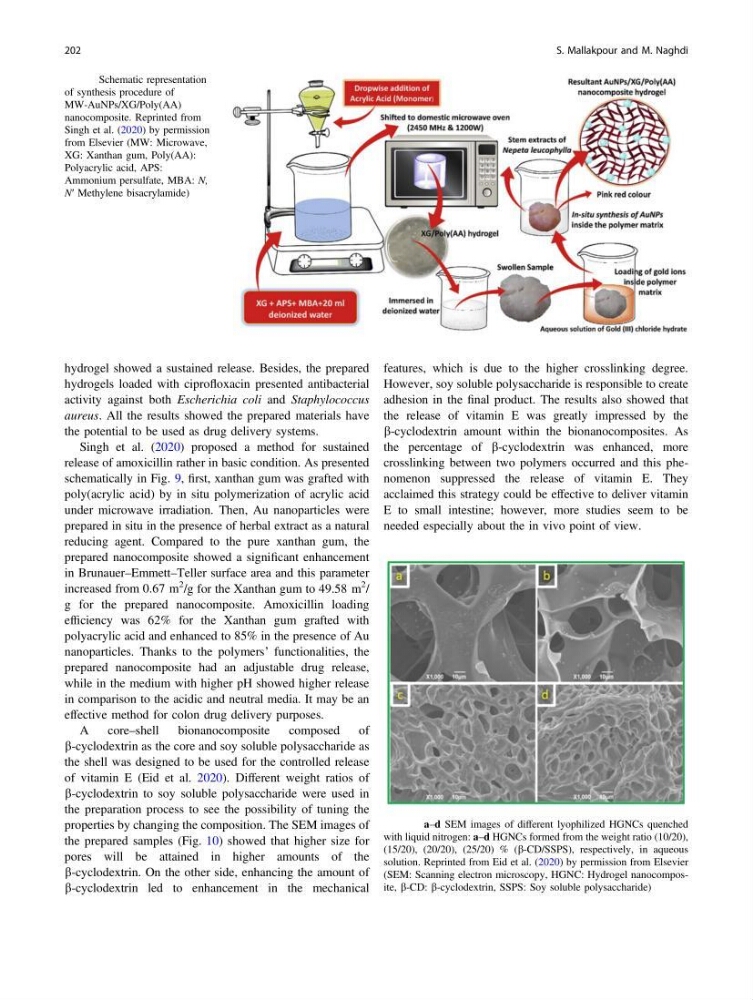
Singh et al. (2020) proposed a method for sustained
release of amoxicillin rather in basic condition. As presented
schematically in Fig. 9, first, xanthan gum was grafted with
poly(acrylic acid) by in situ polymerization of acrylic acid
under microwave irradiation. Then, Au nanoparticles were
prepared in situ in the presence of herbal extract as a natural
reducing agent. Compared to the pure xanthan gum, the
prepared nanocomposite showed a significant enhancement
in Brunauer–Emmett–Teller surface area and this parameter
increased from 0.67 m
2 /g for the Xanthan gum to 49.58 m
2 /
g for the prepared nanocomposite. Amoxicillin loading
efficiency was 62% for the Xanthan gum grafted with
polyacrylic acid and enhanced to 85% in the presence of Au
nanoparticles. Thanks to the polymersʼ functionalities, the
prepared nanocomposite had an adjustable drug release,
while in the medium with higher pH showed higher release
in comparison to the acidic and neutral media. It may be an
effective method for colon drug delivery purposes.
A
core–shell
bionanocomposite
composed
of
b-cyclodextrin as the core and soy soluble polysaccharide as
the shell was designed to be used for the controlled release
of vitamin E (Eid et al. 2020). Different weight ratios of
b-cyclodextrin to soy soluble polysaccharide were used in
the preparation process to see the possibility of tuning the
properties by changing the composition. The SEM images of
the prepared samples (Fig. 10) showed that higher size for
pores will be attained in higher amounts of the
b-cyclodextrin. On the other side, enhancing the amount of
b-cyclodextrin led to enhancement in the mechanical
features, which is due to the higher crosslinking degree.
However, soy soluble polysaccharide is responsible to create
adhesion in the final product. The results also showed that
the release of vitamin E was greatly impressed by the
b-cyclodextrin amount within the bionanocomposites. As
the percentage of b-cyclodextrin was enhanced, more
crosslinking between two polymers occurred and this phenomenon suppressed the release of vitamin E. They
acclaimed this strategy could be effective to deliver vitamin
E to small intestine; however, more studies seem to be
needed especially about the in vivo point of view.
Fig. 9 Schematic representation
of synthesis procedure of
MW-AuNPs/XG/Poly(AA)
nanocomposite. Reprinted from
Singh et al. (2020) by permission
from Elsevier (MW: Microwave,
XG: Xanthan gum, Poly(AA):
Polyacrylic acid, APS:
Ammonium persulfate, MBA: N,
N′ Methylene bisacrylamide)
Fig. 10 a–d SEM images of different lyophilized HGNCs quenched
with liquid nitrogen: a–d HGNCs formed from the weight ratio (10/20),
(15/20), (20/20), (25/20) % (b-CD/SSPS), respectively, in aqueous
solution. Reprinted from Eid et al. (2020) by permission from Elsevier
(SEM: Scanning electron microscopy, HGNC: Hydrogel nanocomposite, b-CD: b-cyclodextrin, SSPS: Soy soluble polysaccharide)
202
S. Mallakpour and M. Naghdi
hydrogels loaded with ciprofloxacin presented antibacterial
activity against both Escherichia coli and Staphylococcus
aureus. All the results showed the prepared materials have
the potential to be used as drug delivery systems.
Singh et al. (2020) proposed a method for sustained
release of amoxicillin rather in basic condition. As presented
schematically in Fig. 9, first, xanthan gum was grafted with
poly(acrylic acid) by in situ polymerization of acrylic acid
under microwave irradiation. Then, Au nanoparticles were
prepared in situ in the presence of herbal extract as a natural
reducing agent. Compared to the pure xanthan gum, the
prepared nanocomposite showed a significant enhancement
in Brunauer–Emmett–Teller surface area and this parameter
increased from 0.67 m
2 /g for the Xanthan gum to 49.58 m
2 /
g for the prepared nanocomposite. Amoxicillin loading
efficiency was 62% for the Xanthan gum grafted with
polyacrylic acid and enhanced to 85% in the presence of Au
nanoparticles. Thanks to the polymersʼ functionalities, the
prepared nanocomposite had an adjustable drug release,
while in the medium with higher pH showed higher release
in comparison to the acidic and neutral media. It may be an
effective method for colon drug delivery purposes.
A
core–shell
bionanocomposite
composed
of
b-cyclodextrin as the core and soy soluble polysaccharide as
the shell was designed to be used for the controlled release
of vitamin E (Eid et al. 2020). Different weight ratios of
b-cyclodextrin to soy soluble polysaccharide were used in
the preparation process to see the possibility of tuning the
properties by changing the composition. The SEM images of
the prepared samples (Fig. 10) showed that higher size for
pores will be attained in higher amounts of the
b-cyclodextrin. On the other side, enhancing the amount of
b-cyclodextrin led to enhancement in the mechanical
features, which is due to the higher crosslinking degree.
However, soy soluble polysaccharide is responsible to create
adhesion in the final product. The results also showed that
the release of vitamin E was greatly impressed by the
b-cyclodextrin amount within the bionanocomposites. As
the percentage of b-cyclodextrin was enhanced, more
crosslinking between two polymers occurred and this phenomenon suppressed the release of vitamin E. They
acclaimed this strategy could be effective to deliver vitamin
E to small intestine; however, more studies seem to be
needed especially about the in vivo point of view.
Fig. 9 Schematic representation
of synthesis procedure of
MW-AuNPs/XG/Poly(AA)
nanocomposite. Reprinted from
Singh et al. (2020) by permission
from Elsevier (MW: Microwave,
XG: Xanthan gum, Poly(AA):
Polyacrylic acid, APS:
Ammonium persulfate, MBA: N,
N′ Methylene bisacrylamide)
Fig. 10 a–d SEM images of different lyophilized HGNCs quenched
with liquid nitrogen: a–d HGNCs formed from the weight ratio (10/20),
(15/20), (20/20), (25/20) % (b-CD/SSPS), respectively, in aqueous
solution. Reprinted from Eid et al. (2020) by permission from Elsevier
(SEM: Scanning electron microscopy, HGNC: Hydrogel nanocomposite, b-CD: b-cyclodextrin, SSPS: Soy soluble polysaccharide)
202
S. Mallakpour and M. Naghdi