

synthesized and then they were added to the chitosan solution and after ultrasonic irradiation of the resulted suspension, bionanocomposite film was prepared by the solution
casting technique. Glycerol was used as the plasticizer and
the amount of Fe 3 O 4 nanoparticles within the polymer
matrix was 10 wt%. The performance of the pure chitosan,
chitosan containing glycerol, and chitosan/Fe 3 O 4 with and
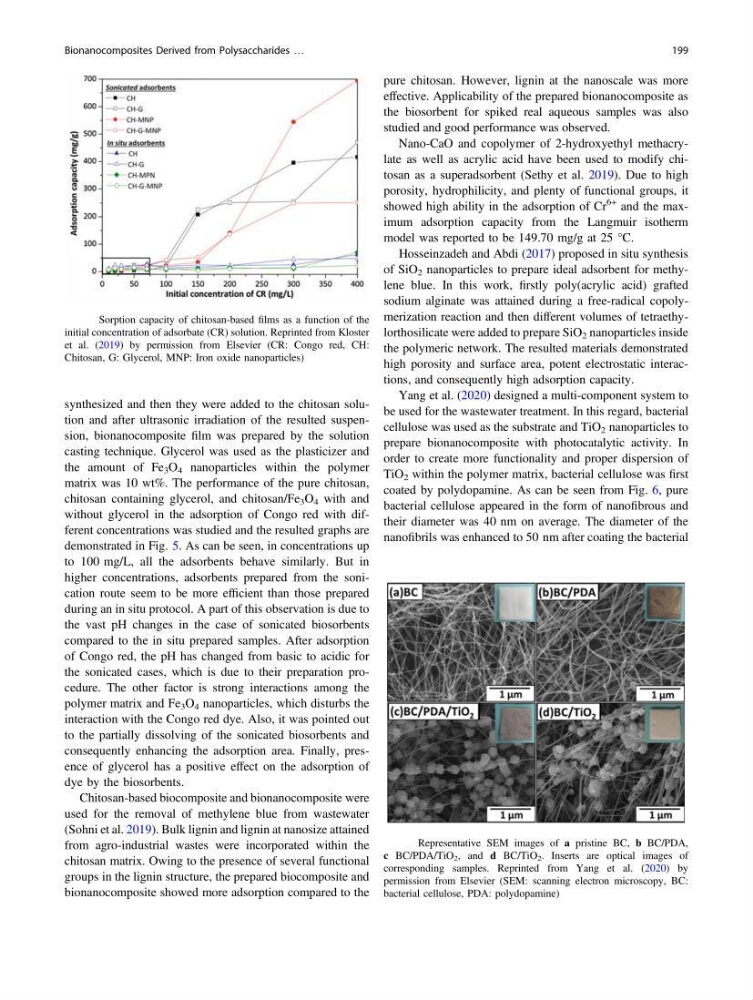
without glycerol in the adsorption of Congo red with different concentrations was studied and the resulted graphs are
demonstrated in Fig. 5. As can be seen, in concentrations up
to 100 mg/L, all the adsorbents behave similarly. But in
higher concentrations, adsorbents prepared from the sonication route seem to be more efficient than those prepared
during an in situ protocol. A part of this observation is due to
the vast pH changes in the case of sonicated biosorbents
compared to the in situ prepared samples. After adsorption
of Congo red, the pH has changed from basic to acidic for
the sonicated cases, which is due to their preparation procedure. The other factor is strong interactions among the
polymer matrix and Fe 3 O 4 nanoparticles, which disturbs the
interaction with the Congo red dye. Also, it was pointed out
to the partially dissolving of the sonicated biosorbents and
consequently enhancing the adsorption area. Finally, presence of glycerol has a positive effect on the adsorption of
dye by the biosorbents.
Chitosan-based biocomposite and bionanocomposite were
used for the removal of methylene blue from wastewater
(Sohni et al. 2019). Bulk lignin and lignin at nanosize attained
from agro-industrial wastes were incorporated within the
chitosan matrix. Owing to the presence of several functional
groups in the lignin structure, the prepared biocomposite and
bionanocomposite showed more adsorption compared to the
pure chitosan. However, lignin at the nanoscale was more
effective. Applicability of the prepared bionanocomposite as
the biosorbent for spiked real aqueous samples was also
studied and good performance was observed.
Nano-CaO and copolymer of 2-hydroxyethyl methacrylate as well as acrylic acid have been used to modify chitosan as a superadsorbent (Sethy et al. 2019). Due to high
porosity, hydrophilicity, and plenty of functional groups, it
showed high ability in the adsorption of Cr
6+ and the maximum adsorption capacity from the Langmuir isotherm
model was reported to be 149.70 mg/g at 25 °C.
Hosseinzadeh and Abdi (2017) proposed in situ synthesis
of SiO 2 nanoparticles to prepare ideal adsorbent for methylene blue. In this work, firstly poly(acrylic acid) grafted
sodium alginate was attained during a free-radical copolymerization reaction and then different volumes of tetraethylorthosilicate were added to prepare SiO 2 nanoparticles inside
the polymeric network. The resulted materials demonstrated
high porosity and surface area, potent electrostatic interactions, and consequently high adsorption capacity.
Yang et al. (2020) designed a multi-component system to
be used for the wastewater treatment. In this regard, bacterial
cellulose was used as the substrate and TiO 2 nanoparticles to
prepare bionanocomposite with photocatalytic activity. In
order to create more functionality and proper dispersion of
TiO 2 within the polymer matrix, bacterial cellulose was first
coated by polydopamine. As can be seen from Fig. 6, pure
bacterial cellulose appeared in the form of nanofibrous and
their diameter was 40 nm on average. The diameter of the
nanofibrils was enhanced to 50 nm after coating the bacterial
Fig. 5 Sorption capacity of chitosan-based films as a function of the
initial concentration of adsorbate (CR) solution. Reprinted from Kloster
et al. (2019) by permission from Elsevier (CR: Congo red, CH:
Chitosan, G: Glycerol, MNP: Iron oxide nanoparticles)
Fig. 6 Representative SEM images of a pristine BC, b BC/PDA,
c BC/PDA/TiO 2 , and d BC/TiO 2 . Inserts are optical images of
corresponding samples. Reprinted from Yang et al. (2020) by
permission from Elsevier (SEM: scanning electron microscopy, BC:
bacterial cellulose, PDA: polydopamine)
Bionanocomposites Derived from Polysaccharides …
199
casting technique. Glycerol was used as the plasticizer and
the amount of Fe 3 O 4 nanoparticles within the polymer
matrix was 10 wt%. The performance of the pure chitosan,
chitosan containing glycerol, and chitosan/Fe 3 O 4 with and
without glycerol in the adsorption of Congo red with different concentrations was studied and the resulted graphs are
demonstrated in Fig. 5. As can be seen, in concentrations up
to 100 mg/L, all the adsorbents behave similarly. But in
higher concentrations, adsorbents prepared from the sonication route seem to be more efficient than those prepared
during an in situ protocol. A part of this observation is due to
the vast pH changes in the case of sonicated biosorbents
compared to the in situ prepared samples. After adsorption
of Congo red, the pH has changed from basic to acidic for
the sonicated cases, which is due to their preparation procedure. The other factor is strong interactions among the
polymer matrix and Fe 3 O 4 nanoparticles, which disturbs the
interaction with the Congo red dye. Also, it was pointed out
to the partially dissolving of the sonicated biosorbents and
consequently enhancing the adsorption area. Finally, presence of glycerol has a positive effect on the adsorption of
dye by the biosorbents.
Chitosan-based biocomposite and bionanocomposite were
used for the removal of methylene blue from wastewater
(Sohni et al. 2019). Bulk lignin and lignin at nanosize attained
from agro-industrial wastes were incorporated within the
chitosan matrix. Owing to the presence of several functional
groups in the lignin structure, the prepared biocomposite and
bionanocomposite showed more adsorption compared to the
pure chitosan. However, lignin at the nanoscale was more
effective. Applicability of the prepared bionanocomposite as
the biosorbent for spiked real aqueous samples was also
studied and good performance was observed.
Nano-CaO and copolymer of 2-hydroxyethyl methacrylate as well as acrylic acid have been used to modify chitosan as a superadsorbent (Sethy et al. 2019). Due to high
porosity, hydrophilicity, and plenty of functional groups, it
showed high ability in the adsorption of Cr
6+ and the maximum adsorption capacity from the Langmuir isotherm
model was reported to be 149.70 mg/g at 25 °C.
Hosseinzadeh and Abdi (2017) proposed in situ synthesis
of SiO 2 nanoparticles to prepare ideal adsorbent for methylene blue. In this work, firstly poly(acrylic acid) grafted
sodium alginate was attained during a free-radical copolymerization reaction and then different volumes of tetraethylorthosilicate were added to prepare SiO 2 nanoparticles inside
the polymeric network. The resulted materials demonstrated
high porosity and surface area, potent electrostatic interactions, and consequently high adsorption capacity.
Yang et al. (2020) designed a multi-component system to
be used for the wastewater treatment. In this regard, bacterial
cellulose was used as the substrate and TiO 2 nanoparticles to
prepare bionanocomposite with photocatalytic activity. In
order to create more functionality and proper dispersion of
TiO 2 within the polymer matrix, bacterial cellulose was first
coated by polydopamine. As can be seen from Fig. 6, pure
bacterial cellulose appeared in the form of nanofibrous and
their diameter was 40 nm on average. The diameter of the
nanofibrils was enhanced to 50 nm after coating the bacterial
Fig. 5 Sorption capacity of chitosan-based films as a function of the
initial concentration of adsorbate (CR) solution. Reprinted from Kloster
et al. (2019) by permission from Elsevier (CR: Congo red, CH:
Chitosan, G: Glycerol, MNP: Iron oxide nanoparticles)
Fig. 6 Representative SEM images of a pristine BC, b BC/PDA,
c BC/PDA/TiO 2 , and d BC/TiO 2 . Inserts are optical images of
corresponding samples. Reprinted from Yang et al. (2020) by
permission from Elsevier (SEM: scanning electron microscopy, BC:
bacterial cellulose, PDA: polydopamine)
Bionanocomposites Derived from Polysaccharides …
199