

cellulose with polydopamine. By comparing Fig. 5c and d,
they concluded that the presence of polydopamine within the
nanocomposite leads to better dispersion of TiO 2 nanoparticles within the polymer matrix. The prepared nanocomposite showed efficiency in both photocatalytic degradation
and removal of methyl orange, methylene blue, and rhodamine B. Presence of active sites and high surface area as a
result of fine dispersion of TiO 2 nanoparticles is effective
factors on the removal process. The photocatalytic activity of
the prepared nanocomposite was compared with commercial
P25 and showed superiority. Using photoluminescence
spectra, it was confirmed that presence of polydopamine
resulted in the separation of electron–hole moieties created at
the interface of TiO 2 and polydopamine, and consequently
improved the photocatalytic performance.
Li et al. (2020) applied Al 2 O 3 -hydroxyapatite composite
to modify chitosan and make it a proper adsorbent for the
water remediation purposes. Following this purpose,
hydroxyapatite was synthesized in situ in the presence of
Al 2 O 3 nanoparticles. The specific surface area and pore
volume gathered from Brunauer–Emmett–Teller analysis
showed significant improvement for the prepared
chitosan/Al 2 O 3 -hydroxyapatite beads compared to the neat
chitosan. The performance of the prepared nanocomposite
beads in the elimination of estradiol and chrysoidine from
aqueous solution was examined and its efficiency was
compared with pure chitosan. The maximum adsorption
capacity dramatically enhanced by incorporation of the
Al 2 O 3 -hydroxyapatite within the chitosan matrix. In the case
of estradiol removal, it enhanced from 29.04 to 39.78 mg/g,
while for the chrysoidine adsorption, it improved from 8.60
to 23.26 mg/g. However, no optimization on the amount of
the adsorbent was done.
A series of pullulan-based nanocomposite hydrogels
embedded with montmorillonite were used as the adsorbents
of crystal violet (Su et al. 2019). Effect of different parameters including montmorillonite content and type of the
crosslinker on the features of the end product as well as
adsorption efficiency was studied. Tetramethylene glycol
diglycidyl ether, 1, 2-bis(2, 3-epoxypropoxy)-ethane, and
epichlorohydrin at varied concentrations were applied as the
crosslinkers and it was observed that the longer chain
crosslinker leads to pores with smaller size. Enhancing the
amount of crosslinker also resulted in smaller pores. In fact,
the pore size seems to be tunable by varying the chain length
and content of the crosslinker. Also, better swelling ability
was observed for the nanocomposites containing tetramethylene glycol diglycidyl ether and epichlorohydrin. On the
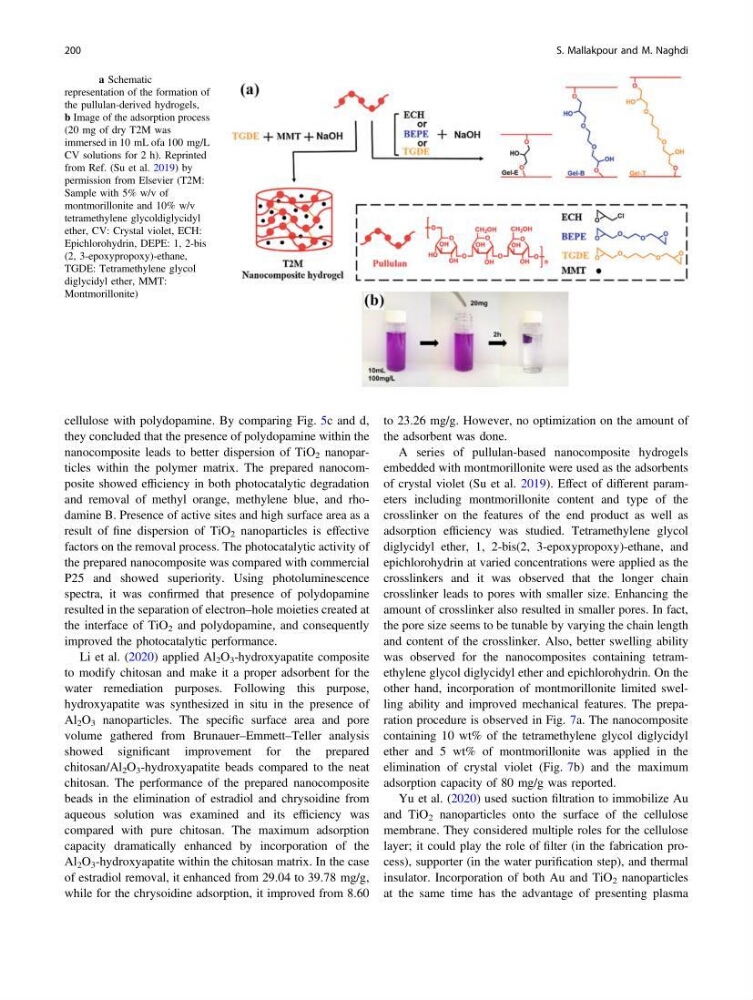
other hand, incorporation of montmorillonite limited swelling ability and improved mechanical features. The preparation procedure is observed in Fig. 7a. The nanocomposite
containing 10 wt% of the tetramethylene glycol diglycidyl
ether and 5 wt% of montmorillonite was applied in the
elimination of crystal violet (Fig. 7b) and the maximum
adsorption capacity of 80 mg/g was reported.
Yu et al. (2020) used suction filtration to immobilize Au
and TiO 2 nanoparticles onto the surface of the cellulose
membrane. They considered multiple roles for the cellulose
layer; it could play the role of filter (in the fabrication process), supporter (in the water purification step), and thermal
insulator. Incorporation of both Au and TiO 2 nanoparticles
at the same time has the advantage of presenting plasma
Fig. 7 a Schematic
representation of the formation of
the pullulan-derived hydrogels,
b Image of the adsorption process
(20 mg of dry T2M was
immersed in 10 mL ofa 100 mg/L
CV solutions for 2 h). Reprinted
from Ref. (Su et al. 2019) by
permission from Elsevier (T2M:
Sample with 5% w/v of
montmorillonite and 10% w/v
tetramethylene glycoldiglycidyl
ether, CV: Crystal violet, ECH:
Epichlorohydrin, DEPE: 1, 2-bis
(2, 3-epoxypropoxy)-ethane,
TGDE: Tetramethylene glycol
diglycidyl ether, MMT:
Montmorillonite)
200
S. Mallakpour and M. Naghdi
they concluded that the presence of polydopamine within the
nanocomposite leads to better dispersion of TiO 2 nanoparticles within the polymer matrix. The prepared nanocomposite showed efficiency in both photocatalytic degradation
and removal of methyl orange, methylene blue, and rhodamine B. Presence of active sites and high surface area as a
result of fine dispersion of TiO 2 nanoparticles is effective
factors on the removal process. The photocatalytic activity of
the prepared nanocomposite was compared with commercial
P25 and showed superiority. Using photoluminescence
spectra, it was confirmed that presence of polydopamine
resulted in the separation of electron–hole moieties created at
the interface of TiO 2 and polydopamine, and consequently
improved the photocatalytic performance.
Li et al. (2020) applied Al 2 O 3 -hydroxyapatite composite
to modify chitosan and make it a proper adsorbent for the
water remediation purposes. Following this purpose,
hydroxyapatite was synthesized in situ in the presence of
Al 2 O 3 nanoparticles. The specific surface area and pore
volume gathered from Brunauer–Emmett–Teller analysis
showed significant improvement for the prepared
chitosan/Al 2 O 3 -hydroxyapatite beads compared to the neat
chitosan. The performance of the prepared nanocomposite
beads in the elimination of estradiol and chrysoidine from
aqueous solution was examined and its efficiency was
compared with pure chitosan. The maximum adsorption
capacity dramatically enhanced by incorporation of the
Al 2 O 3 -hydroxyapatite within the chitosan matrix. In the case
of estradiol removal, it enhanced from 29.04 to 39.78 mg/g,
while for the chrysoidine adsorption, it improved from 8.60
to 23.26 mg/g. However, no optimization on the amount of
the adsorbent was done.
A series of pullulan-based nanocomposite hydrogels
embedded with montmorillonite were used as the adsorbents
of crystal violet (Su et al. 2019). Effect of different parameters including montmorillonite content and type of the
crosslinker on the features of the end product as well as
adsorption efficiency was studied. Tetramethylene glycol
diglycidyl ether, 1, 2-bis(2, 3-epoxypropoxy)-ethane, and
epichlorohydrin at varied concentrations were applied as the
crosslinkers and it was observed that the longer chain
crosslinker leads to pores with smaller size. Enhancing the
amount of crosslinker also resulted in smaller pores. In fact,
the pore size seems to be tunable by varying the chain length
and content of the crosslinker. Also, better swelling ability
was observed for the nanocomposites containing tetramethylene glycol diglycidyl ether and epichlorohydrin. On the
other hand, incorporation of montmorillonite limited swelling ability and improved mechanical features. The preparation procedure is observed in Fig. 7a. The nanocomposite
containing 10 wt% of the tetramethylene glycol diglycidyl
ether and 5 wt% of montmorillonite was applied in the
elimination of crystal violet (Fig. 7b) and the maximum
adsorption capacity of 80 mg/g was reported.
Yu et al. (2020) used suction filtration to immobilize Au
and TiO 2 nanoparticles onto the surface of the cellulose
membrane. They considered multiple roles for the cellulose
layer; it could play the role of filter (in the fabrication process), supporter (in the water purification step), and thermal
insulator. Incorporation of both Au and TiO 2 nanoparticles
at the same time has the advantage of presenting plasma
Fig. 7 a Schematic
representation of the formation of
the pullulan-derived hydrogels,
b Image of the adsorption process
(20 mg of dry T2M was
immersed in 10 mL ofa 100 mg/L
CV solutions for 2 h). Reprinted
from Ref. (Su et al. 2019) by
permission from Elsevier (T2M:
Sample with 5% w/v of
montmorillonite and 10% w/v
tetramethylene glycoldiglycidyl
ether, CV: Crystal violet, ECH:
Epichlorohydrin, DEPE: 1, 2-bis
(2, 3-epoxypropoxy)-ethane,
TGDE: Tetramethylene glycol
diglycidyl ether, MMT:
Montmorillonite)
200
S. Mallakpour and M. Naghdi