

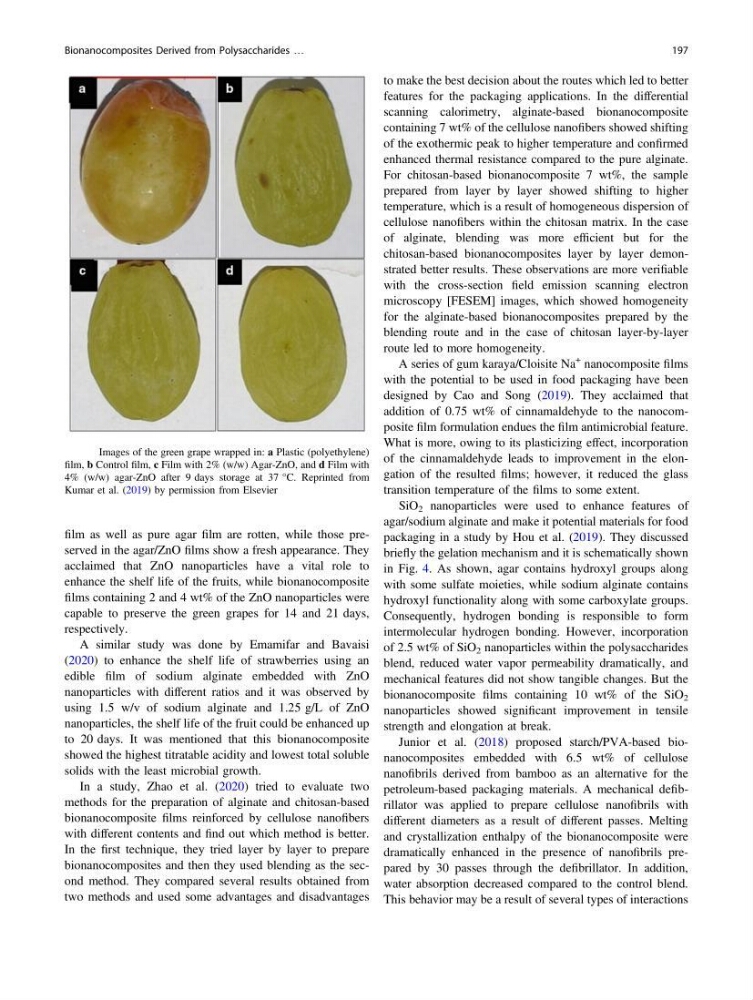
film as well as pure agar film are rotten, while those preserved in the agar/ZnO films show a fresh appearance. They
acclaimed that ZnO nanoparticles have a vital role to
enhance the shelf life of the fruits, while bionanocomposite
films containing 2 and 4 wt% of the ZnO nanoparticles were
capable to preserve the green grapes for 14 and 21 days,
respectively.
A similar study was done by Emamifar and Bavaisi
(2020) to enhance the shelf life of strawberries using an
edible film of sodium alginate embedded with ZnO
nanoparticles with different ratios and it was observed by
using 1.5 w/v of sodium alginate and 1.25 g/L of ZnO
nanoparticles, the shelf life of the fruit could be enhanced up
to 20 days. It was mentioned that this bionanocomposite
showed the highest titratable acidity and lowest total soluble
solids with the least microbial growth.
In a study, Zhao et al. (2020) tried to evaluate two
methods for the preparation of alginate and chitosan-based
bionanocomposite films reinforced by cellulose nanofibers
with different contents and find out which method is better.
In the first technique, they tried layer by layer to prepare
bionanocomposites and then they used blending as the second method. They compared several results obtained from
two methods and used some advantages and disadvantages
to make the best decision about the routes which led to better
features for the packaging applications. In the differential
scanning calorimetry, alginate-based bionanocomposite
containing 7 wt% of the cellulose nanofibers showed shifting
of the exothermic peak to higher temperature and confirmed
enhanced thermal resistance compared to the pure alginate.
For chitosan-based bionanocomposite 7 wt%, the sample
prepared from layer by layer showed shifting to higher
temperature, which is a result of homogeneous dispersion of
cellulose nanofibers within the chitosan matrix. In the case
of alginate, blending was more efficient but for the
chitosan-based bionanocomposites layer by layer demonstrated better results. These observations are more verifiable
with the cross-section field emission scanning electron
microscopy [FESEM] images, which showed homogeneity
for the alginate-based bionanocomposites prepared by the
blending route and in the case of chitosan layer-by-layer
route led to more homogeneity.
A series of gum karaya/Cloisite Na
+ nanocomposite films
with the potential to be used in food packaging have been
designed by Cao and Song (2019). They acclaimed that
addition of 0.75 wt% of cinnamaldehyde to the nanocomposite film formulation endues the film antimicrobial feature.
What is more, owing to its plasticizing effect, incorporation
of the cinnamaldehyde leads to improvement in the elongation of the resulted films; however, it reduced the glass
transition temperature of the films to some extent.
SiO 2 nanoparticles were used to enhance features of
agar/sodium alginate and make it potential materials for food
packaging in a study by Hou et al. (2019). They discussed
briefly the gelation mechanism and it is schematically shown
in Fig. 4. As shown, agar contains hydroxyl groups along
with some sulfate moieties, while sodium alginate contains
hydroxyl functionality along with some carboxylate groups.
Consequently, hydrogen bonding is responsible to form
intermolecular hydrogen bonding. However, incorporation
of 2.5 wt% of SiO 2 nanoparticles within the polysaccharides
blend, reduced water vapor permeability dramatically, and
mechanical features did not show tangible changes. But the
bionanocomposite films containing 10 wt% of the SiO 2
nanoparticles showed significant improvement in tensile
strength and elongation at break.
Junior et al. (2018) proposed starch/PVA-based bionanocomposites embedded with 6.5 wt% of cellulose
nanofibrils derived from bamboo as an alternative for the
petroleum-based packaging materials. A mechanical defibrillator was applied to prepare cellulose nanofibrils with
different diameters as a result of different passes. Melting
and crystallization enthalpy of the bionanocomposite were
dramatically enhanced in the presence of nanofibrils prepared by 30 passes through the defibrillator. In addition,
water absorption decreased compared to the control blend.
This behavior may be a result of several types of interactions
Fig. 3 Images of the green grape wrapped in: a Plastic (polyethylene)
film, b Control film, c Film with 2% (w/w) Agar-ZnO, and d Film with
4% (w/w) agar-ZnO after 9 days storage at 37 °C. Reprinted from
Kumar et al. (2019) by permission from Elsevier
Bionanocomposites Derived from Polysaccharides …
197
acclaimed that ZnO nanoparticles have a vital role to
enhance the shelf life of the fruits, while bionanocomposite
films containing 2 and 4 wt% of the ZnO nanoparticles were
capable to preserve the green grapes for 14 and 21 days,
respectively.
A similar study was done by Emamifar and Bavaisi
(2020) to enhance the shelf life of strawberries using an
edible film of sodium alginate embedded with ZnO
nanoparticles with different ratios and it was observed by
using 1.5 w/v of sodium alginate and 1.25 g/L of ZnO
nanoparticles, the shelf life of the fruit could be enhanced up
to 20 days. It was mentioned that this bionanocomposite
showed the highest titratable acidity and lowest total soluble
solids with the least microbial growth.
In a study, Zhao et al. (2020) tried to evaluate two
methods for the preparation of alginate and chitosan-based
bionanocomposite films reinforced by cellulose nanofibers
with different contents and find out which method is better.
In the first technique, they tried layer by layer to prepare
bionanocomposites and then they used blending as the second method. They compared several results obtained from
two methods and used some advantages and disadvantages
to make the best decision about the routes which led to better
features for the packaging applications. In the differential
scanning calorimetry, alginate-based bionanocomposite
containing 7 wt% of the cellulose nanofibers showed shifting
of the exothermic peak to higher temperature and confirmed
enhanced thermal resistance compared to the pure alginate.
For chitosan-based bionanocomposite 7 wt%, the sample
prepared from layer by layer showed shifting to higher
temperature, which is a result of homogeneous dispersion of
cellulose nanofibers within the chitosan matrix. In the case
of alginate, blending was more efficient but for the
chitosan-based bionanocomposites layer by layer demonstrated better results. These observations are more verifiable
with the cross-section field emission scanning electron
microscopy [FESEM] images, which showed homogeneity
for the alginate-based bionanocomposites prepared by the
blending route and in the case of chitosan layer-by-layer
route led to more homogeneity.
A series of gum karaya/Cloisite Na
+ nanocomposite films
with the potential to be used in food packaging have been
designed by Cao and Song (2019). They acclaimed that
addition of 0.75 wt% of cinnamaldehyde to the nanocomposite film formulation endues the film antimicrobial feature.
What is more, owing to its plasticizing effect, incorporation
of the cinnamaldehyde leads to improvement in the elongation of the resulted films; however, it reduced the glass
transition temperature of the films to some extent.
SiO 2 nanoparticles were used to enhance features of
agar/sodium alginate and make it potential materials for food
packaging in a study by Hou et al. (2019). They discussed
briefly the gelation mechanism and it is schematically shown
in Fig. 4. As shown, agar contains hydroxyl groups along
with some sulfate moieties, while sodium alginate contains
hydroxyl functionality along with some carboxylate groups.
Consequently, hydrogen bonding is responsible to form
intermolecular hydrogen bonding. However, incorporation
of 2.5 wt% of SiO 2 nanoparticles within the polysaccharides
blend, reduced water vapor permeability dramatically, and
mechanical features did not show tangible changes. But the
bionanocomposite films containing 10 wt% of the SiO 2
nanoparticles showed significant improvement in tensile
strength and elongation at break.
Junior et al. (2018) proposed starch/PVA-based bionanocomposites embedded with 6.5 wt% of cellulose
nanofibrils derived from bamboo as an alternative for the
petroleum-based packaging materials. A mechanical defibrillator was applied to prepare cellulose nanofibrils with
different diameters as a result of different passes. Melting
and crystallization enthalpy of the bionanocomposite were
dramatically enhanced in the presence of nanofibrils prepared by 30 passes through the defibrillator. In addition,
water absorption decreased compared to the control blend.
This behavior may be a result of several types of interactions
Fig. 3 Images of the green grape wrapped in: a Plastic (polyethylene)
film, b Control film, c Film with 2% (w/w) Agar-ZnO, and d Film with
4% (w/w) agar-ZnO after 9 days storage at 37 °C. Reprinted from
Kumar et al. (2019) by permission from Elsevier
Bionanocomposites Derived from Polysaccharides …
197