

polysaccharides. The main limitations in usage of unmodified polysaccharides are weak moisture barrier properties
(Yadav et al. 2019) and inadequate mechanical acting, which
could be solved by using them in the form of bionanocomposites (Hou et al. 2019). Meanwhile, in some
cases, antibacterial activity may be donated to the packaging
by incorporation of some nanomaterials like Ag nanoparticles (Ma et al. 2016).
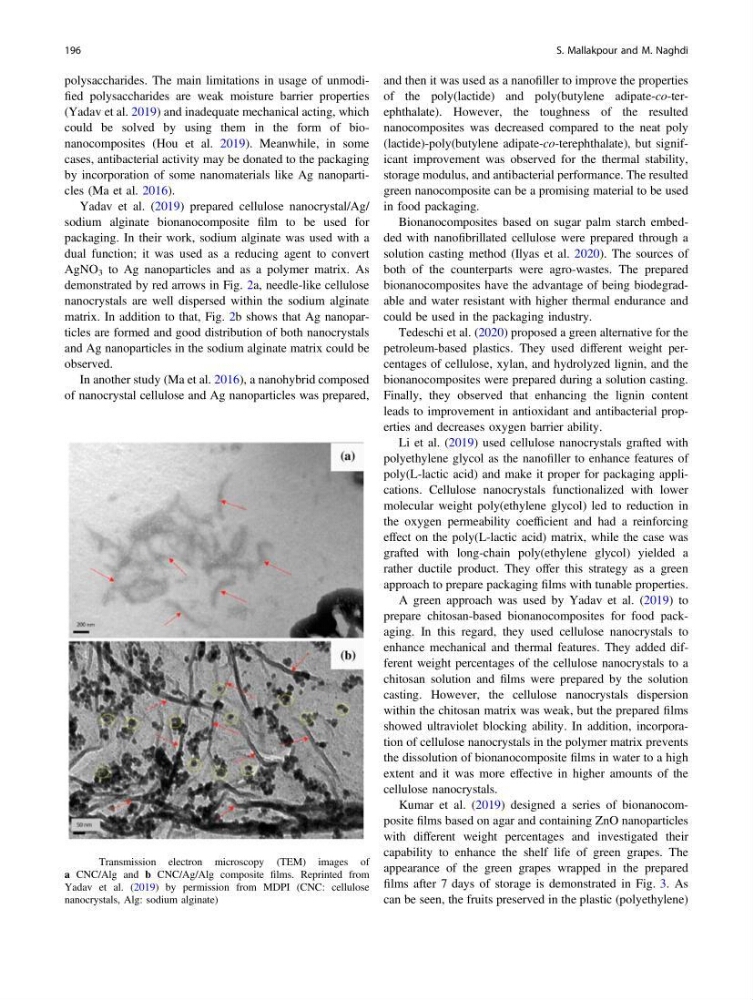
Yadav et al. (2019) prepared cellulose nanocrystal/Ag/
sodium alginate bionanocomposite film to be used for
packaging. In their work, sodium alginate was used with a
dual function; it was used as a reducing agent to convert
AgNO 3 to Ag nanoparticles and as a polymer matrix. As
demonstrated by red arrows in Fig. 2a, needle-like cellulose
nanocrystals are well dispersed within the sodium alginate
matrix. In addition to that, Fig. 2b shows that Ag nanoparticles are formed and good distribution of both nanocrystals
and Ag nanoparticles in the sodium alginate matrix could be
observed.
In another study (Ma et al. 2016), a nanohybrid composed
of nanocrystal cellulose and Ag nanoparticles was prepared,
and then it was used as a nanofiller to improve the properties
of the poly(lactide) and poly(butylene adipate-co-terephthalate). However, the toughness of the resulted
nanocomposites was decreased compared to the neat poly
(lactide)-poly(butylene adipate-co-terephthalate), but significant improvement was observed for the thermal stability,
storage modulus, and antibacterial performance. The resulted
green nanocomposite can be a promising material to be used
in food packaging.
Bionanocomposites based on sugar palm starch embedded with nanofibrillated cellulose were prepared through a
solution casting method (Ilyas et al. 2020). The sources of
both of the counterparts were agro-wastes. The prepared
bionanocomposites have the advantage of being biodegradable and water resistant with higher thermal endurance and
could be used in the packaging industry.
Tedeschi et al. (2020) proposed a green alternative for the
petroleum-based plastics. They used different weight percentages of cellulose, xylan, and hydrolyzed lignin, and the
bionanocomposites were prepared during a solution casting.
Finally, they observed that enhancing the lignin content
leads to improvement in antioxidant and antibacterial properties and decreases oxygen barrier ability.
Li et al. (2019) used cellulose nanocrystals grafted with
polyethylene glycol as the nanofiller to enhance features of
poly(L-lactic acid) and make it proper for packaging applications. Cellulose nanocrystals functionalized with lower
molecular weight poly(ethylene glycol) led to reduction in
the oxygen permeability coefficient and had a reinforcing
effect on the poly(L-lactic acid) matrix, while the case was
grafted with long-chain poly(ethylene glycol) yielded a
rather ductile product. They offer this strategy as a green
approach to prepare packaging films with tunable properties.
A green approach was used by Yadav et al. (2019) to
prepare chitosan-based bionanocomposites for food packaging. In this regard, they used cellulose nanocrystals to
enhance mechanical and thermal features. They added different weight percentages of the cellulose nanocrystals to a
chitosan solution and films were prepared by the solution
casting. However, the cellulose nanocrystals dispersion
within the chitosan matrix was weak, but the prepared films
showed ultraviolet blocking ability. In addition, incorporation of cellulose nanocrystals in the polymer matrix prevents
the dissolution of bionanocomposite films in water to a high
extent and it was more effective in higher amounts of the
cellulose nanocrystals.
Kumar et al. (2019) designed a series of bionanocomposite films based on agar and containing ZnO nanoparticles
with different weight percentages and investigated their
capability to enhance the shelf life of green grapes. The
appearance of the green grapes wrapped in the prepared
films after 7 days of storage is demonstrated in Fig. 3. As
can be seen, the fruits preserved in the plastic (polyethylene)
Fig. 2 Transmission electron microscopy (TEM) images of
a CNC/Alg and b CNC/Ag/Alg composite films. Reprinted from
Yadav et al. (2019) by permission from MDPI (CNC: cellulose
nanocrystals, Alg: sodium alginate)
196
S. Mallakpour and M. Naghdi
(Yadav et al. 2019) and inadequate mechanical acting, which
could be solved by using them in the form of bionanocomposites (Hou et al. 2019). Meanwhile, in some
cases, antibacterial activity may be donated to the packaging
by incorporation of some nanomaterials like Ag nanoparticles (Ma et al. 2016).
Yadav et al. (2019) prepared cellulose nanocrystal/Ag/
sodium alginate bionanocomposite film to be used for
packaging. In their work, sodium alginate was used with a
dual function; it was used as a reducing agent to convert
AgNO 3 to Ag nanoparticles and as a polymer matrix. As
demonstrated by red arrows in Fig. 2a, needle-like cellulose
nanocrystals are well dispersed within the sodium alginate
matrix. In addition to that, Fig. 2b shows that Ag nanoparticles are formed and good distribution of both nanocrystals
and Ag nanoparticles in the sodium alginate matrix could be
observed.
In another study (Ma et al. 2016), a nanohybrid composed
of nanocrystal cellulose and Ag nanoparticles was prepared,
and then it was used as a nanofiller to improve the properties
of the poly(lactide) and poly(butylene adipate-co-terephthalate). However, the toughness of the resulted
nanocomposites was decreased compared to the neat poly
(lactide)-poly(butylene adipate-co-terephthalate), but significant improvement was observed for the thermal stability,
storage modulus, and antibacterial performance. The resulted
green nanocomposite can be a promising material to be used
in food packaging.
Bionanocomposites based on sugar palm starch embedded with nanofibrillated cellulose were prepared through a
solution casting method (Ilyas et al. 2020). The sources of
both of the counterparts were agro-wastes. The prepared
bionanocomposites have the advantage of being biodegradable and water resistant with higher thermal endurance and
could be used in the packaging industry.
Tedeschi et al. (2020) proposed a green alternative for the
petroleum-based plastics. They used different weight percentages of cellulose, xylan, and hydrolyzed lignin, and the
bionanocomposites were prepared during a solution casting.
Finally, they observed that enhancing the lignin content
leads to improvement in antioxidant and antibacterial properties and decreases oxygen barrier ability.
Li et al. (2019) used cellulose nanocrystals grafted with
polyethylene glycol as the nanofiller to enhance features of
poly(L-lactic acid) and make it proper for packaging applications. Cellulose nanocrystals functionalized with lower
molecular weight poly(ethylene glycol) led to reduction in
the oxygen permeability coefficient and had a reinforcing
effect on the poly(L-lactic acid) matrix, while the case was
grafted with long-chain poly(ethylene glycol) yielded a
rather ductile product. They offer this strategy as a green
approach to prepare packaging films with tunable properties.
A green approach was used by Yadav et al. (2019) to
prepare chitosan-based bionanocomposites for food packaging. In this regard, they used cellulose nanocrystals to
enhance mechanical and thermal features. They added different weight percentages of the cellulose nanocrystals to a
chitosan solution and films were prepared by the solution
casting. However, the cellulose nanocrystals dispersion
within the chitosan matrix was weak, but the prepared films
showed ultraviolet blocking ability. In addition, incorporation of cellulose nanocrystals in the polymer matrix prevents
the dissolution of bionanocomposite films in water to a high
extent and it was more effective in higher amounts of the
cellulose nanocrystals.
Kumar et al. (2019) designed a series of bionanocomposite films based on agar and containing ZnO nanoparticles
with different weight percentages and investigated their
capability to enhance the shelf life of green grapes. The
appearance of the green grapes wrapped in the prepared
films after 7 days of storage is demonstrated in Fig. 3. As
can be seen, the fruits preserved in the plastic (polyethylene)
Fig. 2 Transmission electron microscopy (TEM) images of
a CNC/Alg and b CNC/Ag/Alg composite films. Reprinted from
Yadav et al. (2019) by permission from MDPI (CNC: cellulose
nanocrystals, Alg: sodium alginate)
196
S. Mallakpour and M. Naghdi