

cake (Han et al. 2019), and any saccharide are used for the
formation of alcohol using a fermentation process. Biowastes from corn, sugarcane molasses, wheat, etc. are mostly
used as sources for the production of ethanol in several
countries including developed and developing countries. The
general biological process for the production of biofuel from
lignocellulose biowaste was given by Canilha et al. (2012).
During biofuel production, a pretreatment of lignocellulose,
depolymerization of carbohydrate for making free saccharides, fermentation of saccharides to ethanol, and purification of ethanol are involved (Priyadarshan 2011). The
ethanol production could be enhanced by attempting different methodologies. The enhancement in bioethanol production is reported using different methods such as the absence
of lignin and prosperity of fermentable sugars and nitrogen
(Sayed et al. 2018), pretreatment involving enzyme and
basic solution (Bilal et al. 2017), high temperature (around
67 °C) in the absence of live yeast cells (Khattak et al. 2013),
pretreatment with alkaline hydrogen peroxide (Karagöz et al.
2012), hydrolysis and fermentation (Guerfali et al. 2015;
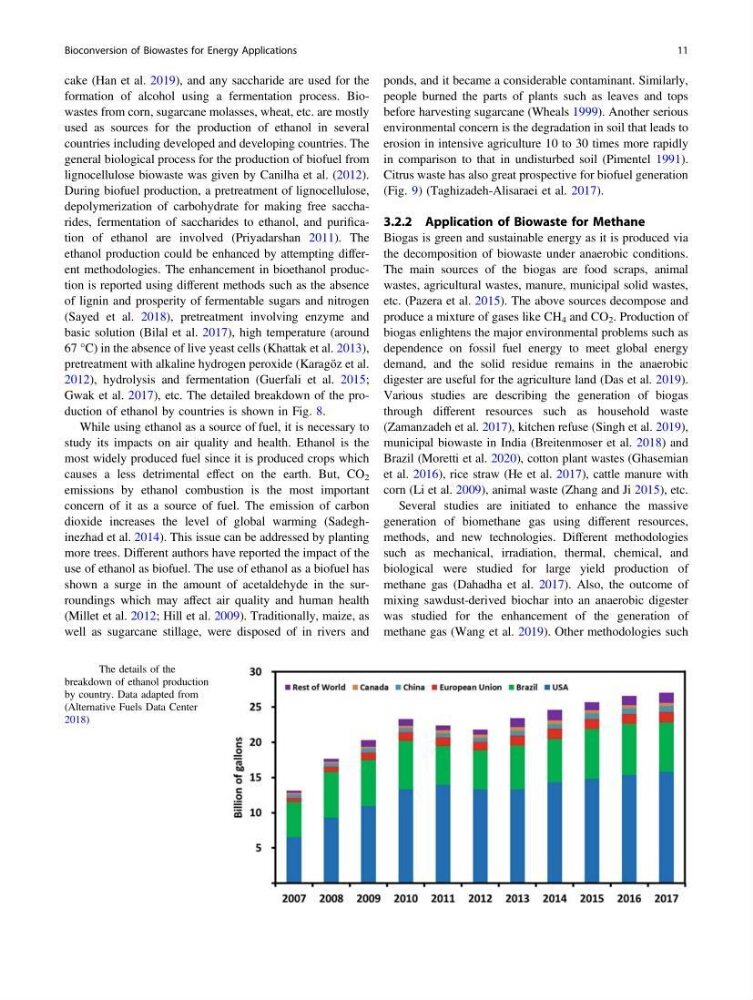
Gwak et al. 2017), etc. The detailed breakdown of the production of ethanol by countries is shown in Fig. 8.
While using ethanol as a source of fuel, it is necessary to
study its impacts on air quality and health. Ethanol is the
most widely produced fuel since it is produced crops which
causes a less detrimental effect on the earth. But, CO 2
emissions by ethanol combustion is the most important
concern of it as a source of fuel. The emission of carbon
dioxide increases the level of global warming (Sadeghinezhad et al. 2014). This issue can be addressed by planting
more trees. Different authors have reported the impact of the
use of ethanol as biofuel. The use of ethanol as a biofuel has
shown a surge in the amount of acetaldehyde in the surroundings which may affect air quality and human health
(Millet et al. 2012; Hill et al. 2009). Traditionally, maize, as
well as sugarcane stillage, were disposed of in rivers and
ponds, and it became a considerable contaminant. Similarly,
people burned the parts of plants such as leaves and tops
before harvesting sugarcane (Wheals 1999). Another serious
environmental concern is the degradation in soil that leads to
erosion in intensive agriculture 10 to 30 times more rapidly
in comparison to that in undisturbed soil (Pimentel 1991).
Citrus waste has also great prospective for biofuel generation
(Fig. 9) (Taghizadeh-Alisaraei et al. 2017).
3.2.2 Application of Biowaste for Methane
Biogas is green and sustainable energy as it is produced via
the decomposition of biowaste under anaerobic conditions.
The main sources of the biogas are food scraps, animal
wastes, agricultural wastes, manure, municipal solid wastes,
etc. (Pazera et al. 2015). The above sources decompose and
produce a mixture of gases like CH 4 and CO 2 . Production of
biogas enlightens the major environmental problems such as
dependence on fossil fuel energy to meet global energy
demand, and the solid residue remains in the anaerobic
digester are useful for the agriculture land (Das et al. 2019).
Various studies are describing the generation of biogas
through different resources such as household waste
(Zamanzadeh et al. 2017), kitchen refuse (Singh et al. 2019),
municipal biowaste in India (Breitenmoser et al. 2018) and
Brazil (Moretti et al. 2020), cotton plant wastes (Ghasemian
et al. 2016), rice straw (He et al. 2017), cattle manure with
corn (Li et al. 2009), animal waste (Zhang and Ji 2015), etc.
Several studies are initiated to enhance the massive
generation of biomethane gas using different resources,
methods, and new technologies. Different methodologies
such as mechanical, irradiation, thermal, chemical, and
biological were studied for large yield production of
methane gas (Dahadha et al. 2017). Also, the outcome of
mixing sawdust-derived biochar into an anaerobic digester
was studied for the enhancement of the generation of
methane gas (Wang et al. 2019). Other methodologies such
Fig. 8 The details of the
breakdown of ethanol production
by country. Data adapted from
(Alternative Fuels Data Center
2018)
Bioconversion of Biowastes for Energy Applications
11
formation of alcohol using a fermentation process. Biowastes from corn, sugarcane molasses, wheat, etc. are mostly
used as sources for the production of ethanol in several
countries including developed and developing countries. The
general biological process for the production of biofuel from
lignocellulose biowaste was given by Canilha et al. (2012).
During biofuel production, a pretreatment of lignocellulose,
depolymerization of carbohydrate for making free saccharides, fermentation of saccharides to ethanol, and purification of ethanol are involved (Priyadarshan 2011). The
ethanol production could be enhanced by attempting different methodologies. The enhancement in bioethanol production is reported using different methods such as the absence
of lignin and prosperity of fermentable sugars and nitrogen
(Sayed et al. 2018), pretreatment involving enzyme and
basic solution (Bilal et al. 2017), high temperature (around
67 °C) in the absence of live yeast cells (Khattak et al. 2013),
pretreatment with alkaline hydrogen peroxide (Karagöz et al.
2012), hydrolysis and fermentation (Guerfali et al. 2015;
Gwak et al. 2017), etc. The detailed breakdown of the production of ethanol by countries is shown in Fig. 8.
While using ethanol as a source of fuel, it is necessary to
study its impacts on air quality and health. Ethanol is the
most widely produced fuel since it is produced crops which
causes a less detrimental effect on the earth. But, CO 2
emissions by ethanol combustion is the most important
concern of it as a source of fuel. The emission of carbon
dioxide increases the level of global warming (Sadeghinezhad et al. 2014). This issue can be addressed by planting
more trees. Different authors have reported the impact of the
use of ethanol as biofuel. The use of ethanol as a biofuel has
shown a surge in the amount of acetaldehyde in the surroundings which may affect air quality and human health
(Millet et al. 2012; Hill et al. 2009). Traditionally, maize, as
well as sugarcane stillage, were disposed of in rivers and
ponds, and it became a considerable contaminant. Similarly,
people burned the parts of plants such as leaves and tops
before harvesting sugarcane (Wheals 1999). Another serious
environmental concern is the degradation in soil that leads to
erosion in intensive agriculture 10 to 30 times more rapidly
in comparison to that in undisturbed soil (Pimentel 1991).
Citrus waste has also great prospective for biofuel generation
(Fig. 9) (Taghizadeh-Alisaraei et al. 2017).
3.2.2 Application of Biowaste for Methane
Biogas is green and sustainable energy as it is produced via
the decomposition of biowaste under anaerobic conditions.
The main sources of the biogas are food scraps, animal
wastes, agricultural wastes, manure, municipal solid wastes,
etc. (Pazera et al. 2015). The above sources decompose and
produce a mixture of gases like CH 4 and CO 2 . Production of
biogas enlightens the major environmental problems such as
dependence on fossil fuel energy to meet global energy
demand, and the solid residue remains in the anaerobic
digester are useful for the agriculture land (Das et al. 2019).
Various studies are describing the generation of biogas
through different resources such as household waste
(Zamanzadeh et al. 2017), kitchen refuse (Singh et al. 2019),
municipal biowaste in India (Breitenmoser et al. 2018) and
Brazil (Moretti et al. 2020), cotton plant wastes (Ghasemian
et al. 2016), rice straw (He et al. 2017), cattle manure with
corn (Li et al. 2009), animal waste (Zhang and Ji 2015), etc.
Several studies are initiated to enhance the massive
generation of biomethane gas using different resources,
methods, and new technologies. Different methodologies
such as mechanical, irradiation, thermal, chemical, and
biological were studied for large yield production of
methane gas (Dahadha et al. 2017). Also, the outcome of
mixing sawdust-derived biochar into an anaerobic digester
was studied for the enhancement of the generation of
methane gas (Wang et al. 2019). Other methodologies such
Fig. 8 The details of the
breakdown of ethanol production
by country. Data adapted from
(Alternative Fuels Data Center
2018)
Bioconversion of Biowastes for Energy Applications
11