

was 50. At 50 bars with a half-life of 177 h, this AC was
highly stable. Moreover, the sequestration by thermo alkotolerant CA from Bacillus sp. has been recorded by Thakur
et al. (2018). The enzyme was stable to 90 °C with a half-life
of 25.36 min, allowing cooling costs and time-saving more
valuable for industrial CO 2 conversion. Moreover, Jo et al.
(2014) have confirmed that recombinant enzymes have a
half-life of over 70 days, at 50 °C, of the Perse-phonella
Marina and Thermovibrio Ammonificans clones and their
expression. Also, under elevated temperatures, this CA
rapidly accelerates CaCO 3 mineralization from CO 2 . Such
experiments have shown concretely the usage of CA as a
successful CO 2 conversion candidate. These biological catalysts are able to survive extreme environments over a
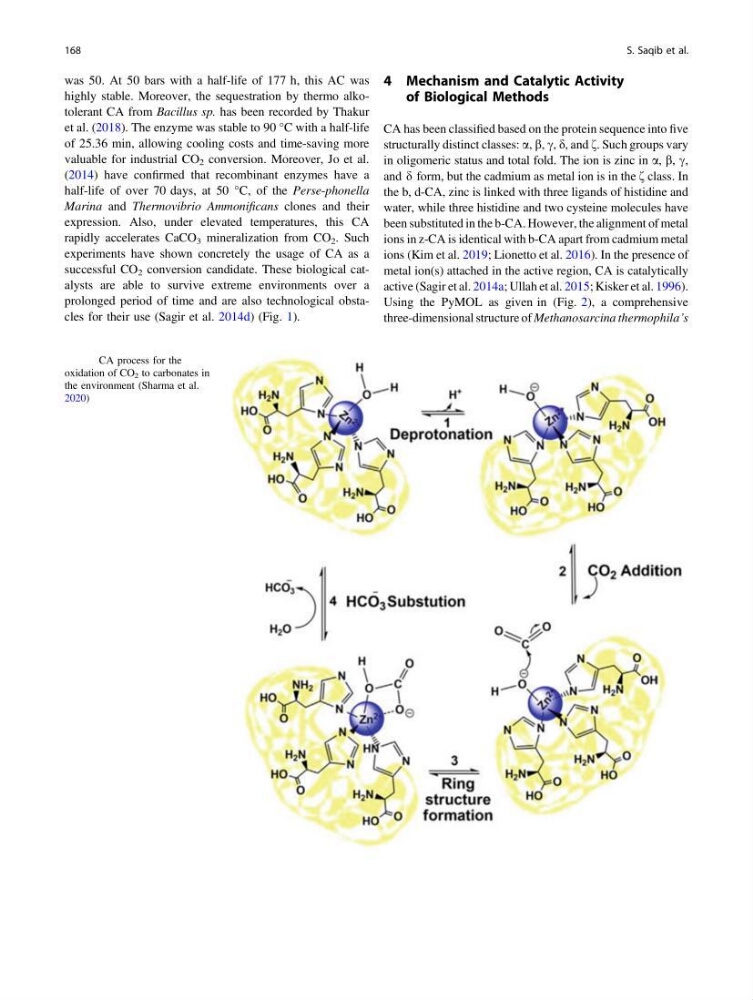
prolonged period of time and are also technological obstacles for their use (Sagir et al. 2014d) (Fig. 1).
4 Mechanism and Catalytic Activity
of Biological Methods
CA has been classified based on the protein sequence into five
structurally distinct classes: a, b, c, d, and f. Such groups vary
in oligomeric status and total fold. The ion is zinc in a, b, c,
and d form, but the cadmium as metal ion is in the f class. In
the b, d-CA, zinc is linked with three ligands of histidine and
water, while three histidine and two cysteine molecules have
been substituted in the b-CA. However, the alignment of metal
ions in z-CA is identical with b-CA apart from cadmium metal
ions (Kim et al. 2019; Lionetto et al. 2016). In the presence of
metal ion(s) attached in the active region, CA is catalytically
active (Sagir et al. 2014a; Ullah et al. 2015; Kisker et al. 1996).
Using the PyMOL as given in (Fig. 2), a comprehensive
three-dimensional structure of Methanosarcina thermophila’s
Fig. 1 CA process for the
oxidation of CO 2 to carbonates in
the environment (Sharma et al.
2020)
168
S. Saqib et al.
highly stable. Moreover, the sequestration by thermo alkotolerant CA from Bacillus sp. has been recorded by Thakur
et al. (2018). The enzyme was stable to 90 °C with a half-life
of 25.36 min, allowing cooling costs and time-saving more
valuable for industrial CO 2 conversion. Moreover, Jo et al.
(2014) have confirmed that recombinant enzymes have a
half-life of over 70 days, at 50 °C, of the Perse-phonella
Marina and Thermovibrio Ammonificans clones and their
expression. Also, under elevated temperatures, this CA
rapidly accelerates CaCO 3 mineralization from CO 2 . Such
experiments have shown concretely the usage of CA as a
successful CO 2 conversion candidate. These biological catalysts are able to survive extreme environments over a
prolonged period of time and are also technological obstacles for their use (Sagir et al. 2014d) (Fig. 1).
4 Mechanism and Catalytic Activity
of Biological Methods
CA has been classified based on the protein sequence into five
structurally distinct classes: a, b, c, d, and f. Such groups vary
in oligomeric status and total fold. The ion is zinc in a, b, c,
and d form, but the cadmium as metal ion is in the f class. In
the b, d-CA, zinc is linked with three ligands of histidine and
water, while three histidine and two cysteine molecules have
been substituted in the b-CA. However, the alignment of metal
ions in z-CA is identical with b-CA apart from cadmium metal
ions (Kim et al. 2019; Lionetto et al. 2016). In the presence of
metal ion(s) attached in the active region, CA is catalytically
active (Sagir et al. 2014a; Ullah et al. 2015; Kisker et al. 1996).
Using the PyMOL as given in (Fig. 2), a comprehensive
three-dimensional structure of Methanosarcina thermophila’s
Fig. 1 CA process for the
oxidation of CO 2 to carbonates in
the environment (Sharma et al.
2020)
168
S. Saqib et al.