

CA class is seen. CA kinetic study has shown that both groups
have the same iso-mechanism in two phases (Smith et al. 1999;
Syrjänen et al. 2010). A structural CA analysis reveals that the
active site of the enzyme varies according to the form of CA.
The catalytic triad is mainly constituted by three amino acid
waste and water/hydroxide molecules that create a coordination relation with the metal ion (Mushtaq et al. 2015; Talebian
et al. 2018; Sagir et al. 2018; Somalinga et al. 2016). The active
CA site has two dominant regions, one hydrophobic area and
the other half the hydrophilic zone. Hydrophobic amino acids
(Val 207, Leu-198, Val-121, Thro-199, Val-143, and
Trp-209) play a significant function for the CO 2 molecule in its
trapping, while those that are induced by hydrophilic amino
acids (Asn-67, Asn-62, Thr-200-Og1, His-64, Tyr-7, and
Thr-199-Og1) are responsible for proton movement and
generation of bicarbonate from CO 2 via hydration reaction
(Ullah et al. 2019a; Domsic and McKenna 2010; Miscione
et al. 2007; Sahoo et al. 2018). The first step is the proton
release from zinc bound to water to produce Zn-hydroxide
ion; (2) hydroxide ion attacks atomic CO 2 , (3) the product (bicarbonate tetrahedral intermediate) formation occurs;
(4) in the last point, the insertion of a water molecule and the
completion of a catalyst process replace the zinc-bound carbonate (Ullah et al. 2019b; Tahir et al. 2019; Aggarwal et al.
2015; Jiang et al. 2003).
5 Biological Transformation of CO 2
to Methanol
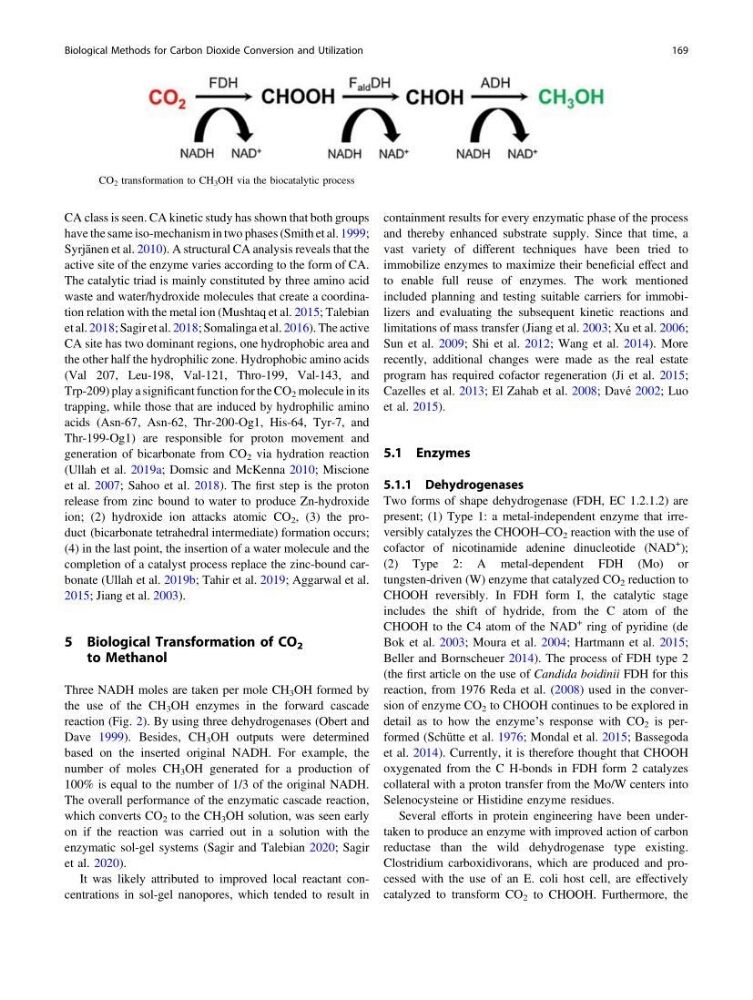
Three NADH moles are taken per mole CH 3 OH formed by
the use of the CH 3 OH enzymes in the forward cascade
reaction (Fig. 2). By using three dehydrogenases (Obert and
Dave 1999). Besides, CH 3 OH outputs were determined
based on the inserted original NADH. For example, the
number of moles CH 3 OH generated for a production of
100% is equal to the number of 1/3 of the original NADH.
The overall performance of the enzymatic cascade reaction,
which converts CO 2 to the CH 3 OH solution, was seen early
on if the reaction was carried out in a solution with the
enzymatic sol-gel systems (Sagir and Talebian 2020; Sagir
et al. 2020).
It was likely attributed to improved local reactant concentrations in sol-gel nanopores, which tended to result in
containment results for every enzymatic phase of the process
and thereby enhanced substrate supply. Since that time, a
vast variety of different techniques have been tried to
immobilize enzymes to maximize their beneficial effect and
to enable full reuse of enzymes. The work mentioned
included planning and testing suitable carriers for immobilizers and evaluating the subsequent kinetic reactions and
limitations of mass transfer (Jiang et al. 2003; Xu et al. 2006;
Sun et al. 2009; Shi et al. 2012; Wang et al. 2014). More
recently, additional changes were made as the real estate
program has required cofactor regeneration (Ji et al. 2015;
Cazelles et al. 2013; El Zahab et al. 2008; Davé 2002; Luo
et al. 2015).
5.1 Enzymes
5.1.1 Dehydrogenases
Two forms of shape dehydrogenase (FDH, EC 1.2.1.2) are
present; (1) Type 1: a metal-independent enzyme that irreversibly catalyzes the CHOOH–CO 2 reaction with the use of
cofactor of nicotinamide adenine dinucleotide (NAD
+
);
(2) Type 2: A metal-dependent FDH (Mo) or
tungsten-driven (W) enzyme that catalyzed CO 2 reduction to
CHOOH reversibly. In FDH form I, the catalytic stage
includes the shift of hydride, from the C atom of the
CHOOH to the C4 atom of the NAD
+ ring of pyridine (de
Bok et al. 2003; Moura et al. 2004; Hartmann et al. 2015;
Beller and Bornscheuer 2014). The process of FDH type 2
(the first article on the use of Candida boidinii FDH for this
reaction, from 1976 Reda et al. (2008) used in the conversion of enzyme CO 2 to CHOOH continues to be explored in
detail as to how the enzyme’s response with CO 2 is performed (Schütte et al. 1976; Mondal et al. 2015; Bassegoda
et al. 2014). Currently, it is therefore thought that CHOOH
oxygenated from the C H-bonds in FDH form 2 catalyzes
collateral with a proton transfer from the Mo/W centers into
Selenocysteine or Histidine enzyme residues.
Several efforts in protein engineering have been undertaken to produce an enzyme with improved action of carbon
reductase than the wild dehydrogenase type existing.
Clostridium carboxidivorans, which are produced and processed with the use of an E. coli host cell, are effectively
catalyzed to transform CO 2 to CHOOH. Furthermore, the
Fig. 2 CO 2 transformation to CH 3 OH via the biocatalytic process
Biological Methods for Carbon Dioxide Conversion and Utilization
169
have the same iso-mechanism in two phases (Smith et al. 1999;
Syrjänen et al. 2010). A structural CA analysis reveals that the
active site of the enzyme varies according to the form of CA.
The catalytic triad is mainly constituted by three amino acid
waste and water/hydroxide molecules that create a coordination relation with the metal ion (Mushtaq et al. 2015; Talebian
et al. 2018; Sagir et al. 2018; Somalinga et al. 2016). The active
CA site has two dominant regions, one hydrophobic area and
the other half the hydrophilic zone. Hydrophobic amino acids
(Val 207, Leu-198, Val-121, Thro-199, Val-143, and
Trp-209) play a significant function for the CO 2 molecule in its
trapping, while those that are induced by hydrophilic amino
acids (Asn-67, Asn-62, Thr-200-Og1, His-64, Tyr-7, and
Thr-199-Og1) are responsible for proton movement and
generation of bicarbonate from CO 2 via hydration reaction
(Ullah et al. 2019a; Domsic and McKenna 2010; Miscione
et al. 2007; Sahoo et al. 2018). The first step is the proton
release from zinc bound to water to produce Zn-hydroxide
ion; (2) hydroxide ion attacks atomic CO 2 , (3) the product (bicarbonate tetrahedral intermediate) formation occurs;
(4) in the last point, the insertion of a water molecule and the
completion of a catalyst process replace the zinc-bound carbonate (Ullah et al. 2019b; Tahir et al. 2019; Aggarwal et al.
2015; Jiang et al. 2003).
5 Biological Transformation of CO 2
to Methanol
Three NADH moles are taken per mole CH 3 OH formed by
the use of the CH 3 OH enzymes in the forward cascade
reaction (Fig. 2). By using three dehydrogenases (Obert and
Dave 1999). Besides, CH 3 OH outputs were determined
based on the inserted original NADH. For example, the
number of moles CH 3 OH generated for a production of
100% is equal to the number of 1/3 of the original NADH.
The overall performance of the enzymatic cascade reaction,
which converts CO 2 to the CH 3 OH solution, was seen early
on if the reaction was carried out in a solution with the
enzymatic sol-gel systems (Sagir and Talebian 2020; Sagir
et al. 2020).
It was likely attributed to improved local reactant concentrations in sol-gel nanopores, which tended to result in
containment results for every enzymatic phase of the process
and thereby enhanced substrate supply. Since that time, a
vast variety of different techniques have been tried to
immobilize enzymes to maximize their beneficial effect and
to enable full reuse of enzymes. The work mentioned
included planning and testing suitable carriers for immobilizers and evaluating the subsequent kinetic reactions and
limitations of mass transfer (Jiang et al. 2003; Xu et al. 2006;
Sun et al. 2009; Shi et al. 2012; Wang et al. 2014). More
recently, additional changes were made as the real estate
program has required cofactor regeneration (Ji et al. 2015;
Cazelles et al. 2013; El Zahab et al. 2008; Davé 2002; Luo
et al. 2015).
5.1 Enzymes
5.1.1 Dehydrogenases
Two forms of shape dehydrogenase (FDH, EC 1.2.1.2) are
present; (1) Type 1: a metal-independent enzyme that irreversibly catalyzes the CHOOH–CO 2 reaction with the use of
cofactor of nicotinamide adenine dinucleotide (NAD
+
);
(2) Type 2: A metal-dependent FDH (Mo) or
tungsten-driven (W) enzyme that catalyzed CO 2 reduction to
CHOOH reversibly. In FDH form I, the catalytic stage
includes the shift of hydride, from the C atom of the
CHOOH to the C4 atom of the NAD
+ ring of pyridine (de
Bok et al. 2003; Moura et al. 2004; Hartmann et al. 2015;
Beller and Bornscheuer 2014). The process of FDH type 2
(the first article on the use of Candida boidinii FDH for this
reaction, from 1976 Reda et al. (2008) used in the conversion of enzyme CO 2 to CHOOH continues to be explored in
detail as to how the enzyme’s response with CO 2 is performed (Schütte et al. 1976; Mondal et al. 2015; Bassegoda
et al. 2014). Currently, it is therefore thought that CHOOH
oxygenated from the C H-bonds in FDH form 2 catalyzes
collateral with a proton transfer from the Mo/W centers into
Selenocysteine or Histidine enzyme residues.
Several efforts in protein engineering have been undertaken to produce an enzyme with improved action of carbon
reductase than the wild dehydrogenase type existing.
Clostridium carboxidivorans, which are produced and processed with the use of an E. coli host cell, are effectively
catalyzed to transform CO 2 to CHOOH. Furthermore, the
Fig. 2 CO 2 transformation to CH 3 OH via the biocatalytic process
Biological Methods for Carbon Dioxide Conversion and Utilization
169