

shortened. Immature compost can contain high C/N ratio,
elevated levels of organic acid, harmful pathogens and other
negative attributes that could make compost land application
unsuitable (Sánchez et al. 2017).
The composting process does not just stop at a specific
point, the material continues to break down until the nutrients are consumed by the final remaining microorganisms
and until most of the carbon is converted to CO 2 . Be that as
it may, the compost turns out to be relatively stable and
useful before this point. Compost is said to be “ready” when
the ideal characteristics of compost such as good C/N ratio,
less O 2 demand, ambient temperature, neutral pH and earthy
odour are attained (Rynk et al. 1994).
To conclude, the composting process relies on numerous
factors as discussed, particularly on C/N ratios, moisture
content, aeration, temperature and surface area. It is important to balance these factors to accomplish a quality product
within a reasonable composting period. Imbalance in feedstock formulations and process parameters can cause upsets
to the process such as accumulation of acids, poor growth of
composting bacteria, generation of methane due to anaerobic
conditions and a highly odorous pile.
4.3 Co-composting of Palm Oil Mill Waste
Derivative
Co-composting is characterized as the composting of a blend
of two or more types of wastes to achieve superior compost
quality (Maheshwari 2014). For example, EFB with POME
mixture was co-composted with fishmeal, bonemeal and
bunch ash to increase the nitrogen (N), phosphorous (P) and
potassium (K) content of EFB compost (Hau 2020; Lew
et al. 2020). These additives are essentially by-products of
the fishing, meat and palm oil industries. As a result of the
addition, the author reported improvement in compost texture, odour reduction and enhanced NPK content with an
ideal final C/N ratio. Another example is co-composting of
chicken manure with sawdust, where the addition of sawdust
increases the pile C/N ratio from 3.83 to a healthy range of
20–30 (Singh et al. 2018).
Various co-composting strategies are employed in the
palm oil industry as outlined in Table 6, where EFB makes
up the bulk of the composting blends due to its sheer mass of
production. For every 1 tonne of FFB processed, 20% will
end up as EFB with up to 70% moisture content (Zafar 2019;
Vakili 2014). Its use as a solid fuel is unsuitable due to the
high moisture content (Singh et al. 2010). Therefore, EFB
needs to be recycled or repurposed into compost. Rapid
degradation of EFB can be attained within 45 days by
co-composting with mill by-products such as with POME
(Stichnothe and Schuchardt 2010; Schuchardt et al. 2002;
Baharuddin et al. 2009, 2010; Vakili et al. 2012; Yahya et al.
2010), POMS (Al-Madhoun 2005) and banana skin
(Ravindra 2015). The additives provide extra nutrients for
the growth of composting bacteria.
In terms of carbon to nitrogen ratio, co-composting
between palm oil by-products alone generally resulted in a
low C/N ratio value of less than 20 and could achieve an
ideal C/N ratio value of between 20 and 30 with the addition
of chicken manure, sewage sludge, poultry litter and banana
skin (Table 6). A study by Thambirajah et al. (1995)
revealed that the initial composting pile of only EFB, EFB
with cow manure, EFB with goat manure and EFB with
chicken manure at starting C/N ratios of 52, 48, 35, 47,
respectively, were remarkably reduced to 24, 18, 14 and 12,
respectively, after 60 days of composting (Thambirajah et al.
1995). In the aforementioned study, the compost pile
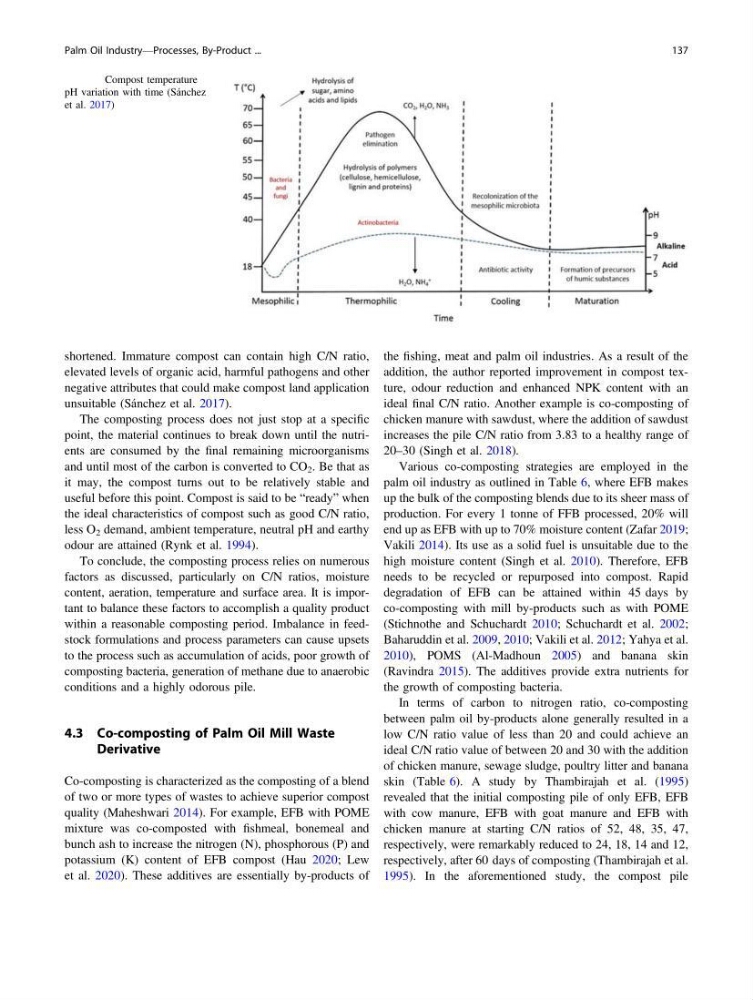
Fig. 10 Compost temperature
pH variation with time (Sánchez
et al. 2017)
Palm Oil Industry—Processes, By-Product ...
137
elevated levels of organic acid, harmful pathogens and other
negative attributes that could make compost land application
unsuitable (Sánchez et al. 2017).
The composting process does not just stop at a specific
point, the material continues to break down until the nutrients are consumed by the final remaining microorganisms
and until most of the carbon is converted to CO 2 . Be that as
it may, the compost turns out to be relatively stable and
useful before this point. Compost is said to be “ready” when
the ideal characteristics of compost such as good C/N ratio,
less O 2 demand, ambient temperature, neutral pH and earthy
odour are attained (Rynk et al. 1994).
To conclude, the composting process relies on numerous
factors as discussed, particularly on C/N ratios, moisture
content, aeration, temperature and surface area. It is important to balance these factors to accomplish a quality product
within a reasonable composting period. Imbalance in feedstock formulations and process parameters can cause upsets
to the process such as accumulation of acids, poor growth of
composting bacteria, generation of methane due to anaerobic
conditions and a highly odorous pile.
4.3 Co-composting of Palm Oil Mill Waste
Derivative
Co-composting is characterized as the composting of a blend
of two or more types of wastes to achieve superior compost
quality (Maheshwari 2014). For example, EFB with POME
mixture was co-composted with fishmeal, bonemeal and
bunch ash to increase the nitrogen (N), phosphorous (P) and
potassium (K) content of EFB compost (Hau 2020; Lew
et al. 2020). These additives are essentially by-products of
the fishing, meat and palm oil industries. As a result of the
addition, the author reported improvement in compost texture, odour reduction and enhanced NPK content with an
ideal final C/N ratio. Another example is co-composting of
chicken manure with sawdust, where the addition of sawdust
increases the pile C/N ratio from 3.83 to a healthy range of
20–30 (Singh et al. 2018).
Various co-composting strategies are employed in the
palm oil industry as outlined in Table 6, where EFB makes
up the bulk of the composting blends due to its sheer mass of
production. For every 1 tonne of FFB processed, 20% will
end up as EFB with up to 70% moisture content (Zafar 2019;
Vakili 2014). Its use as a solid fuel is unsuitable due to the
high moisture content (Singh et al. 2010). Therefore, EFB
needs to be recycled or repurposed into compost. Rapid
degradation of EFB can be attained within 45 days by
co-composting with mill by-products such as with POME
(Stichnothe and Schuchardt 2010; Schuchardt et al. 2002;
Baharuddin et al. 2009, 2010; Vakili et al. 2012; Yahya et al.
2010), POMS (Al-Madhoun 2005) and banana skin
(Ravindra 2015). The additives provide extra nutrients for
the growth of composting bacteria.
In terms of carbon to nitrogen ratio, co-composting
between palm oil by-products alone generally resulted in a
low C/N ratio value of less than 20 and could achieve an
ideal C/N ratio value of between 20 and 30 with the addition
of chicken manure, sewage sludge, poultry litter and banana
skin (Table 6). A study by Thambirajah et al. (1995)
revealed that the initial composting pile of only EFB, EFB
with cow manure, EFB with goat manure and EFB with
chicken manure at starting C/N ratios of 52, 48, 35, 47,
respectively, were remarkably reduced to 24, 18, 14 and 12,
respectively, after 60 days of composting (Thambirajah et al.
1995). In the aforementioned study, the compost pile
Fig. 10 Compost temperature
pH variation with time (Sánchez
et al. 2017)
Palm Oil Industry—Processes, By-Product ...
137