

for treatment and value addition rather than being left
underutilized. Moreover, by capturing the biogas for energy
use, rampant methane release into the environment can be
prevented.
4 Aerobic Composting of Palm Oil Mill
Waste by-Products
4.1 Biological Processes
Aerobic composting is the decomposition of organic matter
(OM) by microorganisms under certain controlled conditions
whereby microorganisms consume oxygen (O 2 ) while
feeding on organic materials (Pace et al. 1995). The composting process is a rapid bioconversion of OM into compost
which is also known as humic substances (Ravindra 2015).
Composting is a useful method to recycle waste and to
produce compost fertilizer that is chemically stable, which
can be used as a fertilizer to provide nutrients for plants and
to improve soil structure (Nutongkaew 2011). The matured
compost is good for land application without harming the
environment. According to Zahrim and Asis (2010), composting is a proven technology for processing EFB from
palm oil mills and it can reduce the initial weight and volume of the fresh EFB by 50% and 85%, respectively.
Vegetative wastes like palm oil mill derivatives contain
high amounts of cellulose, lignin and hemicellulose which
could serve as crucial sources of carbon (C) and nitrogen
(N) for a balanced composting process (Maheshwari 2014).
However, the contents of N in the majority of the palm oil
mill or vegetative waste is simply not enough for effective
composting (Maheshwari 2014). In most cases, additives
like urea, manure, dairy, meat waste, fish and others are
added into the composting pile of palm oil mill wastes to
promote a healthy composting process (Imbeah 1998).
4.2 Parameters of Aerobic Composting
During the early stages of composting, O 2 and other easily
degradable components of raw material are consumed
rapidly by the microorganisms (Pace et al. 1995). A good
indicator of knowing the composting progress is through the
observation of temperature change of the windrow or pile
from the release of heat during microbial activity (Rynk
et al. 1994).
From a typical temperature and pH profile of composting
shown in Fig. 10, the temperature usually follows a pattern
of rapid increase to 43–70 °C where it remains for a few
weeks depending on the raw materials (Sánchez et al. 2017).
The temperatures will steadily decrease until the compost
reaches ambient air temperature as the active composting
slows down. The composting process is affected by
numerous factors such as pH level, temperature, aeration
rate, carbon to nitrogen ratio, moisture content and the
physical structure of raw materials as listed in Table 5.
The curing period begins when windows or piles no
longer reheat after turning and it usually lasts up 3 to
4 weeks. During this time, the materials continue to compost
but at a slower pace with a decreasing rate of oxygen consumption (Rynk et al. 1994). Curing happens at mesophilic
temperatures and the significance of curing increases if the
active composting stage is either poorly managed or
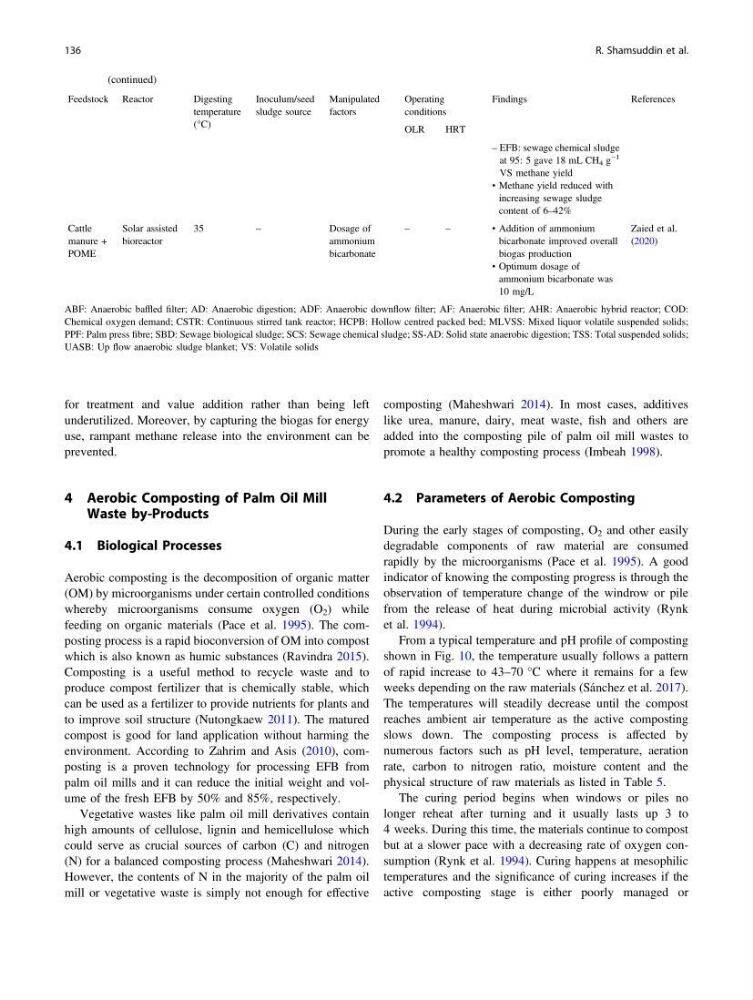
Table 4 (continued)
Feedstock Reactor
Digesting
temperature
(°C)
Inoculum/seed
sludge source
Manipulated
factors
Operating
conditions
Findings
References
OLR
HRT
– EFB: sewage chemical sludge
at 95: 5 gave 18 mL CH 4 g
−1
VS methane yield
• Methane yield reduced with
increasing sewage sludge
content of 6–42%
Cattle
manure +
POME
Solar assisted
bioreactor
35
–
Dosage of
ammonium
bicarbonate
–
–
• Addition of ammonium
bicarbonate improved overall
biogas production
• Optimum dosage of
ammonium bicarbonate was
10 mg/L
Zaied et al.
(2020)
ABF: Anaerobic baffled filter; AD: Anaerobic digestion; ADF: Anaerobic downflow filter; AF: Anaerobic filter; AHR: Anaerobic hybrid reactor; COD:
Chemical oxygen demand; CSTR: Continuous stirred tank reactor; HCPB: Hollow centred packed bed; MLVSS: Mixed liquor volatile suspended solids;
PPF: Palm press fibre; SBD: Sewage biological sludge; SCS: Sewage chemical sludge; SS-AD: Solid state anaerobic digestion; TSS: Total suspended solids;
UASB: Up flow anaerobic sludge blanket; VS: Volatile solids
136
R. Shamsuddin et al.
underutilized. Moreover, by capturing the biogas for energy
use, rampant methane release into the environment can be
prevented.
4 Aerobic Composting of Palm Oil Mill
Waste by-Products
4.1 Biological Processes
Aerobic composting is the decomposition of organic matter
(OM) by microorganisms under certain controlled conditions
whereby microorganisms consume oxygen (O 2 ) while
feeding on organic materials (Pace et al. 1995). The composting process is a rapid bioconversion of OM into compost
which is also known as humic substances (Ravindra 2015).
Composting is a useful method to recycle waste and to
produce compost fertilizer that is chemically stable, which
can be used as a fertilizer to provide nutrients for plants and
to improve soil structure (Nutongkaew 2011). The matured
compost is good for land application without harming the
environment. According to Zahrim and Asis (2010), composting is a proven technology for processing EFB from
palm oil mills and it can reduce the initial weight and volume of the fresh EFB by 50% and 85%, respectively.
Vegetative wastes like palm oil mill derivatives contain
high amounts of cellulose, lignin and hemicellulose which
could serve as crucial sources of carbon (C) and nitrogen
(N) for a balanced composting process (Maheshwari 2014).
However, the contents of N in the majority of the palm oil
mill or vegetative waste is simply not enough for effective
composting (Maheshwari 2014). In most cases, additives
like urea, manure, dairy, meat waste, fish and others are
added into the composting pile of palm oil mill wastes to
promote a healthy composting process (Imbeah 1998).
4.2 Parameters of Aerobic Composting
During the early stages of composting, O 2 and other easily
degradable components of raw material are consumed
rapidly by the microorganisms (Pace et al. 1995). A good
indicator of knowing the composting progress is through the
observation of temperature change of the windrow or pile
from the release of heat during microbial activity (Rynk
et al. 1994).
From a typical temperature and pH profile of composting
shown in Fig. 10, the temperature usually follows a pattern
of rapid increase to 43–70 °C where it remains for a few
weeks depending on the raw materials (Sánchez et al. 2017).
The temperatures will steadily decrease until the compost
reaches ambient air temperature as the active composting
slows down. The composting process is affected by
numerous factors such as pH level, temperature, aeration
rate, carbon to nitrogen ratio, moisture content and the
physical structure of raw materials as listed in Table 5.
The curing period begins when windows or piles no
longer reheat after turning and it usually lasts up 3 to
4 weeks. During this time, the materials continue to compost
but at a slower pace with a decreasing rate of oxygen consumption (Rynk et al. 1994). Curing happens at mesophilic
temperatures and the significance of curing increases if the
active composting stage is either poorly managed or
Table 4 (continued)
Feedstock Reactor
Digesting
temperature
(°C)
Inoculum/seed
sludge source
Manipulated
factors
Operating
conditions
Findings
References
OLR
HRT
– EFB: sewage chemical sludge
at 95: 5 gave 18 mL CH 4 g
−1
VS methane yield
• Methane yield reduced with
increasing sewage sludge
content of 6–42%
Cattle
manure +
POME
Solar assisted
bioreactor
35
–
Dosage of
ammonium
bicarbonate
–
–
• Addition of ammonium
bicarbonate improved overall
biogas production
• Optimum dosage of
ammonium bicarbonate was
10 mg/L
Zaied et al.
(2020)
ABF: Anaerobic baffled filter; AD: Anaerobic digestion; ADF: Anaerobic downflow filter; AF: Anaerobic filter; AHR: Anaerobic hybrid reactor; COD:
Chemical oxygen demand; CSTR: Continuous stirred tank reactor; HCPB: Hollow centred packed bed; MLVSS: Mixed liquor volatile suspended solids;
PPF: Palm press fibre; SBD: Sewage biological sludge; SCS: Sewage chemical sludge; SS-AD: Solid state anaerobic digestion; TSS: Total suspended solids;
UASB: Up flow anaerobic sludge blanket; VS: Volatile solids
136
R. Shamsuddin et al.