

mosques and monitors sermons for political
commentary.
5
Internet in the United Arab Emirates
The UAE is among the most highly Internet-connected countries in the Middle East. The UAE
Yearbook for 2007 states that there are more than
578,000 Internet subscribers in the country. 6
September 2006 figures on Internet penetration
place the number of Internet users at 1.40 million,
or 35 percent of the population, 7 though Etisalat
(Emirates Telecommunications Corporation)—
the nation’s primary service provider—estimates
that more than 51 percent of the country is
online. 8
Since 1976, nearly all telephone and Internet
service in the UAE has been furnished by the
government-owned Etisalat—either through
direct sale of subscriptions to customers or
through commercial resale of Etisalat services via
providers such as Dubai Internet City (DIC) telecom. With the release of the General Policy for
the Telecommunication Sector (GTP) in 2006, 9
the UAE government moved to liberalize the
telecommunications market, though it remains to
be seen how competition will affect Etisalat’s
monopoly on telecom operations. The UAE
Telecommunications Regulatory Authority (TRA)
granted a twenty-year license to the Emirates
Integrated Telecommunications Company
(EITC)—more widely known under its traded
name “du”—to offer fixed-line, mobile, and
Internet services. Prior to liberalization, du served
the Dubai free zone and a few affiliated residential complexes, providing unfettered Internet
access in those areas, but acquisitions and partnerships with other telecom companies have
expanded du’s capabilities and customer base.
du now aims to capture 30 percent of the UAE
telecom market within three years. 10
Legal and regulatory frameworks
Controls on Internet content in the UAE, actualized through filtering and other forms of enforcement, are geared toward safeguarding political,
moral, and religious values. According to Etisalat,
there is some evidence that these controls enjoy
popular support. A 2002 survey found that 60
percent of Etisalat subscribers surveyed favored
retaining the ISP’s automatic filtering system, with
51 percent saying that it protected family members from objectionable content. In 2004, the
UAE cited the survey as indicating that the role
of filtering “in protecting users from offensive
406
Country Summaries
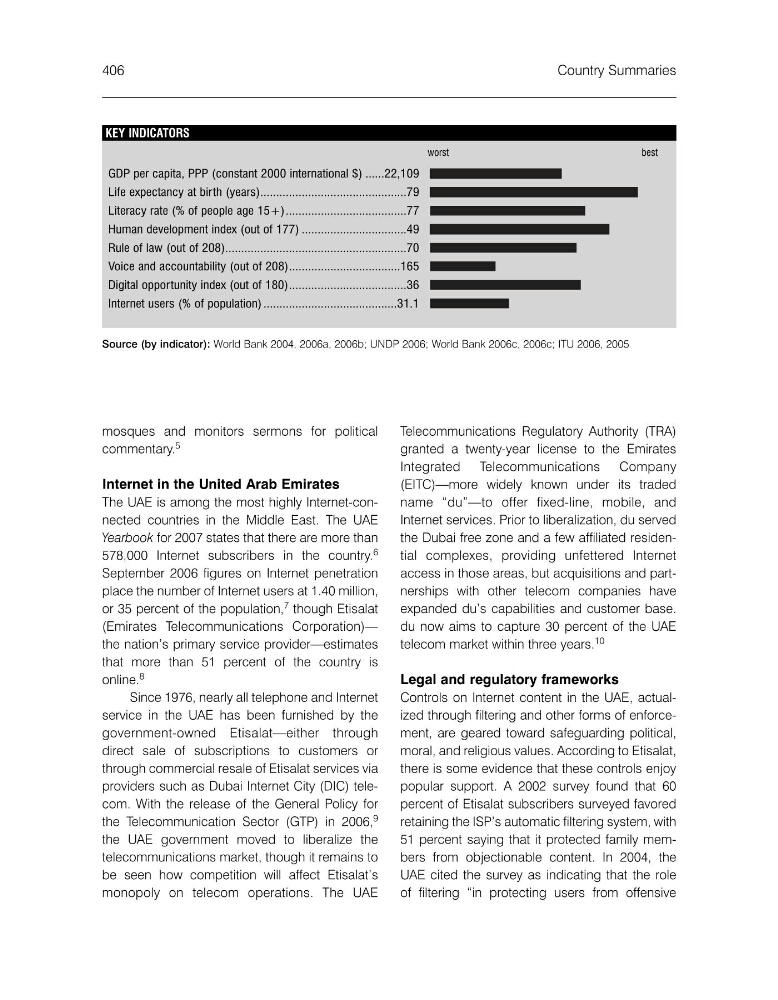
KEY INDICATORS
worst
best
GDP per capita, PPP (constant 2000 international $) ......22,109 7.47
Life expectancy at birth (years)..............................................79 7.09
Literacy rate (% of people age 15+)......................................77 4.73
Human development index (out of 177) .................................49 6.44
Rule of law (out of 208).........................................................70 6.17
Voice and accountability (out of 208)...................................165 2.83
Digital opportunity index (out of 180).....................................36 6.88
Internet users (% of population) ..........................................31.1 5.98
Source (by indicator): World Bank 2004, 2006a, 2006b; UNDP 2006; World Bank 2006c, 2006c; ITU 2006, 2005
commentary.
5
Internet in the United Arab Emirates
The UAE is among the most highly Internet-connected countries in the Middle East. The UAE
Yearbook for 2007 states that there are more than
578,000 Internet subscribers in the country. 6
September 2006 figures on Internet penetration
place the number of Internet users at 1.40 million,
or 35 percent of the population, 7 though Etisalat
(Emirates Telecommunications Corporation)—
the nation’s primary service provider—estimates
that more than 51 percent of the country is
online. 8
Since 1976, nearly all telephone and Internet
service in the UAE has been furnished by the
government-owned Etisalat—either through
direct sale of subscriptions to customers or
through commercial resale of Etisalat services via
providers such as Dubai Internet City (DIC) telecom. With the release of the General Policy for
the Telecommunication Sector (GTP) in 2006, 9
the UAE government moved to liberalize the
telecommunications market, though it remains to
be seen how competition will affect Etisalat’s
monopoly on telecom operations. The UAE
Telecommunications Regulatory Authority (TRA)
granted a twenty-year license to the Emirates
Integrated Telecommunications Company
(EITC)—more widely known under its traded
name “du”—to offer fixed-line, mobile, and
Internet services. Prior to liberalization, du served
the Dubai free zone and a few affiliated residential complexes, providing unfettered Internet
access in those areas, but acquisitions and partnerships with other telecom companies have
expanded du’s capabilities and customer base.
du now aims to capture 30 percent of the UAE
telecom market within three years. 10
Legal and regulatory frameworks
Controls on Internet content in the UAE, actualized through filtering and other forms of enforcement, are geared toward safeguarding political,
moral, and religious values. According to Etisalat,
there is some evidence that these controls enjoy
popular support. A 2002 survey found that 60
percent of Etisalat subscribers surveyed favored
retaining the ISP’s automatic filtering system, with
51 percent saying that it protected family members from objectionable content. In 2004, the
UAE cited the survey as indicating that the role
of filtering “in protecting users from offensive
406
Country Summaries
KEY INDICATORS
worst
best
GDP per capita, PPP (constant 2000 international $) ......22,109 7.47
Life expectancy at birth (years)..............................................79 7.09
Literacy rate (% of people age 15+)......................................77 4.73
Human development index (out of 177) .................................49 6.44
Rule of law (out of 208).........................................................70 6.17
Voice and accountability (out of 208)...................................165 2.83
Digital opportunity index (out of 180).....................................36 6.88
Internet users (% of population) ..........................................31.1 5.98
Source (by indicator): World Bank 2004, 2006a, 2006b; UNDP 2006; World Bank 2006c, 2006c; ITU 2006, 2005