

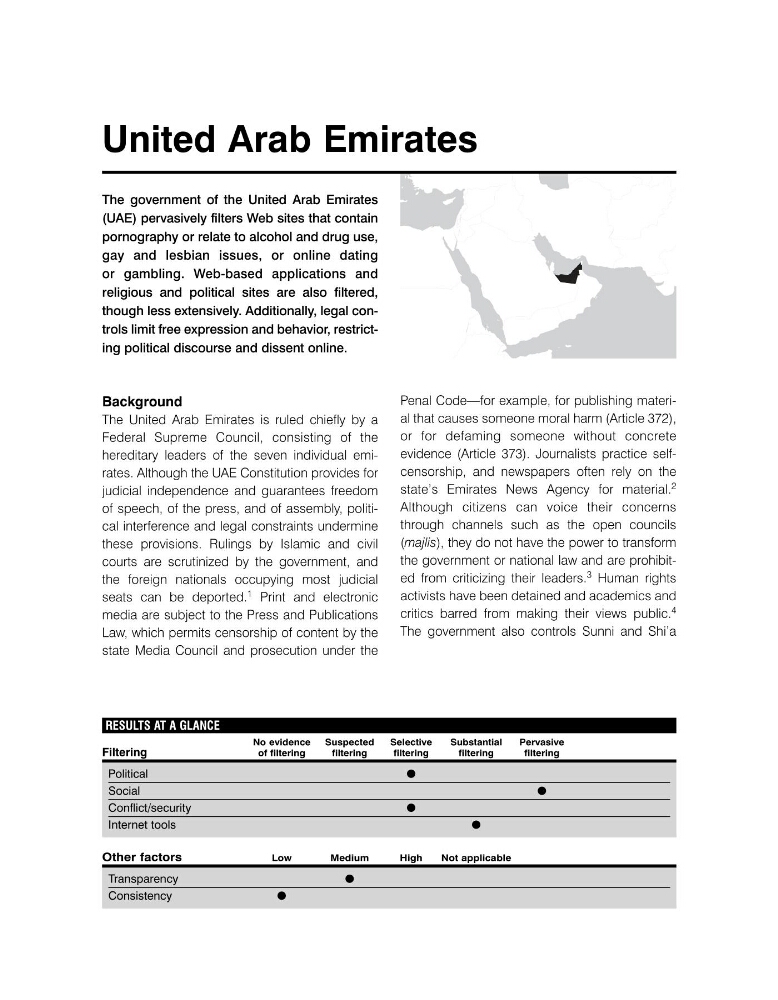
The government of the United Arab Emirates
(UAE) pervasively filters Web sites that contain
pornography or relate to alcohol and drug use,
gay and lesbian issues, or online dating
or gambling. Web-based applications and
religious and political sites are also filtered,
though less extensively. Additionally, legal controls limit free expression and behavior, restricting political discourse and dissent online.
Background
The United Arab Emirates is ruled chiefly by a
Federal Supreme Council, consisting of the
hereditary leaders of the seven individual emirates. Although the UAE Constitution provides for
judicial independence and guarantees freedom
of speech, of the press, and of assembly, political interference and legal constraints undermine
these provisions. Rulings by Islamic and civil
courts are scrutinized by the government, and
the foreign nationals occupying most judicial
seats can be deported. 1 Print and electronic
media are subject to the Press and Publications
Law, which permits censorship of content by the
state Media Council and prosecution under the
Penal Code—for example, for publishing material that causes someone moral harm (Article 372),
or for defaming someone without concrete
evidence (Article 373). Journalists practice selfcensorship, and newspapers often rely on the
state’s Emirates News Agency for material. 2
Although citizens can voice their concerns
through channels such as the open councils
(majlis), they do not have the power to transform
the government or national law and are prohibited from criticizing their leaders. 3 Human rights
activists have been detained and academics and
critics barred from making their views public. 4
The government also controls Sunni and Shi’a
RESULTS AT A GLANCE
No evidence
Suspected
Selective
Substantial
Pervasive
Filtering
of filtering
filtering
filtering
filtering
filtering
Political
●
Social
●
Conflict/security
●
Internet tools
●
Other factors
Low
Medium
High
Not applicable
Transparency
●
Consistency
●
United Arab Emirates
(UAE) pervasively filters Web sites that contain
pornography or relate to alcohol and drug use,
gay and lesbian issues, or online dating
or gambling. Web-based applications and
religious and political sites are also filtered,
though less extensively. Additionally, legal controls limit free expression and behavior, restricting political discourse and dissent online.
Background
The United Arab Emirates is ruled chiefly by a
Federal Supreme Council, consisting of the
hereditary leaders of the seven individual emirates. Although the UAE Constitution provides for
judicial independence and guarantees freedom
of speech, of the press, and of assembly, political interference and legal constraints undermine
these provisions. Rulings by Islamic and civil
courts are scrutinized by the government, and
the foreign nationals occupying most judicial
seats can be deported. 1 Print and electronic
media are subject to the Press and Publications
Law, which permits censorship of content by the
state Media Council and prosecution under the
Penal Code—for example, for publishing material that causes someone moral harm (Article 372),
or for defaming someone without concrete
evidence (Article 373). Journalists practice selfcensorship, and newspapers often rely on the
state’s Emirates News Agency for material. 2
Although citizens can voice their concerns
through channels such as the open councils
(majlis), they do not have the power to transform
the government or national law and are prohibited from criticizing their leaders. 3 Human rights
activists have been detained and academics and
critics barred from making their views public. 4
The government also controls Sunni and Shi’a
RESULTS AT A GLANCE
No evidence
Suspected
Selective
Substantial
Pervasive
Filtering
of filtering
filtering
filtering
filtering
filtering
Political
●
Social
●
Conflict/security
●
Internet tools
●
Other factors
Low
Medium
High
Not applicable
Transparency
●
Consistency
●
United Arab Emirates