

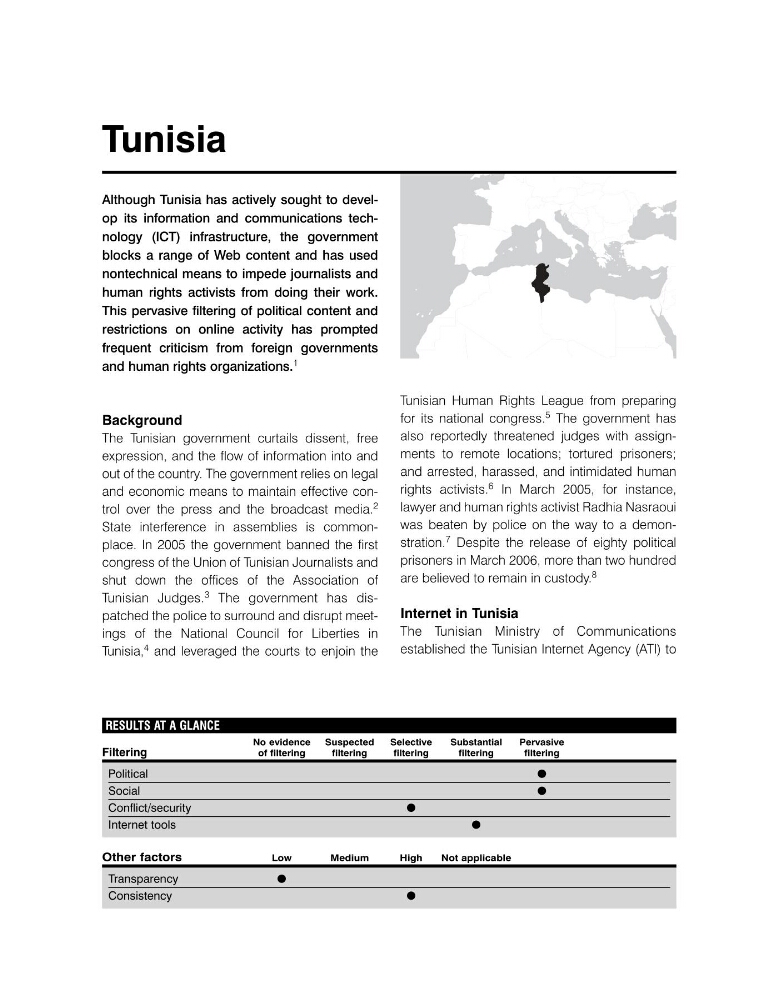
Although Tunisia has actively sought to develop its information and communications technology (ICT) infrastructure, the government
blocks a range of Web content and has used
nontechnical means to impede journalists and
human rights activists from doing their work.
This pervasive filtering of political content and
restrictions on online activity has prompted
frequent criticism from foreign governments
and human rights organizations.
1
Background
The Tunisian government curtails dissent, free
expression, and the flow of information into and
out of the country. The government relies on legal
and economic means to maintain effective control over the press and the broadcast media. 2
State interference in assemblies is commonplace. In 2005 the government banned the first
congress of the Union of Tunisian Journalists and
shut down the offices of the Association of
Tunisian Judges. 3 The government has dispatched the police to surround and disrupt meetings of the National Council for Liberties in
Tunisia, 4 and leveraged the courts to enjoin the
Tunisian Human Rights League from preparing
for its national congress. 5 The government has
also reportedly threatened judges with assignments to remote locations; tortured prisoners;
and arrested, harassed, and intimidated human
rights activists. 6 In March 2005, for instance,
lawyer and human rights activist Radhia Nasraoui
was beaten by police on the way to a demonstration. 7 Despite the release of eighty political
prisoners in March 2006, more than two hundred
are believed to remain in custody. 8
Internet in Tunisia
The Tunisian Ministry of Communications
established the Tunisian Internet Agency (ATI) to
RESULTS AT A GLANCE
No evidence
Suspected
Selective
Substantial
Pervasive
Filtering
of filtering
filtering
filtering
filtering
filtering
Political
●
Social
●
Conflict/security
●
Internet tools
●
Other factors
Low
Medium
High
Not applicable
Transparency
●
Consistency
●
Tunisia
blocks a range of Web content and has used
nontechnical means to impede journalists and
human rights activists from doing their work.
This pervasive filtering of political content and
restrictions on online activity has prompted
frequent criticism from foreign governments
and human rights organizations.
1
Background
The Tunisian government curtails dissent, free
expression, and the flow of information into and
out of the country. The government relies on legal
and economic means to maintain effective control over the press and the broadcast media. 2
State interference in assemblies is commonplace. In 2005 the government banned the first
congress of the Union of Tunisian Journalists and
shut down the offices of the Association of
Tunisian Judges. 3 The government has dispatched the police to surround and disrupt meetings of the National Council for Liberties in
Tunisia, 4 and leveraged the courts to enjoin the
Tunisian Human Rights League from preparing
for its national congress. 5 The government has
also reportedly threatened judges with assignments to remote locations; tortured prisoners;
and arrested, harassed, and intimidated human
rights activists. 6 In March 2005, for instance,
lawyer and human rights activist Radhia Nasraoui
was beaten by police on the way to a demonstration. 7 Despite the release of eighty political
prisoners in March 2006, more than two hundred
are believed to remain in custody. 8
Internet in Tunisia
The Tunisian Ministry of Communications
established the Tunisian Internet Agency (ATI) to
RESULTS AT A GLANCE
No evidence
Suspected
Selective
Substantial
Pervasive
Filtering
of filtering
filtering
filtering
filtering
filtering
Political
●
Social
●
Conflict/security
●
Internet tools
●
Other factors
Low
Medium
High
Not applicable
Transparency
●
Consistency
●
Tunisia