

regulate the country’s Internet and domain name
system (DNS) services, which had formerly fallen
under the Regional Institute for Computer
Sciences and Telecommunications (IRSIT)’s
purview. 9 The ATI is the gateway from which all of
Tunisia’s twelve Internet service providers (ISPs)
lease their bandwidth.
10
Seven of these ISPs are
publicly operated; the other five—Planet Tunisie,
3S Global Net, Hexabyte, Tunet, and Topnet—are
private. 11 These ISPs offer a range of options,
including hourly dialup access,
12
broadband
access (with prices starting at less than USD25
per month),
13
and satellite-based Internet.
14
The government has energetically sought to
spread access to the Internet. The ATI reports
connectivity of 100 percent for universities,
research laboratories, and secondary schools,
and 70 percent for primary schools. 15
Government-brokered “Free Internet” programs
that provide Web access for the price of a local
telephone call and increased competition among
ISPs have significantly reduced the economic
barriers to Internet access. Those Tunisians
for whom personal computers remain prohibitively
expensive may also access the Internet
from more than 300 cybercafés set up by the
authorities. 16
Tunisia’s rapid growth in Internet capacity is
reflected in an increase in Internet use. In just five
years, Tunisia’s Internet penetration rate rose
from 1 percent (2001) to 9.3 percent (2006), 17
and today there are roughly one million Internet
users in the country.
18
Legal and regulatory frameworks
In addition to filtering Web content, the government of Tunisia utilizes laws, regulations, and surveillance to achieve strict control over the
Internet.
The Tunisian External Communication
Agency (ATCE), the government body responsible for media regulation, contends that fewer
than 10 percent of newspapers are under state
ownership and editorial control. 19 However, the
ATCE uses its regulatory powers to help government supporters and hamper detractors seeking
advertising space in the print media. 20 The state
maintains direct ownership of all three of the
country’s television stations and all but one radio
station (which does not air news). Although the
Internet has unquestionably made it easier for
Tunisians to read news and opinions not found in
the country’s monolithic press and broadcast
396
Country Summaries
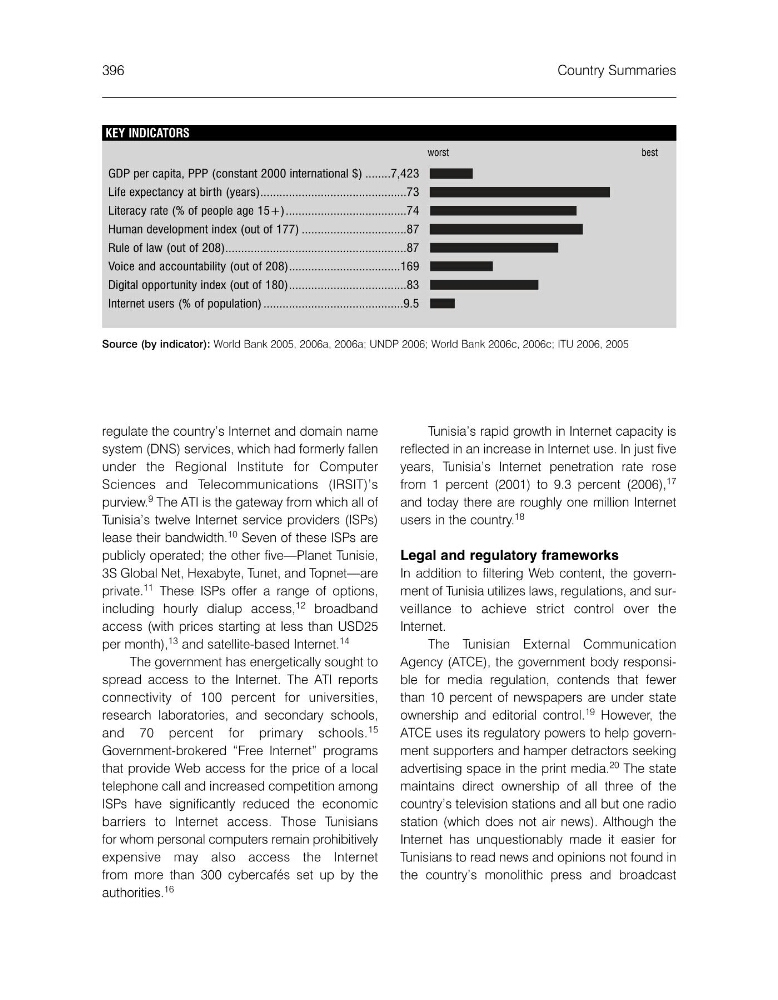
KEY INDICATORS
worst
best
GDP per capita, PPP (constant 2000 international $) ........7,423 4.65
Life expectancy at birth (years)..............................................73 6.12
Literacy rate (% of people age 15+)......................................74 4.44
Human development index (out of 177) .................................87 5.55
Rule of law (out of 208).........................................................87 5.42
Voice and accountability (out of 208)...................................169 2.74
Digital opportunity index (out of 180).....................................83 5.22
Internet users (% of population) ............................................9.5 3.95
Source (by indicator): World Bank 2005, 2006a, 2006a; UNDP 2006; World Bank 2006c, 2006c; ITU 2006, 2005
system (DNS) services, which had formerly fallen
under the Regional Institute for Computer
Sciences and Telecommunications (IRSIT)’s
purview. 9 The ATI is the gateway from which all of
Tunisia’s twelve Internet service providers (ISPs)
lease their bandwidth.
10
Seven of these ISPs are
publicly operated; the other five—Planet Tunisie,
3S Global Net, Hexabyte, Tunet, and Topnet—are
private. 11 These ISPs offer a range of options,
including hourly dialup access,
12
broadband
access (with prices starting at less than USD25
per month),
13
and satellite-based Internet.
14
The government has energetically sought to
spread access to the Internet. The ATI reports
connectivity of 100 percent for universities,
research laboratories, and secondary schools,
and 70 percent for primary schools. 15
Government-brokered “Free Internet” programs
that provide Web access for the price of a local
telephone call and increased competition among
ISPs have significantly reduced the economic
barriers to Internet access. Those Tunisians
for whom personal computers remain prohibitively
expensive may also access the Internet
from more than 300 cybercafés set up by the
authorities. 16
Tunisia’s rapid growth in Internet capacity is
reflected in an increase in Internet use. In just five
years, Tunisia’s Internet penetration rate rose
from 1 percent (2001) to 9.3 percent (2006), 17
and today there are roughly one million Internet
users in the country.
18
Legal and regulatory frameworks
In addition to filtering Web content, the government of Tunisia utilizes laws, regulations, and surveillance to achieve strict control over the
Internet.
The Tunisian External Communication
Agency (ATCE), the government body responsible for media regulation, contends that fewer
than 10 percent of newspapers are under state
ownership and editorial control. 19 However, the
ATCE uses its regulatory powers to help government supporters and hamper detractors seeking
advertising space in the print media. 20 The state
maintains direct ownership of all three of the
country’s television stations and all but one radio
station (which does not air news). Although the
Internet has unquestionably made it easier for
Tunisians to read news and opinions not found in
the country’s monolithic press and broadcast
396
Country Summaries
KEY INDICATORS
worst
best
GDP per capita, PPP (constant 2000 international $) ........7,423 4.65
Life expectancy at birth (years)..............................................73 6.12
Literacy rate (% of people age 15+)......................................74 4.44
Human development index (out of 177) .................................87 5.55
Rule of law (out of 208).........................................................87 5.42
Voice and accountability (out of 208)...................................169 2.74
Digital opportunity index (out of 180).....................................83 5.22
Internet users (% of population) ............................................9.5 3.95
Source (by indicator): World Bank 2005, 2006a, 2006a; UNDP 2006; World Bank 2006c, 2006c; ITU 2006, 2005