

the Internet. We are also observing a recent and tremendously dynamic process. The view we
have now may change dramatically in the coming years.
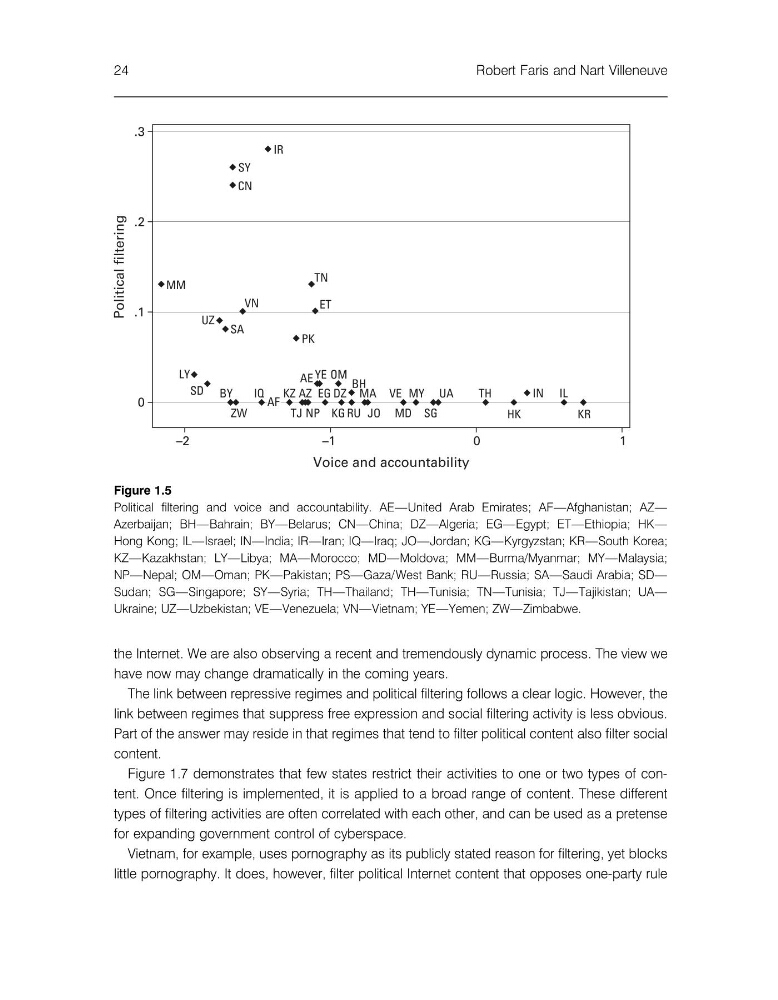
The link between repressive regimes and political filtering follows a clear logic. However, the
link between regimes that suppress free expression and social filtering activity is less obvious.
Part of the answer may reside in that regimes that tend to filter political content also filter social
content.
Figure 1.7 demonstrates that few states restrict their activities to one or two types of content. Once filtering is implemented, it is applied to a broad range of content. These different
types of filtering activities are often correlated with each other, and can be used as a pretense
for expanding government control of cyberspace.
Vietnam, for example, uses pornography as its publicly stated reason for filtering, yet blocks
little pornography. It does, however, filter political Internet content that opposes one-party rule
Figure 1.5
Political filtering and voice and accountability. AE—United Arab Emirates; AF—Afghanistan; AZ—
Azerbaijan; BH—Bahrain; BY—Belarus; CN—China; DZ—Algeria; EG—Egypt; ET—Ethiopia; HK—
Hong Kong; IL—Israel; IN—India; IR—Iran; IQ—Iraq; JO—Jordan; KG—Kyrgyzstan; KR—South Korea;
KZ—Kazakhstan; LY—Libya; MA—Morocco; MD—Moldova; MM—Burma/Myanmar; MY—Malaysia;
NP—Nepal; OM—Oman; PK—Pakistan; PS—Gaza/West Bank; RU—Russia; SA—Saudi Arabia; SD—
Sudan; SG—Singapore; SY—Syria; TH—Thailand; TH—Tunisia; TN—Tunisia; TJ—Tajikistan; UA—
Ukraine; UZ—Uzbekistan; VE—Venezuela; VN—Vietnam; YE—Yemen; ZW—Zimbabwe.
24
Robert Faris and Nart Villeneuve
have now may change dramatically in the coming years.
The link between repressive regimes and political filtering follows a clear logic. However, the
link between regimes that suppress free expression and social filtering activity is less obvious.
Part of the answer may reside in that regimes that tend to filter political content also filter social
content.
Figure 1.7 demonstrates that few states restrict their activities to one or two types of content. Once filtering is implemented, it is applied to a broad range of content. These different
types of filtering activities are often correlated with each other, and can be used as a pretense
for expanding government control of cyberspace.
Vietnam, for example, uses pornography as its publicly stated reason for filtering, yet blocks
little pornography. It does, however, filter political Internet content that opposes one-party rule
Figure 1.5
Political filtering and voice and accountability. AE—United Arab Emirates; AF—Afghanistan; AZ—
Azerbaijan; BH—Bahrain; BY—Belarus; CN—China; DZ—Algeria; EG—Egypt; ET—Ethiopia; HK—
Hong Kong; IL—Israel; IN—India; IR—Iran; IQ—Iraq; JO—Jordan; KG—Kyrgyzstan; KR—South Korea;
KZ—Kazakhstan; LY—Libya; MA—Morocco; MD—Moldova; MM—Burma/Myanmar; MY—Malaysia;
NP—Nepal; OM—Oman; PK—Pakistan; PS—Gaza/West Bank; RU—Russia; SA—Saudi Arabia; SD—
Sudan; SG—Singapore; SY—Syria; TH—Thailand; TH—Tunisia; TN—Tunisia; TJ—Tajikistan; UA—
Ukraine; UZ—Uzbekistan; VE—Venezuela; VN—Vietnam; YE—Yemen; ZW—Zimbabwe.
24
Robert Faris and Nart Villeneuve