

an uncommon circumstance. Pointing simply toward the absence of a solid rule of law does
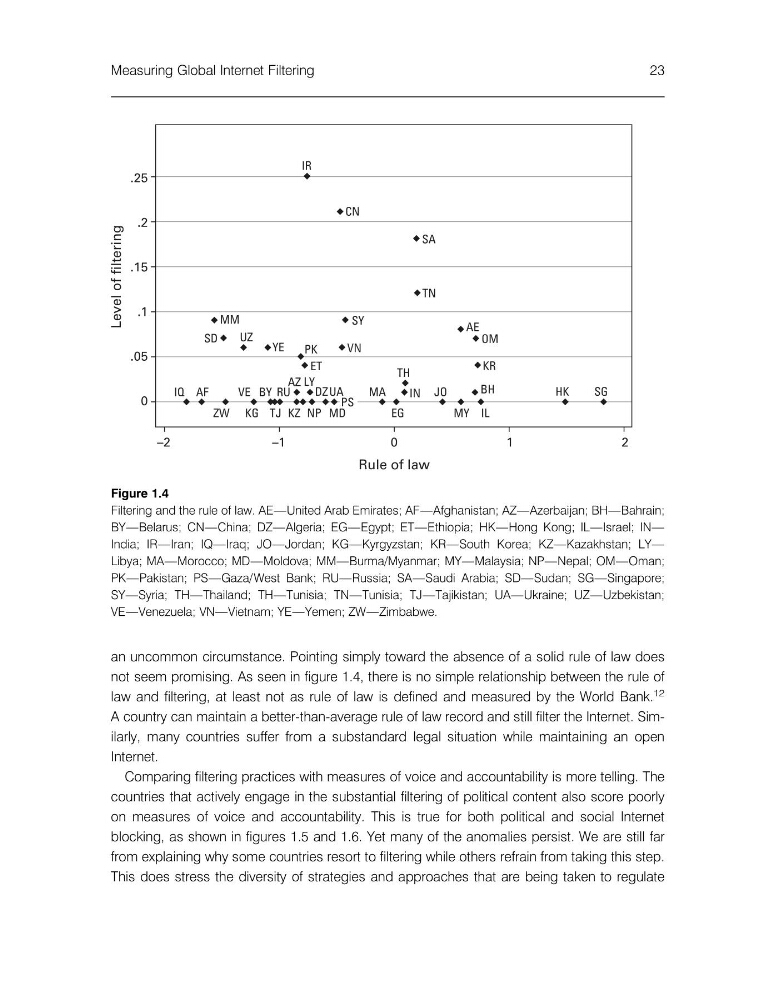
not seem promising. As seen in figure 1.4, there is no simple relationship between the rule of
law and filtering, at least not as rule of law is defined and measured by the World Bank.
12
A country can maintain a better-than-average rule of law record and still filter the Internet. Similarly, many countries suffer from a substandard legal situation while maintaining an open
Internet.
Comparing filtering practices with measures of voice and accountability is more telling. The
countries that actively engage in the substantial filtering of political content also score poorly
on measures of voice and accountability. This is true for both political and social Internet
blocking, as shown in figures 1.5 and 1.6. Yet many of the anomalies persist. We are still far
from explaining why some countries resort to filtering while others refrain from taking this step.
This does stress the diversity of strategies and approaches that are being taken to regulate
Figure 1.4
Filtering and the rule of law. AE—United Arab Emirates; AF—Afghanistan; AZ—Azerbaijan; BH—Bahrain;
BY—Belarus; CN—China; DZ—Algeria; EG—Egypt; ET—Ethiopia; HK—Hong Kong; IL—Israel; IN—
India; IR—Iran; IQ—Iraq; JO—Jordan; KG—Kyrgyzstan; KR—South Korea; KZ—Kazakhstan; LY—
Libya; MA—Morocco; MD—Moldova; MM—Burma/Myanmar; MY—Malaysia; NP—Nepal; OM—Oman;
PK—Pakistan; PS—Gaza/West Bank; RU—Russia; SA—Saudi Arabia; SD—Sudan; SG—Singapore;
SY—Syria; TH—Thailand; TH—Tunisia; TN—Tunisia; TJ—Tajikistan; UA—Ukraine; UZ—Uzbekistan;
VE—Venezuela; VN—Vietnam; YE—Yemen; ZW—Zimbabwe.
Measuring Global Internet Filtering
23
not seem promising. As seen in figure 1.4, there is no simple relationship between the rule of
law and filtering, at least not as rule of law is defined and measured by the World Bank.
12
A country can maintain a better-than-average rule of law record and still filter the Internet. Similarly, many countries suffer from a substandard legal situation while maintaining an open
Internet.
Comparing filtering practices with measures of voice and accountability is more telling. The
countries that actively engage in the substantial filtering of political content also score poorly
on measures of voice and accountability. This is true for both political and social Internet
blocking, as shown in figures 1.5 and 1.6. Yet many of the anomalies persist. We are still far
from explaining why some countries resort to filtering while others refrain from taking this step.
This does stress the diversity of strategies and approaches that are being taken to regulate
Figure 1.4
Filtering and the rule of law. AE—United Arab Emirates; AF—Afghanistan; AZ—Azerbaijan; BH—Bahrain;
BY—Belarus; CN—China; DZ—Algeria; EG—Egypt; ET—Ethiopia; HK—Hong Kong; IL—Israel; IN—
India; IR—Iran; IQ—Iraq; JO—Jordan; KG—Kyrgyzstan; KR—South Korea; KZ—Kazakhstan; LY—
Libya; MA—Morocco; MD—Moldova; MM—Burma/Myanmar; MY—Malaysia; NP—Nepal; OM—Oman;
PK—Pakistan; PS—Gaza/West Bank; RU—Russia; SA—Saudi Arabia; SD—Sudan; SG—Singapore;
SY—Syria; TH—Thailand; TH—Tunisia; TN—Tunisia; TJ—Tajikistan; UA—Ukraine; UZ—Uzbekistan;
VE—Venezuela; VN—Vietnam; YE—Yemen; ZW—Zimbabwe.
Measuring Global Internet Filtering
23