

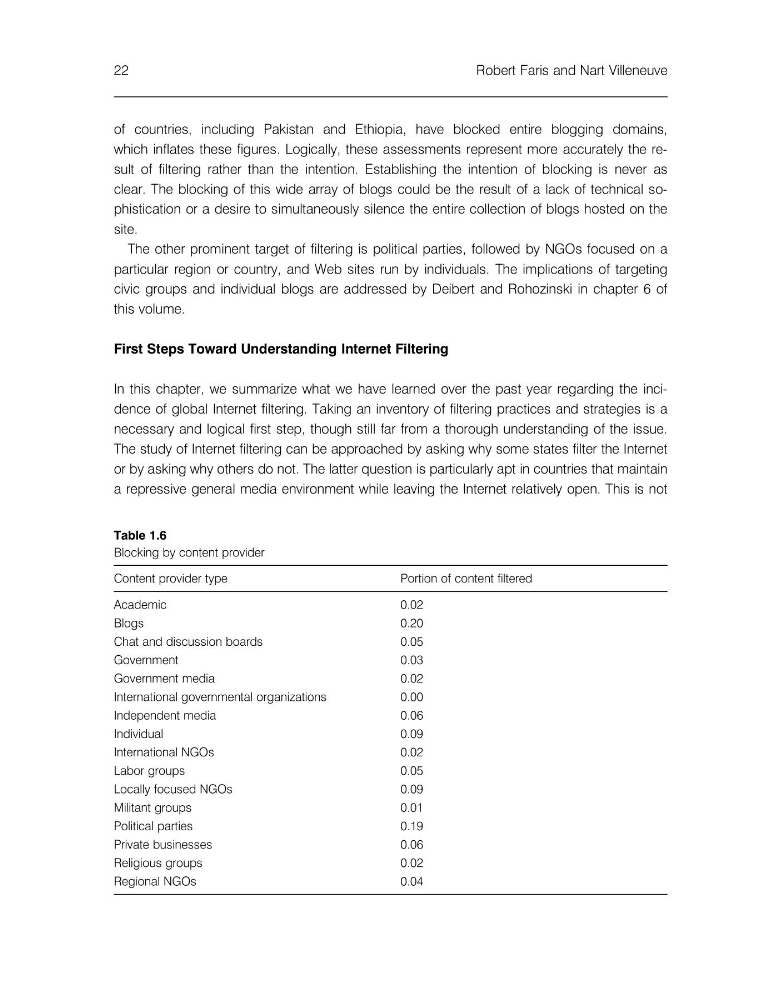
of countries, including Pakistan and Ethiopia, have blocked entire blogging domains,
which inflates these figures. Logically, these assessments represent more accurately the result of filtering rather than the intention. Establishing the intention of blocking is never as
clear. The blocking of this wide array of blogs could be the result of a lack of technical sophistication or a desire to simultaneously silence the entire collection of blogs hosted on the
site.
The other prominent target of filtering is political parties, followed by NGOs focused on a
particular region or country, and Web sites run by individuals. The implications of targeting
civic groups and individual blogs are addressed by Deibert and Rohozinski in chapter 6 of
this volume.
First Steps Toward Understanding Internet Filtering
In this chapter, we summarize what we have learned over the past year regarding the incidence of global Internet filtering. Taking an inventory of filtering practices and strategies is a
necessary and logical first step, though still far from a thorough understanding of the issue.
The study of Internet filtering can be approached by asking why some states filter the Internet
or by asking why others do not. The latter question is particularly apt in countries that maintain
a repressive general media environment while leaving the Internet relatively open. This is not
Table 1.6
Blocking by content provider
Content provider type
Portion of content filtered
Academic
0.02
Blogs
0.20
Chat and discussion boards
0.05
Government
0.03
Government media
0.02
International governmental organizations
0.00
Independent media
0.06
Individual
0.09
International NGOs
0.02
Labor groups
0.05
Locally focused NGOs
0.09
Militant groups
0.01
Political parties
0.19
Private businesses
0.06
Religious groups
0.02
Regional NGOs
0.04
22
Robert Faris and Nart Villeneuve
which inflates these figures. Logically, these assessments represent more accurately the result of filtering rather than the intention. Establishing the intention of blocking is never as
clear. The blocking of this wide array of blogs could be the result of a lack of technical sophistication or a desire to simultaneously silence the entire collection of blogs hosted on the
site.
The other prominent target of filtering is political parties, followed by NGOs focused on a
particular region or country, and Web sites run by individuals. The implications of targeting
civic groups and individual blogs are addressed by Deibert and Rohozinski in chapter 6 of
this volume.
First Steps Toward Understanding Internet Filtering
In this chapter, we summarize what we have learned over the past year regarding the incidence of global Internet filtering. Taking an inventory of filtering practices and strategies is a
necessary and logical first step, though still far from a thorough understanding of the issue.
The study of Internet filtering can be approached by asking why some states filter the Internet
or by asking why others do not. The latter question is particularly apt in countries that maintain
a repressive general media environment while leaving the Internet relatively open. This is not
Table 1.6
Blocking by content provider
Content provider type
Portion of content filtered
Academic
0.02
Blogs
0.20
Chat and discussion boards
0.05
Government
0.03
Government media
0.02
International governmental organizations
0.00
Independent media
0.06
Individual
0.09
International NGOs
0.02
Labor groups
0.05
Locally focused NGOs
0.09
Militant groups
0.01
Political parties
0.19
Private businesses
0.06
Religious groups
0.02
Regional NGOs
0.04
22
Robert Faris and Nart Villeneuve